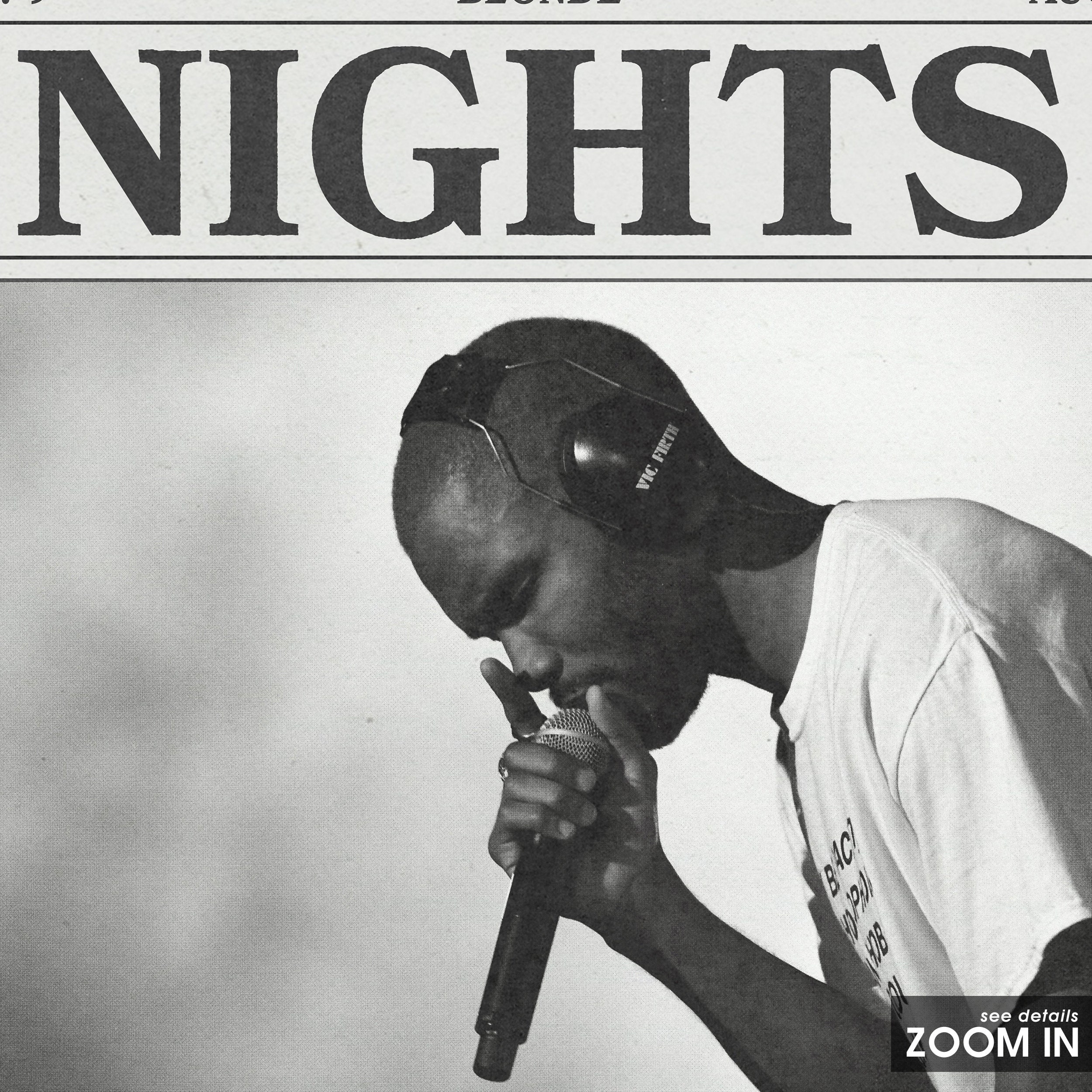
It is exactly three minutes and thirty seconds into the song. If you know, you know. That iconic, stomach-flipping pitch shift in the Nights Frank Ocean lyrics isn't just a production trick; it is a cultural landmark. Blonde dropped in 2016, and honestly, the world hasn't really been the same since. We are talking about a track that split an album perfectly in half, marking the transition from the sun-drenched haze of "Pink + White" into the murky, late-night introspection of the record's back half.
Frank Ocean doesn't write songs. He builds architectures of memory. When people search for the meaning behind these specific lyrics, they aren't just looking for a Genius annotation. They are looking for a reason why a song about working "ten-hour shifts" and "New Year's Eve" feels like a religious experience every single time the beat switches.
The Anatomy of the Beat Switch
Most pop songs are predictable. You get a verse, a chorus, another verse, maybe a bridge if the songwriter is feeling spicy. Frank threw that out the window. "Nights" is structurally a diptych—two distinct paintings joined by a single hinge.
The first half is upbeat, almost guitar-driven indie pop. It’s "rolling marijuana, that’s a cheap vacation." It’s the sound of being young, broke, and somewhat okay with it. Then, the guitar starts to wail. It stretches. It bends. And then? Total silence for a heartbeat.
That switch occurs at the 3:30 mark. In an album that is 60 minutes long, this is the literal midpoint. It’s genius. It’s calculated. It’s Frank. The second half of the Nights Frank Ocean lyrics drags us into the "after-dark" phase. The tempo slows. The voice drops an octave. It becomes a hazy, nocturnal confession about the aftermath of Hurricane Katrina and the displacement of his family to Houston.
Suburban Decadence and Houston Heat
A lot of people miss the geographical specificity here. Frank is a New Orleans native. When he sings about "1998, my family had that Acura," he isn’t just flexing a vintage car. He’s establishing a timeline of middle-class stability before the storm hit.
The lyrics transition into the reality of being a "refugee" in Texas.
"After the storm, we lived in Houston for a while."
It’s blunt. It’s raw. He talks about staying at the "Sleep Inn" and trying to find a sense of self in a city that wasn't home. This isn't just "vibes." It is a narrative of survival disguised as a low-fi R&B track.
You’ve probably felt that weird, disjointed energy when you move to a new city. Everything is familiar but wrong. That’s what the second half of "Nights" captures perfectly. The lyrics "Every night fucks every day up / Every day patches the night up" isn't just a clever play on words; it’s the cycle of depression and recovery. It’s the exhaustion of a ten-hour shift where the sun and moon start to blur into one continuous, gray smear of time.
Decoding the Wordplay
Frank is a master of the "double entendre." Take the line about "Round the city, round the clock." On the surface, he's just driving. But dig deeper into the Nights Frank Ocean lyrics, and you see he’s talking about the cyclical nature of his own thoughts.
He mentions "Shut the fuck up, I don't want your conversation."
Kinda harsh, right?
But in the context of the song, it’s about the sensory overload of fame and the longing for silence. He’s looking for a "real love," something that doesn't feel like a transaction.
- The "Acura" represents the past.
- The "Zani" (Xanax) represents the numbing of the present.
- The "New Year's" reference is the false hope of the future.
He’s playing with time. He’s showing us that even when we move forward, we are constantly circling back to the version of ourselves that existed before things got complicated. It’s why the song resonates with 20-somethings so hard. We are all just trying to patch the night up.
Why "Nights" Dominates TikTok and Reels
It’s funny how a song from 2016 becomes a viral sensation in 2024, 2025, and now 2026. The beat switch is the ultimate "reveal" format. You see people showing their "day life" versus their "night life."
But the trend misses the point sometimes.
The Nights Frank Ocean lyrics are deeply lonely.
"Wanna see nirvana, but don't want to die."
That is one of the most profound lines in modern music. It’s the human paradox. We want peace, we want the "highest state," but we are terrified of the cost. Frank articulates the millennial and Gen Z existential dread better than any philosopher could. He puts it over a wavy synth and makes us dance to our own anxiety.
The Technical Brilliance of the Vocals
If you listen closely to the second half, Frank’s voice is heavily processed. It sounds like he’s underwater or maybe just really, really tired. This wasn't an accident. In a 2016 interview with The New York Times, Frank talked about the importance of "texture" in music. He wanted the listener to feel the humidity of a Houston summer.
The way he drags the syllables in "all my night... talkin' 'bout those nights" makes it feel like he’s falling asleep mid-sentence. It’s immersive. It’s basically ASMR for the heartbroken.
Then there’s the line: "Stayin' with you when I didn't have a address / Fuckin' on you when I didn't have a mattress."
It’s gritty. It’s real. It grounds the abstract metaphors in a physical reality that anyone who has ever been "down bad" understands. You don't need a PhD in music theory to get why that hits. You just need to have been broke and in love once.
What We Get Wrong About the Lyrics
A common misconception is that "Nights" is a breakup song. It’s not. Or at least, it’s not just that. It’s a song about the passage of time. It’s about how 2012 feels like yesterday and a decade ago simultaneously.
When he says, "Keep a place for me, for me," he’s not necessarily talking to a lover. He might be talking to his younger self. He’s asking the boy in the 1998 Acura to remember him.
The Nights Frank Ocean lyrics serve as a bridge between who Frank was in New Orleans and who he became in the global spotlight. It’s an internal dialogue.
Actionable Insights for the Listener
If you want to truly experience this song the way it was intended, you have to stop shuffling your playlist.
- Listen in Sequence: Play "Solo" before "Nights." The transition is vital. "Solo" ends with a sense of isolation that "Nights" tries to solve through movement.
- The 3:30 Mark: If you are a creator, study that transition. It’s the gold standard of subverting expectations. It teaches us that you can change the entire mood of a piece of art without losing the audience, as long as the emotional core remains consistent.
- Check the Credits: Look up Joe Thornalley (Vegyn) and Michael Uzowuru. Their production on this track is what allowed Frank’s lyrics to breathe. Understanding the collaboration helps you see the song as a piece of "fine art" rather than just a radio hit.
- Read the Poetry: Take the lyrics away from the music. Read them as a poem. Notice the lack of a traditional rhyme scheme in the second half. It’s stream-of-consciousness. It’s messy. It’s human.
The enduring power of the Nights Frank Ocean lyrics lies in their refusal to be simple. They are as complex as a late-night drive through a city you used to love but don't recognize anymore. Every time you hit play, you find a new layer, a new regret, or a new reason to keep driving.
Frank hasn't released a full album since Blonde. Maybe he doesn't need to. When you’ve written a song that perfectly captures the split-second where the day turns into the night, you’ve already said everything that needs to be said. Just keep the "Acura" running.
Practical Next Step: To get the full experience of Frank's storytelling, listen to the "Dissect" podcast season on Blonde. It breaks down the frequency and musical theory of the 3:30 switch in a way that makes you appreciate the engineering behind the emotion. Alternatively, try journaling your own "midpoint" – what was the moment your life shifted from its first half to its second?