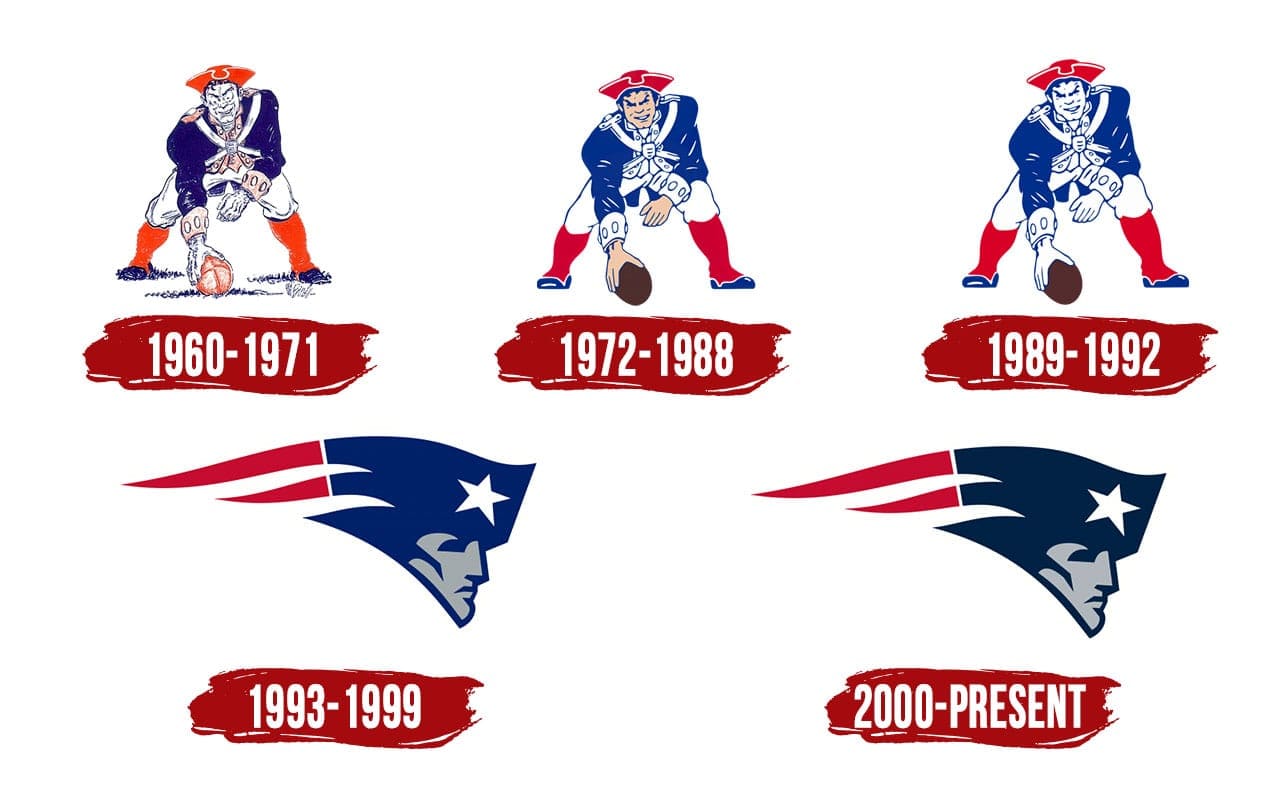
The New England Patriots logos are kinda like the team itself: you either love them with a burning passion or you absolutely despise them because they’ve won too much. It’s funny. If you walk around Foxborough today, you’ll see sea of navy blue and silver, but if you look closer at the tailgates, there’s this massive, lingering obsession with a hiking, center-snapping Revolutionary War soldier named Pat.
Most teams change their look to fix a losing culture. The Patriots did it right before they became the greatest dynasty in the history of the NFL. That timing matters. It created a weird generational divide in the fanbase. You have the older crowd who remembers the lean years and clings to the "Pat Patriot" era, and then you have the younger fans who only know the "Flying Elvis" as the symbol of six Super Bowl rings.
The Birth of Pat Patriot and the Phil Bissell Era
Believe it or not, the original logo wasn't even a guy. When the team started in 1960 as the Boston Patriots in the AFL, the logo was basically just a blue tricorn hat. That’s it. It lasted one season. It was boring.
Then came Phil Bissell. He was a cartoonist for the Boston Globe, and he sketched up this gritty, determined revolutionary soldier ready to hike a football. The team’s owner, Billy Sullivan, loved it. Pat Patriot wasn't some corporate, streamlined graphic designed by a marketing firm in Manhattan. He was a cartoon. He had personality. He looked like he was about to get into a bar fight in Southie.
For thirty years, Pat was the face of the franchise. He saw the team go to their first Super Bowl in 1985, where they unfortunately got demolished by the Chicago Bears. But here’s the thing about Pat: he was a nightmare to reproduce.
Think about it. From a design perspective, the 1960-1992 logo is incredibly complex. You’ve got the detailed lace on the boots, the fingers on the ball, the facial features, and the three-color scheme. It looked great on a large helmet, but it was a total mess when you tried to shrink it down for a business card or a 1980s television screen. By the early 90s, the NFL was moving toward "brand identity." They wanted sleek. They wanted modern. Pat Patriot was many things, but he definitely wasn't sleek.
Why 1993 Changed Everything
The transition in 1993 was jarring. Honestly, it was a mess at first. James Orthwein, who owned the team briefly before Robert Kraft bought them, wanted a complete overhaul. He wanted to distance the team from the "Patsies" reputation of the late 80s.
Enter the "Flying Elvis."
That’s the nickname fans immediately gave the new logo. It’s officially a stylized profile of a minuteman with a hat that trails off into red stripes, but everyone just saw a silver-faced Elvis Presley. People hated it. It felt cold. It felt corporate. It was the 90s, so everything had to have those "motion lines" to look fast.
But then, something happened. Robert Kraft bought the team in 1994. He kept the logo. Then they drafted a guy named Drew Bledsoe. Then they hired Bill Parcells. Suddenly, the Flying Elvis wasn't just a weird drawing; it was the logo of a team that actually won games.
The Evolution of the Silver Face
If you look at the 1993 version of the Flying Elvis compared to the one today, they aren't exactly the same. The original 1993 version had a much brighter, almost "royal" blue. In 2000—conveniently the year Bill Belichick arrived—the team darkened the colors to "Nautical Blue."
This was a massive shift in the New England Patriots logos' psychology. The darker blue looked more serious. More "militaristic," if you want to use the buzzwords the design team probably used. It moved away from the bright, patriotic pop of the 70s and into a sleek, "We are here to do a job" aesthetic. It’s the logo Tom Brady wore for his entire career. When you win six titles in a specific logo, it stops being "that weird Elvis thing" and starts being an icon.
The Logos That Never Were: The 1979 Near-Miss
There is a weird piece of Patriots history that most people forget. In 1979, the team actually tried to replace Pat Patriot. They were worried even back then that he was too detailed.
They held a vote at halftime during a game against the San Diego Chargers. They showed a new logo on the jumbotron—a very 70s-looking, simplified profile of a minuteman in a circle. It looked like a postage stamp. The fans booed it so loudly that the team scrapped the plan immediately. They didn't even wait for the final tally. They just saw the reaction and said, "Nope, Pat stays."
It shows you how much New Englanders hate being told what to do. You can't just swap a logo in Boston without a fight. The only reason the 1993 change stuck was because the team was so bad at the time that fans were willing to try anything to change the luck.
Technical Breakdown: Why Designers Love the Modern Logo
Despite the nostalgia for Pat, if you talk to a graphic designer, they will tell you the current New England Patriots logo is a masterpiece of "vector efficiency."
- Scalability: It works at 16 pixels and 16 feet.
- Directionality: The logo faces right, which in Western design implies forward progress and the future. Pat Patriot was hunched over, facing left (the past).
- Color Balance: The use of white space (or silver space) creates a natural "hidden" flow between the hat and the face.
Most modern NFL logos follow this "swoosh-ified" trend—think of the Falcons, the Eagles, or the Rams. They all have that sharp, tapered look. The Patriots were actually one of the first to jump on that train, and they’ve barely touched the design in over two decades because it works.
The Secret "Secret" Logos
We can't talk about New England Patriots logos without mentioning the shoulder "Secondary" logos.
In the 90s, they had a secondary logo that was a cursive "Patriots" script over a simplified tricorn hat. It was used mostly on starter jackets and sideline gear. Then there’s the "P" logo that sometimes appears on merchandise. None of these ever gained traction. Why? Because the Patriots brand is top-heavy. The primary logo is so dominant that the secondary marks feel like an afterthought.
Fact-Checking the "Elvis" Mythology
There’s a common misconception that the Flying Elvis was designed to look like a flag. While the trailing stripes are obviously "flag-like," the actual design brief focused on the "Minuteman in motion." The designer, Ken Loh, has spoken about this in interviews. He wanted to capture the "spirit of the American Revolution" but through a 1990s lens.
Another weird fact: The logo is actually asymmetrical in a way most people don't notice. The stars aren't just thrown on there; they are placed to balance the visual weight of the "heavy" silver face against the "light" red streaks.
What Happens Next?
Is Pat Patriot coming back? Probably not full-time.
The NFL’s "one-shell rule" was the only thing stopping the Patriots from wearing the old white helmets with Pat on them for years. Now that the rule has been relaxed, we see the "Throwbacks" once or twice a season. The merchandise sales for the old logo are astronomical. Honestly, the team makes too much money off the old logo to ever truly kill it off, but they’ve won too much in the new logo to ever go back permanently.
It’s a stalemate.
If you're looking to dive deeper into the visual history of the team, here is what you should actually do:
- Check out the "Hall at Patriot Place": They have the original hand-drawn sketches by Phil Bissell. Seeing the pencil marks on the paper changes how you view the "Pat" logo. It feels human.
- Compare the 1993 "Silver Face" to the 2000 "Navy Face": Look at photos from the Bledsoe era versus the early Brady era. The color shift is subtle but it completely changes the "vibe" of the helmet.
- Watch the 1979 "Logo Vote" footage: It’s a hilarious reminder that sports fans have always been vocal about branding, long before Twitter existed.
The Patriots' visual identity is a bridge between two eras. One is a gritty, AFL underdog story represented by a cartoon soldier. The other is a cold, calculated, winning machine represented by a silver-faced icon. Both are essential to what the team is today. If you want to understand the New England Patriots, you have to understand that they are a team that is constantly trying to balance that "Old School" Boston grit with "New Age" global dominance.
Next time you see the Flying Elvis, don't just see a logo. See the 1993 rebrand that almost failed, the color change that defined a dynasty, and the ghost of a cartoon soldier that still refuses to leave the building.