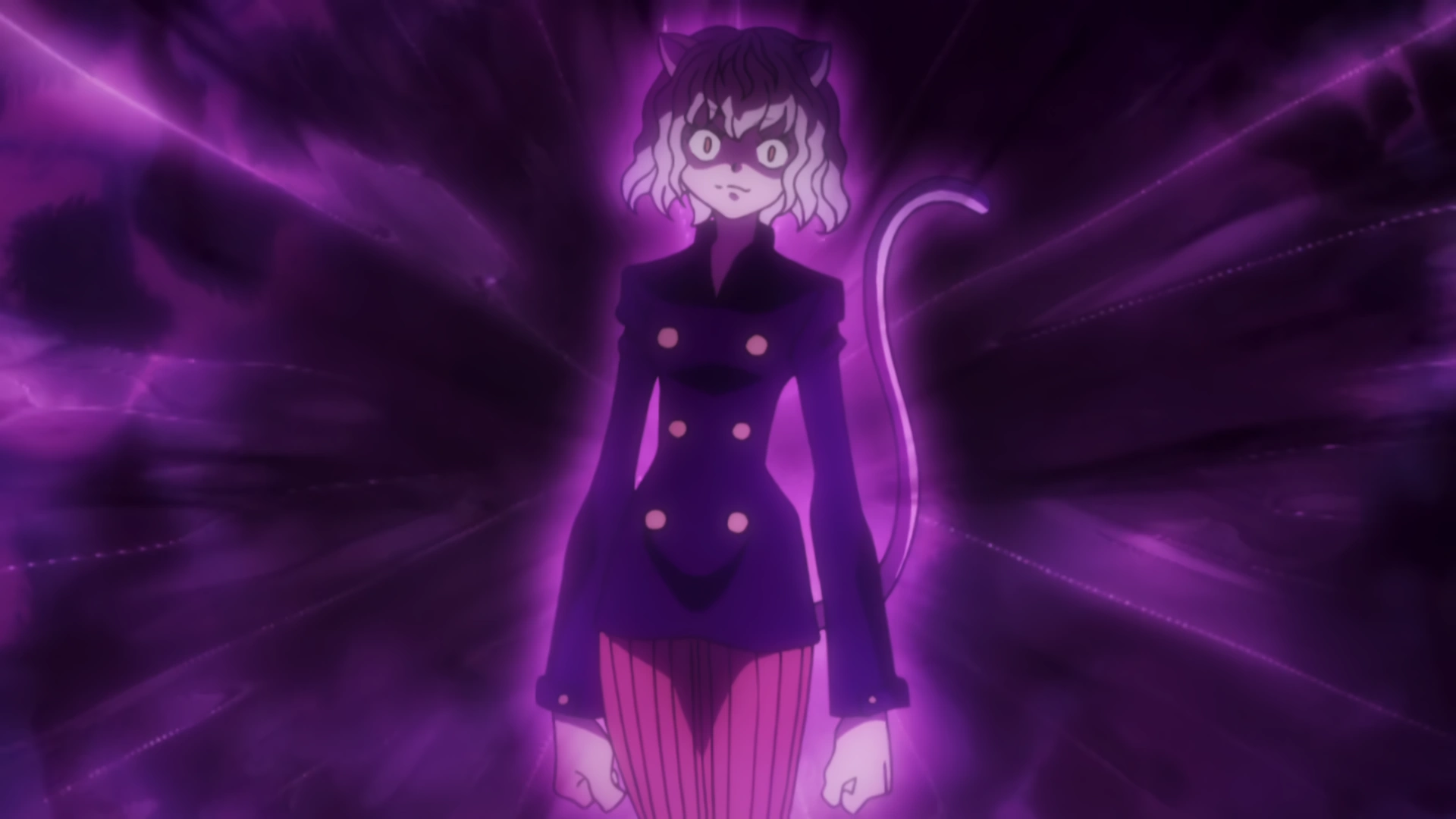
Honestly, if you watched Hunter x Hunter and didn't feel a genuine chill the moment Neferpitou dropped into the frame, you might be made of stone. Pitou isn't just another shonen antagonist with a high power level. They represent a total shift in the series—the exact second where the "adventure" part of the show dies and a horror movie begins.
Most people remember the cat ears and the "nyan" speech patterns, but there is something deeply unsettling about how Yoshihiro Togashi wrote this character. They are a Specialist, a Royal Guard, and basically a walking natural disaster.
What Really Happened with Pitou’s Introduction
The Chimera Ant arc was already getting dark, but Pitou's birth changed the stakes. Remember Pokkle? He was a decent Hunter, someone we’d followed since the exam. Pitou didn't just kill him; they used him. They literally poked around in his brain while he was still alive to learn about Nen. It was clinical. It was cruel. And it was our first hint that the Royal Guard wasn't playing by the same rules as the previous Ants.
Then came the Kite incident.
That single moment—Kite losing his arm in a flash—is burned into the brain of every fan. It was the first time Gon and Killua faced someone they couldn't even perceive moving. Pitou didn't have a grand philosophy or a grudge. They just wanted to test their strength. They were a kitten playing with a ball of yarn, only the yarn was a high-level Pro Hunter.
The Gender Debate That Never Ends
If you spend five minutes in any HxH forum, you’ll see the "Is Pitou a boy or a girl?" argument. It’s a mess.
In the manga, Togashi used the pronoun boku, which is typically used by young males, but it’s not a hard rule. Some tomboyish female characters use it too. The official data books often use masculine terms, yet the anime design by Madhouse gave Pitou a much more feminine silhouette, complete with more pronounced hips and a bust in later scenes.
The truth? It’s probably intentional ambiguity. Togashi loves characters that defy easy categorization (look at Alluka or Kalluto). Pitou is a Chimera Ant—a hybrid of multiple species. Applying human gender binary to a creature that was literally "cooked" in a queen's womb might be missing the point entirely. They are a predator first and a person second.
How Pitou’s Nen Abilities Work (The Scary Part)
Pitou’s Nen is terrifying because of its versatility. Being a Specialist gives them an edge, but the way they manifested their Hatsu says a lot about their personality.
Doctor Blythe
This is the giant, hovering surgical doll. It can fix almost anything, but it has a massive drawback: Pitou can’t move more than 20 meters from it, and they are left completely vulnerable while it's active. We saw this during the palace invasion when Pitou was healing Komugi. That image of Pitou, defenseless and pleading for Gon to wait, is one of the most tense scenes in the whole show.
Puppeteering
This is how Pitou controlled an entire army. By attaching Nen threads to bodies (living or dead), they could manipulate thousands of people at once. It’s what they did to Kite’s corpse, which is arguably the most "evil" thing any character does in the series. Using a friend's body as a training dummy for recruits is a level of psychological warfare that even the Phantom Troupe usually avoids.
Terpsichora
This is Pitou’s combat trump card. It’s a literal puppet master that takes control of Pitou’s own body, pushing their muscles and nerves past their natural limits. The scariest thing about Terpsichora? It doesn't stop just because Pitou dies. When Gon finally finished the fight, Pitou’s corpse kept attacking because the Nen was fueled by a singular, post-mortem desire to protect the King.
The Tragedy of the Royal Guard
It’s weird to feel bad for a character that decapitated a fan favorite, but Togashi makes it hard not to. By the end of the arc, Pitou wasn't the "playing with toys" monster they were at the start. They developed loyalty. They developed a sense of duty that bordered on love.
When Meruem ordered Pitou to save Komugi, Pitou cried. Those weren't fake tears. They realized that the King—their god—had found something more important than world domination. Pitou’s willingness to break their own arms and submit to Gon’s demands just to keep the King’s wish alive showed a weirdly human growth.
They became the "mother" figure of the palace, protecting the King’s newfound humanity even though it eventually led to their own brutal death.
Why Pitou Still Matters to Fans
Pitou is the ultimate "wall." In most anime, the hero hits a wall, trains for a week, and breaks it. Gon couldn't do that. The only way to beat Pitou was for Gon to literally throw away his entire future and his life.
Pitou’s existence forced the protagonist to become a monster. That’s the legacy of the character. They didn't just lose a fight; they broke the hero.
If you're looking to dive deeper into the lore, I'd suggest re-reading the manga chapters specifically covering the "Selection" process in East Gorteau. The anime cuts a few minor details about how Pitou managed the logistics of the 5,000 Nen-using cocoons, which really highlights their terrifying efficiency as a commander, not just a brawler.
Take a close look at the volume 28 cover art next time you're browsing the manga; the Virgin Mary parallels Togashi draws with Pitou are subtle but say everything you need to know about how he viewed their role in Meruem's "salvation."