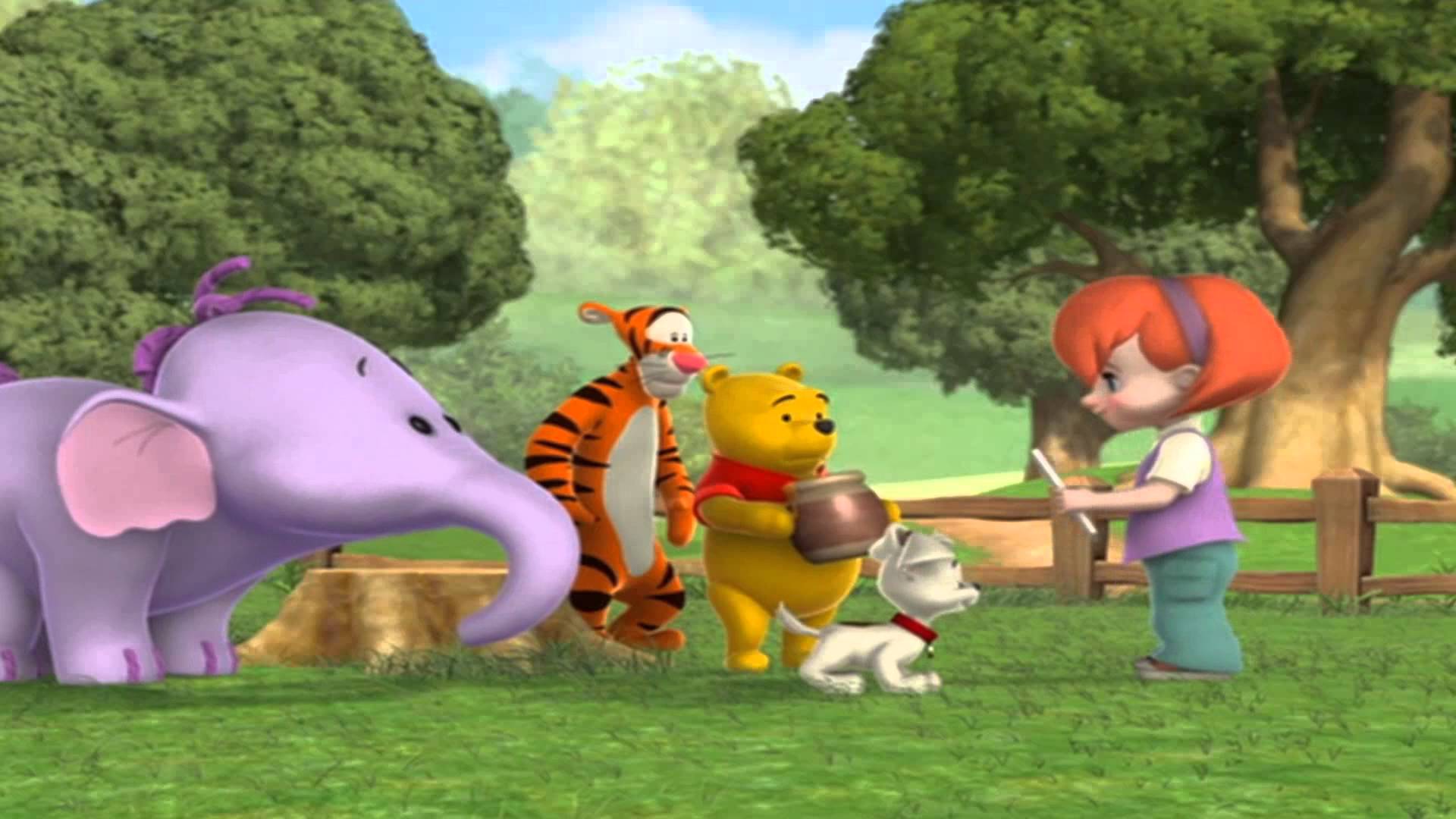
When Disney first announced My Friends Tigger & Pooh back in 2007, the internet—or at least the corner of it inhabited by nostalgic parents and A.A. Milne purists—experienced a collective "Wait, what?" moment. Christopher Robin was gone. In his place stood a 6-year-old girl with a red cap, a energetic dog named Buster, and a scooter. Her name was Darby.
She was the new protagonist. Honestly, the shift felt radical at the time. For decades, the Hundred Acre Wood was defined by the quiet, whimsical bond between a British boy and his stuffed animals. Suddenly, we were looking at a 3D-animated mystery show where the characters wore "Super Sleuth" costumes and solved neighborhood problems.
But here’s the thing.
Darby wasn't just a random replacement. She was a calculated move by Disney to modernize a franchise that, while beloved, was starting to feel a bit dusty to the preschool demographic of the mid-2000s. Whether you loved the change or found the CGI a bit jarring compared to the classic hand-drawn sketches, Darby’s impact on the Pooh mythos is undeniable.
The Super Sleuth Era: Who Exactly is Darby?
Darby is a spunky, imaginative 6-year-old who lives in the Hundred Acre Wood. Unlike Christopher Robin, who often acted as a wise, paternal figure or a distant observer to the animals' antics, Darby is one of the gang. She’s an active participant. Along with Tigger and Pooh, she forms the "Super Sleuths." Whenever a siren wails (triggered by a "Think, Think, Think" moment), the trio dons their special outfits and sets out to solve a mystery.
It’s easy to see why Disney went this route. Shows like Dora the Explorer and Blue’s Clues had proven that kids wanted interactivity. They wanted to solve puzzles. By introducing My Friends Tigger & Pooh Darby, Disney turned the Hundred Acre Wood from a place of idle wandering into a place of active investigation.
The dynamic changed. Tigger became more of an equal peer to the human lead, and Pooh—while still "of very little brain"—offered a unique kind of logic that helped Darby crack cases. It was less about the philosophy of "doing nothing" and more about the logistics of finding Piglet’s lost scarf or figuring out why the honey trees were empty.
Why the Fanbase Was So Split
If you grew up with the 1960s featurettes or the 1988 series The New Adventures of Winnie the Pooh, seeing a scooter-riding girl lead the pack felt like heresy. There’s a specific kind of "Pooh purism" that exists. Critics argued that Darby stripped away the melancholy and British charm of Milne’s original work.
They weren't entirely wrong. The show felt very "American preschool."
However, looking at the data from that era, the show was a massive hit. Young viewers didn't care about the lack of a British accent or the absence of Christopher Robin (who, by the way, did appear in a few special episodes to explain he was away at college). To a four-year-old in 2008, Darby was relatable. She was someone they could actually be. She didn't just visit the woods; she belonged there.
Chloë Grace Moretz: The Voice Behind the Cap
Most people don't realize that Darby was voiced by a young Chloë Grace Moretz. This was right before she became a household name in films like Kick-Ass and Hugo. If you go back and watch the episodes now, you can hear that signature raspy quality in her voice beginning to develop.
Moretz brought a genuine curiosity to the role. It wasn't the typical high-pitched, saccharine voice acting you often get in children's television. There was a groundedness to Darby that made the character work, even when the plot involved talking to a gopher about a missing vegetable.
The casting was a stroke of genius. It gave Darby a sense of leadership. She wasn't just a sidekick; she was the glue holding the "Super Sleuths" together. When she said, "Anytime, anywhere, the Super Sleuths are there!" kids actually believed her.
The Mystery of the Missing Christopher Robin
One of the biggest questions parents asked was: "Where did Christopher Robin go?"
Disney handled this with a surprising amount of grace. Instead of erasing him, they simply moved him forward in his timeline. In the movie Pooh's Super Sleuth Christmas Movie, it’s established that Christopher Robin is older now. He’s busy with school and growing up.
This is actually very much in line with the ending of the original Milne books. The "Enchanted Place" at the end of The House at Pooh Corner is all about Christopher Robin having to leave his toys behind to go to school. My Friends Tigger & Pooh Darby simply picks up the mantle for a new generation. Darby is the child who stays behind when the other children grow up. She is the guardian of the woods while the world outside changes.
Evolution of the Animation Style
We have to talk about the CGI. This was a 180-degree turn from the lush, watercolor backgrounds of the 1970s.
It was bright. It was saturated. It was 3D.
For some, the "plastic" look of the characters took away the "stuffed animal" feel. Pooh didn't look like he was made of felt; he looked like he was made of pixels. But the 3D environment allowed for more kinetic action. Tigger could bounce in ways that felt more three-dimensional and chaotic, which fits his character perfectly.
The show ran for three seasons and 63 episodes. It won several awards for its educational content. By the time it ended in 2010, Darby had firmly etched her place in the Disney canon, even if she doesn't appear in the "classic" merchandise lineups as often as the original crew.
The Enduring Legacy of Darby’s World
Despite the initial pushback, the show succeeded in its primary goal: keeping the brand relevant.
It taught kids basic deductive reasoning. It emphasized teamwork over individual heroics. Most importantly, it kept the Hundred Acre Wood alive during a decade where hand-drawn animation was struggling to find its footing in the theatrical market.
If you're looking to revisit the series, it’s often available on streaming platforms like Disney+. It’s a fascinating time capsule of mid-2000s children’s media. It represents a bridge between the traditional storytelling of the past and the high-energy, educational programming of the future.
What You Can Do Now
If you are a parent or a collector interested in this specific era of Pooh history, there are a few things to keep in mind:
- Check the Timeline: If you're watching with kids, explain that Darby is Christopher Robin's friend who looks after the woods while he's at school. It helps maintain the continuity of the world.
- Look for the DVD Specials: Some of the best Darby content isn't in the standard episodes but in the direct-to-video movies like Tigger & Pooh and a Musical Too. These had higher production values and more emotional weight.
- Appreciate the Voice Work: Listen closely to the guest stars. The show featured veteran voice actors like Jim Cummings (the definitive Pooh and Tigger), ensuring that even with a new human lead, the core heart of the animals remained unchanged.
- Understand the Sleuth Strategy: Use the "Think, Think, Think" method in real life with your kids. It’s actually a decent primitive version of the scientific method—pausing to evaluate evidence before jumping to a conclusion.
Darby might not be the protagonist everyone expected, but she was the one the Hundred Acre Wood needed at the time. She proved that the woods are big enough for more than one human friend. She showed us that even if we grow up and go to school like Christopher Robin, there will always be someone new to listen to Tigger’s stories and share a pot of honey with a silly old bear.