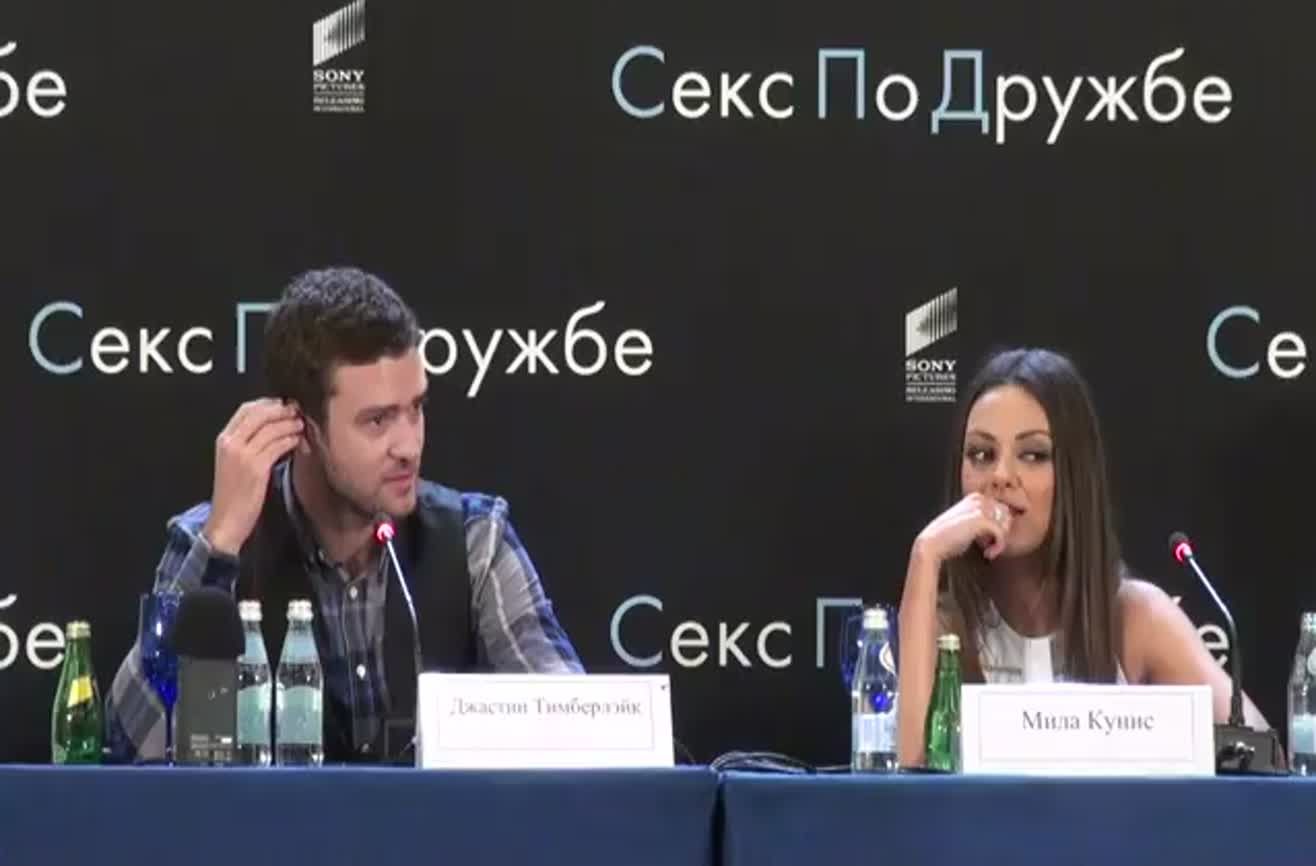
Ever seen that video where Mila Kunis basically morphs into a protective older sister and shuts down a reporter in fluent, rapid-fire Russian? It’s a classic. She’s sitting next to Justin Timberlake in Moscow, and this reporter asks—in Russian—why Justin is even making movies instead of music. Before the translator can even blink, Mila snaps back.
"Why movies? Why not?"
She didn't just answer; she defended him with the kind of sharp, effortless wit that only a native speaker can pull off. It’s a side of her Hollywood fans rarely see, and honestly, it’s kinda fascinating how much her linguistic background has shaped her career and her recent activism.
The "Heritage Speaker" Reality
Most people assume Mila learned Russian for a role or maybe just picked up bits and pieces from her parents. Not even close. She was born Milena Markovna Kunis in Chernivtsi, which was then part of the Soviet Union (now Ukraine). Russian was the language of the house, the street, and the school. When her family fled to Los Angeles in 1991, she was seven years old.
She arrived with exactly zero English.
Imagine being seven and suddenly being dropped into a second-grade classroom in LA where you can't understand a single word. She’s described that first year as "being blind and deaf." It was traumatic. But while she mastered English fast enough to land a Barbie commercial by age nine, that "mother tongue" didn't just disappear.
Technically, linguists call her a heritage speaker.
This means she’s totally fluent in casual conversation—the kind of stuff you talk about over dinner—but might trip up on complex political jargon or super formal grammar. If you listen closely to her long-form interviews on shows like Urgant Show, you'll notice she has a slight American lilt. It's subtle, but it's there. Native speakers in Moscow often point out that her vocabulary is a bit "frozen" in the early 90s, which makes sense since that’s when she left.
Why She Doesn't Speak Ukrainian
This is a huge point of confusion for people, especially lately. Since Mila was born in Ukraine, shouldn't she speak Ukrainian?
Well, it’s complicated.
During the Soviet era, Russian was the dominant language of the USSR, especially in urban centers and for Jewish families like hers. In a 2022 interview with Chris Wallace, she was very blunt about it: "I don't speak Ukrainian." She grew up in a Russian-speaking household in a Russian-speaking part of the Soviet Union. For decades, she actually told people she was Russian because, as she put it, it was just easier.
"When I'd tell people I'm from Ukraine, the first question I'd get was, 'Where is Ukraine?'" she told Maria Shriver. Saying "Russia" saved her a ten-minute geography lesson. That changed in early 2022.
The Shift from "Russian" to "Proud Ukrainian"
The invasion of Ukraine was a massive turning point for Mila.
She described it as a "gut punch." Suddenly, the "easier" label of being Russian felt wrong. She and her husband, Ashton Kutcher, launched a massive GoFundMe that eventually raised over $37 million for humanitarian aid. They didn't just sign a check; they leveraged their massive platforms to get Flexport and Airbnb to provide real-time logistics and housing for refugees.
It’s interesting to see how she navigates this now. She still speaks Russian with her parents, Mark and Elvira. She’s even teaching her kids, Wyatt and Dmitri, to understand Russian. Why? Because it’s her family’s language, regardless of the geopolitics. She’s very careful to distinguish between the Russian people and the actions of the Russian government.
That Famous "Bodyguard" Moment
We have to go back to that Justin Timberlake press conference for Friends with Benefits. It's the ultimate proof of her fluency.
The reporter was trying to be "edgy" by questioning Justin's career choices. Mila didn't wait for the earpiece translation. She just cut the guy off. Justin sat there, totally lost, looking at her like she was a secret agent. When he finally got the translation, he just laughed and said, "This is my bodyguard."
It wasn't just that she knew the words. It was the attitude.
There’s a specific kind of bluntness in Russian culture that Mila carries perfectly. She doesn't do the "polite Hollywood pivot." She goes straight for the jugular when someone is being rude. You can see it again in her Family Guy work. Every now and then, Meg Griffin will bust out a line in Russian, and that’s all Mila. She isn't reading a phonetic script; she’s just talking.
Cultural Nuances You Might Miss
- The "Jewish Russian" Accent: Some native speakers have noted that Mila’s accent reflects the specific dialect of the Ukrainian Jewish community she was born into. It’s a very niche, soulful way of speaking.
- Grammar Gaps: Because she didn't go to middle or high school in the USSR, she sometimes uses the wrong "case" (Russian has six of them, and they’re a nightmare).
- Code-Switching: She can flip the switch instantly. One second she's the girl-next-door from California, and the next, she’s a stern Eastern European mom.
What You Can Learn From Mila's Bilingualism
Mila’s story isn't just about being a "cool" bilingual celeb. It’s about the resilience of the immigrant experience. She used her language as a bridge when she needed it, and as a shield when her friends were being attacked.
If you're interested in her linguistic journey, here’s how to actually dive deeper:
- Watch the Urgant Show Interview: It’s on YouTube. Watch it without the English subtitles first. Even if you don't speak the language, you can see how her body language and "vibe" change the moment she stops speaking English.
- Check out her 2022 "Conversations Above the Noise" interview: This is where she gets really raw about her identity shift and why she stopped telling people she was Russian.
- Follow the Impact: Look into where those $37 million actually went. It wasn't just a PR stunt; Flexport and Airbnb used those funds to house over 100,000 people.
Ultimately, Mila Kunis is a reminder that you can be "LA through and through" and still carry the weight and beauty of your heritage in every word you speak. She’s not just an actress who speaks another language; she’s someone who lives in two worlds at once.
To get a real sense of her fluency, look for the unedited press junkets from the Max Payne era. She often translates for the room without being asked, showing a level of comfort with the language that goes way beyond "just knowing a few phrases." It’s her raw, unfiltered self.