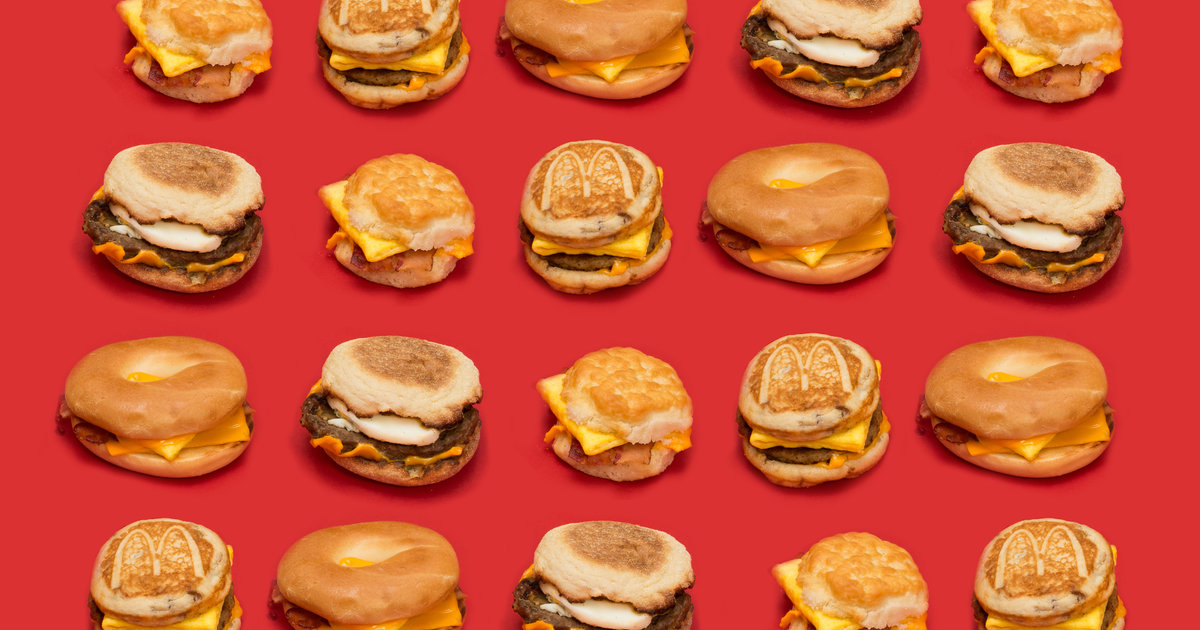
You're running late. The Golden Arches are basically glowing in the distance like a beacon of hope. We’ve all been there, idling in the drive-thru lane at 8:15 AM, wondering if that Egg McMuffin is going to ruin our macros for the entire day or if it’s actually a stealthy win for protein.
Honestly, finding accurate McDonald's nutritional information breakfast data used to feel like trying to solve a riddle. Now, the info is everywhere, but people still read it wrong. They see "egg" and think "healthy" or see "sausage" and think "disaster." The reality is a lot more nuanced than that. It’s about the hidden sodium, the specific way they prep the eggs, and whether you're accidentally drinking a meal's worth of sugar in your "light" coffee.
Let's get real for a second. McDonald's isn't a health food store. Nobody goes there for a kale salad at sunrise. But if you’re trying to navigate the menu without blowing your fitness goals, you need to look past the calorie count and look at the ingredient quality.
The Egg McMuffin vs. The Biscuit Battle
There is a massive divide in the McDonald's nutritional information breakfast world between the English Muffin and the Biscuit. Most people think they're interchangeable. They aren't. Not even close.
The classic Egg McMuffin is sort of the gold standard for fast-food nutrition. Why? Because it uses a "round egg." That’s a real, cracked-on-the-griddle egg cooked in a metal ring. It’s lean. When you look at the stats, an Egg McMuffin usually clocks in around 310 calories with 17 grams of protein. That’s actually a very solid ratio for anyone hitting the gym later.
Now, look at the Sausage Biscuit.
The biscuit itself is a different beast. It’s flaky because it’s loaded with palm oil and hydrogenated fats. A single Sausage Biscuit can hit 460 calories, but here’s the kicker: it has almost double the sodium of the McMuffin. We’re talking over 1,000 milligrams. That is nearly half of what the American Heart Association suggests for your entire day. If you add an egg to that biscuit, you’re suddenly pushing 530 calories.
It’s not just about the calories. It’s the bloat. The "folded egg" used in biscuits and McGriddles isn't just a cracked egg; it's a liquid egg blend that includes nonfat milk, modified corn starch, and citric acid. If you want the "cleanest" protein on the menu, you have to ask for the round egg, even if you’re getting a different sandwich.
High Protein or High Sugar?
The Big Breakfast with Hotcakes is the heavyweight champion of the menu. It’s a lot.
If you sit down with the full platter—scrambled eggs, sausage, hash browns, and hotcakes with syrup—you are staring down 1,340 calories. That’s a lot for one sitting. But the real "hidden" danger in the McDonald's nutritional information breakfast data isn't the fat in the sausage. It’s the sugar in the syrup and the refined carbs in the cakes.
- Hotcakes (3) with butter and syrup: 580 calories.
- Total Carbs: 101 grams.
- Sugar: 45 grams.
That’s basically eating a candy bar with your eggs. You'll feel great for twenty minutes. Then, the insulin spike hits, and by 11:00 AM, you’re face-planting onto your keyboard at work.
What about the Fruit & Maple Oatmeal?
This is where the "health halo" comes into play. People order the oatmeal because it sounds like the responsible choice. It’s oats! It’s fruit! It’s... 320 calories and 31 grams of sugar. For comparison, a cheeseburger has less sugar.
The oats themselves are fine, but McDonald’s pre-loads them with cream and brown sugar. If you’re watching your glucose levels, this "healthy" option might actually be worse for you than a plain Egg McMuffin. If you really want the oatmeal, you have to be that person who asks for it without the brown sugar and raisins. It's annoying, but it saves your afternoon from a sugar crash.
Sodium: The Silent Killer of "Light" Choices
Sodium is the biggest hurdle in the McDonald's nutritional information breakfast guide.
Most people focus on fat. Fat gives you flavor and satiety. Sodium, however, is used as a preservative and a flavor enhancer in almost every processed meat on the menu.
Check out the Bacon, Egg & Cheese McGriddle. It sounds smaller than a Big Breakfast, right? It has 1,230 milligrams of sodium. That is an astronomical amount of salt for a sandwich that fits in the palm of your hand. If you have high blood pressure or you’re just trying to avoid looking like a pufferfish in your midday meetings, the sodium levels are more important than the calorie count.
Interestingly, the hash browns are relatively low in sodium (about 310mg) compared to the sandwiches. They’re fried in vegetable oil, which brings the fat up to 8 grams, but if you’re choosing between an extra meat patty or a side of hash browns, the potato might actually be the lesser of two evils for your heart.
The Liquid Calories Nobody Counts
We have to talk about the McCafé line.
A black coffee has 0 calories. Easy.
But the "Small" Mocha Frappé? 420 calories.
A "Medium" Iced Caramel Macchiato? 280 calories and 33 grams of sugar.
When you combine a Sausage McMuffin with Egg (480 calories) and a medium flavored coffee, you’ve hit nearly 800 calories before the sun is fully up. That’s more than most people need for breakfast and lunch combined. The McDonald's nutritional information breakfast stats usually show the food and the drinks separately, so it’s easy to ignore how they stack up.
If you need caffeine, stick to the Americano or a plain latte with nonfat milk. It keeps the protein-to-sugar ratio in check.
Hacking the Menu for Better Nutrition
You aren't stuck with the menu exactly as it's printed on the glowing board.
Since McDonald's moved to more digital kiosks, it's actually easier to customize your order without the cashier giving you the side-eye. You can drastically change the McDonald's nutritional information breakfast profile of your meal with three specific moves.
First, lose the cheese. On an Egg McMuffin, removing the American cheese drops about 50 calories and a significant chunk of saturated fat and sodium. Second, swap the meat. If you want the protein but not the grease, ask for Canadian bacon instead of the sausage patty. The sausage is delicious, sure, but it's a calorie bomb.
Third, and this is the pro move: sub the bun. You can actually order a breakfast sandwich "no bun" or ask for a lettuce wrap, though the latter is hit-or-miss depending on the location. Even just eating the "insides" of an Egg McMuffin—the egg and the Canadian bacon—gives you a high-protein, low-carb start for under 150 calories.
Real Data: A Quick Comparison
Instead of a confusing table, let’s just look at the raw reality of three common orders.
If you grab a Sausage, Egg & Cheese McGriddle, you’re taking in 550 calories, 33g of fat, and 1,290mg of sodium. It’s heavy. It’s salty. It’s a "once-in-a-while" treat.
If you go for the Sausage Burrito, it’s a bit of a surprise win. At 310 calories and 13g of protein, it’s one of the more manageable items on the menu. The downside? It’s highly processed, and the "fluffy" eggs in there are the liquid-mix version.
If you choose the Egg McMuffin, you stay at 310 calories but jump to 17g of protein and only 13g of fat. It’s the most "real food" item they serve in the morning.
The Transparency Factor
McDonald’s has actually been a leader in making this data accessible. They were one of the first to put calorie counts on the boards. They have a full calculator on their website. They aren't hiding the facts; we just usually choose to ignore them because a McGriddle smells like heaven.
However, keep in mind that nutritional labels have a "margin of error." The FDA allows up to a 20% variance. That means your 310-calorie muffin could technically be 370 calories if the person on the line was a little heavy-handed with the liquid margarine that day.
Actionable Steps for Your Next Visit
Don't just drive away with a bag of regret. Use the data to make a call that fits your day.
- Prioritize the "Round Egg." It is the only egg on the menu that isn't a liquid blend. You can ask for it on any sandwich.
- Ditch the "Value Meal" logic. You don't need the hash brown and the large orange juice. The juice alone adds 200+ calories of pure sugar.
- Check the App. The McDonald's app usually has the full nutritional breakdown updated in real-time based on your customizations. Use it.
- Drink water or black coffee. If you're eating a high-sodium breakfast, you need the hydration anyway.
- Watch the condiments. Grape jam and strawberry preserves add 35-45 calories per packet. Ketchup adds sugar. Salt adds... well, salt.
Managing your health while eating fast food isn't about being perfect. It's about harm reduction. By choosing the English muffin over the biscuit and the round egg over the folded one, you're already ahead of 90% of the people in that drive-thru line.
Knowing the McDonald's nutritional information breakfast facts doesn't mean you can't eat there. It just means you’re finally the one in control of the bag, rather than the bag being in control of you.