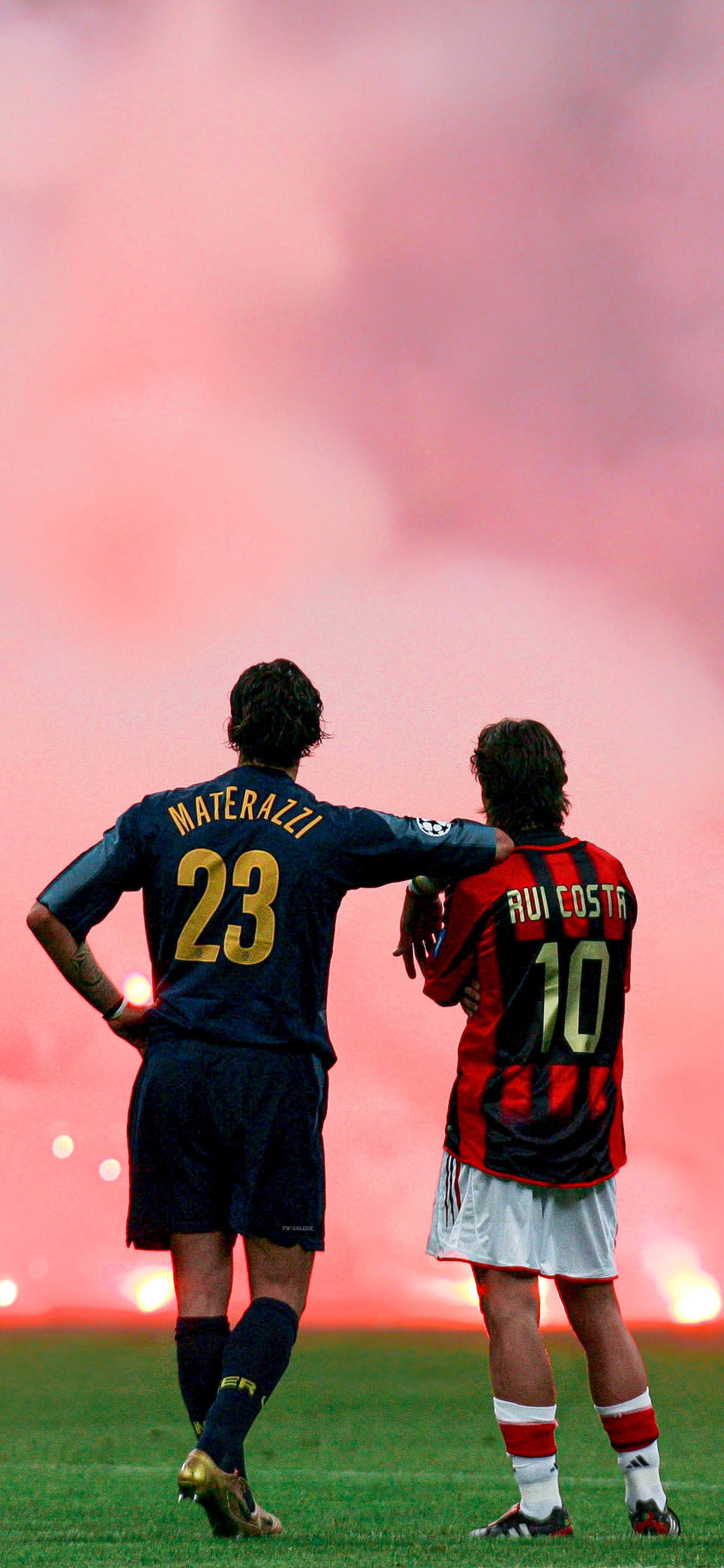
It was April 12, 2005. San Siro was literally on fire. The air felt heavy, thick with the acrid smell of flares and the deafening roar of a crowd that had completely lost its mind. If you close your eyes and think of the Milan Derby, you don’t see a goal. You don’t see a trophy lift. You see two men—Marco Materazzi and Manuel Rui Costa—standing side-by-side, watching the chaos unfold.
One is a "hard man," a defender known for bruising strikers. The other is a "maestro," a Portuguese playmaker with socks rolled down to his ankles and elegance in every touch. They are rivals. They play for Inter and AC Milan. Yet, in that moment, they are just two human beings watching a masterpiece of sporting dysfunction.
That image has become the "Mona Lisa" of Italian football. But honestly, most people get the context completely wrong. It wasn't a planned moment of sportsmanship. It was a reaction to one of the most disgraceful nights in the history of the Champions League.
Why the Materazzi e Rui Costa photo still matters twenty years later
The photo was captured by Stefano Rellandini. It’s perfect. You have the red glow of the flares illuminating the smoke, the bright jerseys of the two Milanese giants, and Materazzi’s arm casually leaning on Rui Costa’s shoulder. It looks like they’re waiting for a bus in a war zone.
People love this photo because it represents the "Old Calcio." This was an era where Serie A was the undisputed center of the footballing universe. You had Shevchenko, Kaká, Adriano, and Zanetti all on the same pitch. But the match—the second leg of the Champions League quarter-final—never actually finished. Inter fans, furious that a goal by Esteban Cambiasso had been disallowed by referee Markus Merk, began raining projectiles onto the pitch.
A flare hit Milan keeper Dida in the shoulder. It was scary. He went down, the game was halted, and for 25 minutes, everyone just... stood there. That’s when the magic happened.
What really happened on the pitch that night
Basically, the stadium became a giant furnace. Firefighters were trying to clear the flares, but more kept coming. It was a deluge of red light. Materazzi and Rui Costa found themselves near the center circle.
Think about the tension. These two clubs share a stadium. Their fans live in the same apartment blocks. They eat at the same trattorias. Usually, a Derby della Madonnina is a cage match. But as the smoke billowed, the tribalism sort of evaporated. They weren't Inter and Milan players anymore. They were just two professionals embarrassed by the scene.
Materazzi, ever the character, leaned on Rui Costa. It was a gesture of "Can you believe this?" rather than some grand peace treaty. Rui Costa didn't shrug him off. They stood there for what felt like an eternity, bathed in the crimson light of the Curva Nord’s fury.
The match was eventually abandoned. AC Milan were handed a 3-0 win by default, moving them into the semi-finals. But the scoreline is a footnote. The image is the legacy. It shows that even in the middle of a literal riot, there’s a shared language between athletes.
Breaking down the "Hard Man" and the "Maestro"
To understand why this specific pairing worked, you have to look at who these guys were.
Marco Materazzi was—and is—a polarizing figure. Before he became the guy who got Zinedine Zidane sent off in the 2006 World Cup final, he was Inter’s enforcer. He played with a chip on his shoulder the size of the Duomo. He was loud, aggressive, and perfectly happy to be the villain.
Then you have Manuel Rui Costa. If Materazzi was a sledgehammer, Rui Costa was a violin. He was part of Portugal's "Golden Generation." He played the game with a sort of melancholy grace. He was one of the last true "number 10s" who prioritized the final pass over the final shot.
Seeing Materazzi, the agitator, seeking comfort or companionship from Rui Costa, the gentleman, created a visual juxtaposition that shouldn't work. But it does. It’s the contrast of styles and personalities united by a singular, chaotic event.
The technical reality of the 2005 Euroderby
Let’s be real for a second: Italian football in the mid-2000s had a massive problem with the Ultras. This wasn't just a "cool photo op." It was a security failure.
- The Disallowed Goal: Cambiasso scored a header in the 71st minute. Merk ruled it out for a foul on Dida that most Inter fans still swear never happened.
- The Escalation: The first flare hit the pitch around the 73rd minute.
- The Injury: Dida suffered first-degree burns on his right shoulder. He had to be replaced by Christian Abbiati before the game was eventually called off.
- The Sanctions: Inter were fined €200,000 and ordered to play their next four European matches behind closed doors. At the time, it was the largest fine ever handed out by UEFA.
If you look closely at the high-resolution versions of the photo, you can see the debris on the grass. Bottles, lighters, coins. It wasn't just flares. It was a dangerous environment. Yet, Materazzi and Rui Costa look completely unbothered. That’s the "pro" mentality. When you've played in front of 80,000 people your whole life, a few dozen flares are just background noise.
Why it won't happen again
Modern football is sanitized. You’ve got high-definition cameras everywhere, facial recognition, and massive plastic barriers. The "flare culture" still exists in Italy, but it’s heavily regulated. The 2005 Derby was the end of an era—the wild west of European football.
Also, the rivalry has changed. Back then, both Milan clubs were owned by Italian moguls (Berlusconi and Moratti). It was personal. Today, they are owned by international investment firms. The "vibe" is different. It’s more corporate. You still get the passion, but it’s unlikely we’d see a match abandoned in the Champions League quarter-finals because the pitch looks like the surface of Mars.
Taking inspiration from the Materazzi e Rui Costa moment
There's actually a lot to learn from this photo if you're a fan of the game or just a student of human behavior.
First, it’s about perspective. Sometimes, the "big game" or the "urgent project" goes off the rails. When that happens, the best thing you can do is take a step back and acknowledge the absurdity of the situation with someone else, even if they’re technically your opponent.
Second, it’s a reminder that rivalry doesn’t have to mean hatred. You can spend 90 minutes trying to stop someone from doing their job, but you can still share a shoulder when the world is burning down around you.
Third, aesthetics matter. If that photo was taken on a sunny afternoon with no smoke, nobody would care. The "vibe" of the flares created a timeless aesthetic. It turned a moment of shame for Italian football into a moment of legendary art.
Practical steps for Calcio fans and collectors
If you're a fan of this era, don't just look at the memes. There are better ways to engage with this history.
- Watch the full 2005 Derby highlights: Not just the flares, but the football. The quality of play before the chaos was insane. Pirlo’s passing, Stam’s defending, Adriano’s power. It was a masterclass.
- Seek out the photographer: Stefano Rellandini's work is incredible. Looking at his other shots from that night gives you a much better sense of the scale of the riot.
- Visit San Siro soon: The stadium is famously under threat of being demolished or heavily renovated. If you want to stand where Materazzi and Rui Costa stood, you should get to Milan sooner rather than later.
- Check out the jerseys: The 2004/05 Inter and Milan kits are considered absolute classics. If you’re a shirt collector, these are the "holy grails." The Inter Pirelli kit and the Milan Opel/Bwin era shirts are iconic for a reason.
The Materazzi and Rui Costa photo is a reminder that football is more than just a game. It’s a series of moments, some beautiful, some ugly, and some that are both at the same time. It captures a moment in time when two giants stood still while the world around them went up in flames. It’s not just a sports photo. It’s a testament to the fact that even in our most divided moments, we usually find ourselves standing right next to each other, wondering what on earth is going on.
To truly understand Italian football, you have to accept the chaos. You have to accept that sometimes the game isn't played on the grass, but in the air, through the smoke, and in the silence between two rivals. Materazzi and Rui Costa didn't say a word to each other that went on the record, but they said everything that needed to be said about the beautiful, messy, dramatic world of Calcio.