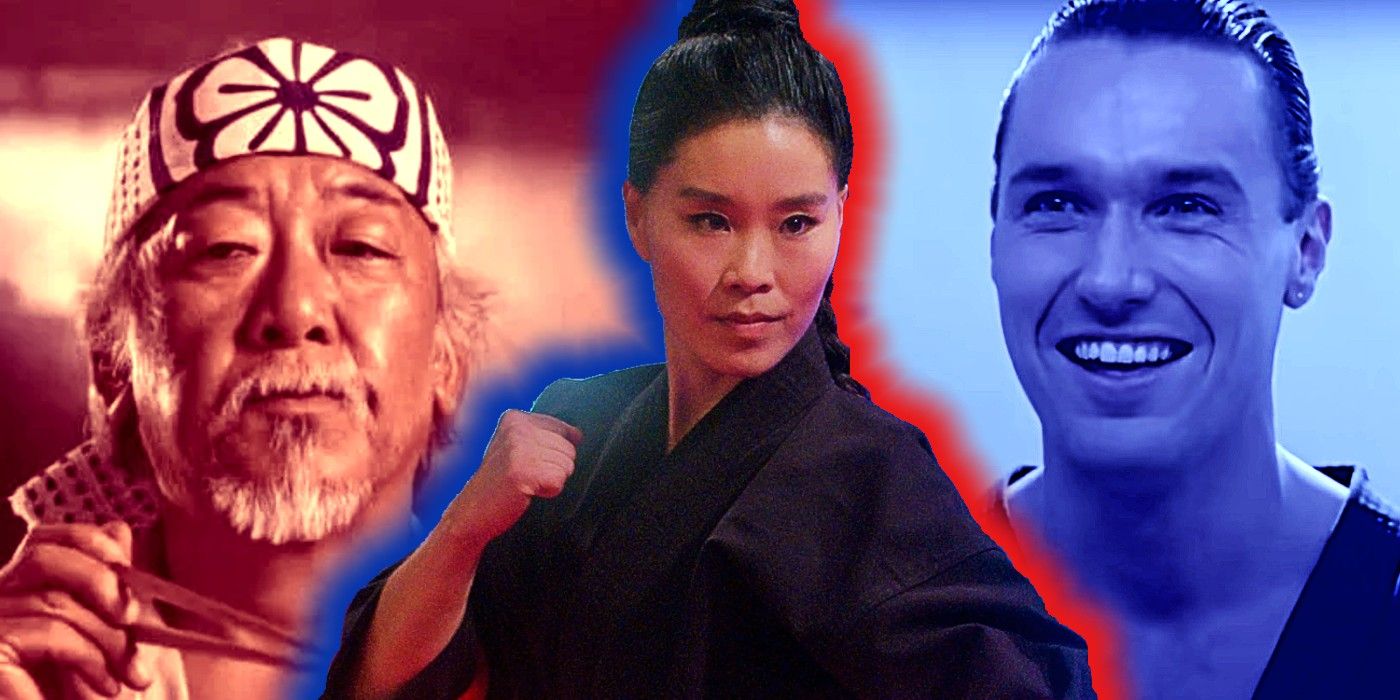
If you’ve spent any time watching Cobra Kai on Netflix, you know the name. Kim Sun-Yung. He’s the guy who basically started this whole mess. Without him, there is no "No Mercy." No sweep the leg. No Terry Silver cackling while he sets fire to a local businessman's dreams.
Honestly, for a long time, Kim Sun-Yung was just a ghost. A name dropped by Silver in The Karate Kid Part III to sound more legitimate. But as the show expanded, we realized he wasn't just some marketing gimmick. He was the architect of a philosophy that has ruined countless lives in the San Fernando Valley.
The Man Behind the "No Mercy" Madness
Master Kim Sun-Yung is the anti-Miyagi. That’s the easiest way to look at it. While Mr. Miyagi was all about balance and bonsai trees, Kim was about survival. Cold, hard survival.
He didn't grow up in a peaceful dojo. He grew up in Korea during the Japanese occupation. Think about that for a second. If you’re a kid and your country is being occupied by a brutal military force, you don't learn martial arts to find "inner peace." You learn it to keep from being killed. This trauma is the bedrock of the Way of the Fist.
Basically, Kim Sun-Yung took the foundations of Tang Soo Do and stripped away the fluff. He didn't want "spirit." He wanted weapons. Human weapons.
Why He Trained the Americans
It’s kinda weird when you think about it. Why would this legendary Korean master train a bunch of American soldiers like Captain Turner?
The Korean War changed everything. During the conflict in the early 1950s, US soldiers were stationed all over the peninsula. Turner was one of the few who actually sought out the "real" stuff. Kim saw something in these men—or maybe he just saw an opportunity to spread his gospel of strength.
- Captain Turner: The first American "disciple" who brought the style to the US Army.
- John Kreese: Learned the basics from Turner but eventually went to the source.
- Terry Silver: The man who actually had the money to make Kim’s style a global brand.
When Kreese and Silver went back to South Korea in 1980, they weren't just visiting. They were getting "polished." They wanted the pure, unadulterated version of Tang Soo Do that Kim Sun-Yung perfected. And man, did they get it.
Is Master Kim Sun-Yung Still Alive?
This was the big question for years. Fans assumed he was long dead. I mean, the math didn't look great. If he was training soldiers in 1950, he’d have to be ancient by the time Cobra Kai Season 6 rolled around.
But this is Cobra Kai. Logic takes a backseat to drama.
In a massive Season 6 twist, we find out the old man is still kicking. Well, maybe not "kicking" like he’s 20, but he’s alive. He’s the one pulling the strings behind Kim Da-Eun. It turns out he’s been running his own private fortress of pain in Korea this whole time.
He’s roughly 93 or 94 years old. Still terrifying. Still obsessed with the Sekai Taikai.
The C.S. Lee Recasting
You might have noticed he looks a bit different in the final season. That’s because the showrunners brought in C.S. Lee (the guy who played Masuka on Dexter) to play the legendary master.
It was a smart move. Lee brings a quiet, simmering menace to the role. He doesn't need to scream like Kreese. He just sits there and judges you for being weak. It’s way more effective.
The Rivalry Most People Missed: Kim vs. Sato
Here’s a deep cut for the real fans. Master Kim didn't just hate weakness; he had a massive grudge against the Okinawan styles.
Chozen Toguchi eventually reveals that his uncle, Sato, had "much anger" toward Kim Sun-Yung. It makes total sense. Sato was a traditionalist. He believed in the Okinawan way. Kim Sun-Yung was the guy training the "invaders" (as some viewed the Americans) and teaching a style that felt like a perversion of the art.
This isn't just about dojos fighting. It’s a decades-old geopolitical grudge played out with high kicks.
Tang Soo Do: The Real-Life Style
Despite all the "Cobra Kai" branding, the style is real. It’s Tang Soo Do.
In the real world, Tang Soo Do is often called "Korean Karate." It has roots in Chinese martial arts and Japanese Shotokan. If you look at the way Johnny Lawrence fights, it’s a lot of linear power. Heavy kicks. Direct punches.
The show gets a lot of the history right. Tang Soo Do really did become popular with US servicemen stationed in Korea. Chuck Norris is probably the most famous practitioner in the real world. He learned it while serving in the Air Force in South Korea.
But let’s be clear: real Tang Soo Do masters don't usually encourage you to break your opponent's ribs for fun. That’s the "Kim Sun-Yung" special.
The Legacy of the "Fist"
Kim Sun-Yung’s greatest "achievement" wasn't a tournament trophy. It was the radicalization of John Kreese.
When Kreese was in that cage over the snake pit in Vietnam, he wasn't thinking about honor. He was thinking about what Turner told him about Kim’s philosophy. "Kill or be killed." That moment turned a decent soldier into a monster.
Kim Sun-Yung’s influence is like a virus. It passed from him to Turner, from Turner to Kreese, from Kreese to Silver, and eventually to every kid who ever walked into a Cobra Kai dojo.
- Phase 1: Trauma-based survival in occupied Korea.
- Phase 2: Integration into the US military training pipeline.
- Phase 3: Corporate expansion via Terry Silver's bank account.
- Phase 4: The global takeover attempt at the Sekai Taikai.
What You Can Actually Learn From This
Okay, look. Master Kim is a villain. No doubt. But there’s a reason his style is so effective. It’s built on a foundation of absolute discipline and the refusal to accept defeat.
If you’re a fan looking to understand the "lore" better, stop looking for heroes in the Kim lineage. There aren't any. Even Kim Da-Eun, his granddaughter, is just another victim of his impossible standards.
The Actionable Insight: If you want to dive deeper into the history that inspired the character, look into the life of Hwang Kee, the founder of Moo Duk Kwan (the most famous school of Tang Soo Do). While he wasn't a ruthless shadow-master, his journey of preserving Korean culture through martial arts is the real story behind the fiction.
To truly understand the show's final act, watch the flashbacks in Season 6 closely. They don't just explain why Kreese is the way he is—they show that Kim Sun-Yung is the true "final boss" of the entire franchise. He is the source of the shadow that Daniel and Johnny have been fighting since 1984.
Study the specific movements of the Korean team in the Sekai Taikai episodes. You'll see the technical differences—higher kicks, more spinning, and a complete lack of defensive posturing. That's the Kim Sun-Yung legacy in motion. It’s all offense, all the time.