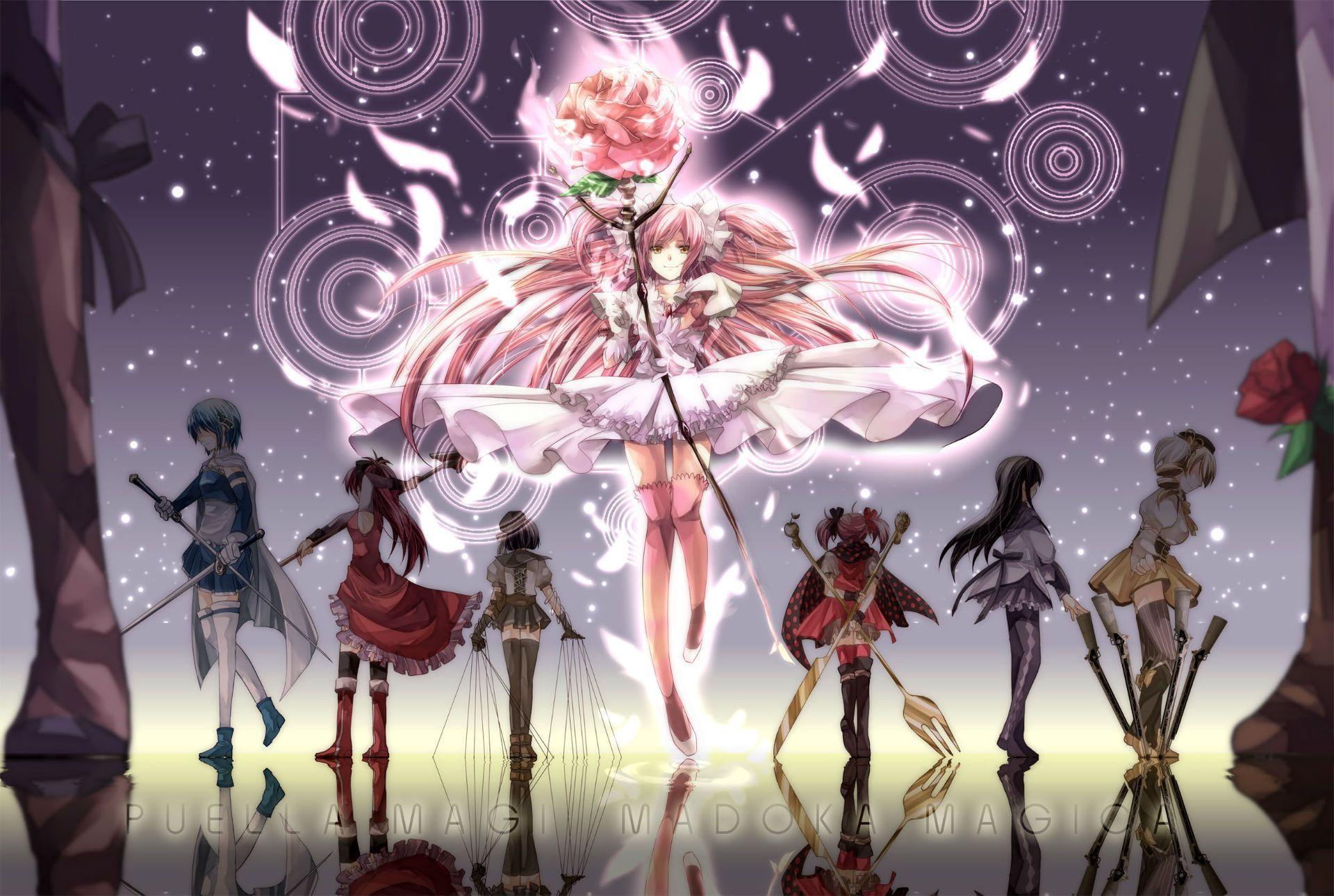
It happened in 2011. Most of us were just getting used to the "dark magical girl" trope when Gen Urobuchi decided to flip the entire table. We saw Madoka Kaname, a girl who spent almost the entire series crying and hesitating, suddenly rewrite the laws of the universe. It wasn't just a power-up. It was a conceptual shift. When people search for the Madoka Magica final form, they aren't just looking for a stat sheet or a new outfit design. They’re looking for the moment a middle schooler became a literal goddess to save her friends from a cycle of suffering that seemed infinite.
Honestly? It’s still one of the most debated endings in anime history.
Some call her Godoka. Others call her Ultimate Madoka. Whatever name you use, that shimmering, winged entity represents the peak of the Puella Magi Madoka Magica franchise. It’s a form that defies the standard "shonen" logic where you just punch harder. Instead, she chose to exist everywhere, at all times, just to make sure no magical girl would ever have to become a Witch again.
What is the Madoka Magica Final Form?
Technically, it’s the Law of Cycles.
When Madoka makes her wish in Episode 12, she doesn't ask for a big gun or a shield. She wishes to erase all witches before they are even born. Because the universe operates on a system of equivalent exchange—thanks, Kyubey—that wish is so massive it requires an equal amount of despair. Madoka absorbs it all. She becomes a paradox. She is a magical girl who hunts her own future self.
This Madoka Magica final form is characterized by those iconic white wings, the cosmos reflected in the lining of her dress, and eyes that seem to see through the fabric of reality. She isn't just "strong." She is omnipresent. She exists in the past, the present, and the future. You can't really "fight" her because she’s the rules of the game now.
The Physics of a Goddess
Think about the scale here. Most "final forms" in anime are about localized destruction. Goku goes Ultra Instinct and shakes a void. Naruto gets a glowing shroud. But Madoka? She changes the fundamental constants of physics.
Before her wish, the "Soul Gem" system was a trap. You run out of magic, you turn into a monster, and then your friends have to kill you. It sucked. By ascending to her Madoka Magica final form, Madoka intercepts that process. Before the gem can shatter into a Grief Seed, she appears, takes the burden, and guides the girl to a sort of magical girl heaven.
It’s selfless. It’s also incredibly lonely.
Because she exists as a concept, she can no longer be seen or heard by the people she loves. Except for Homura. And maybe Tatsuya, if you believe the hints in the final scenes. That’s the tragedy of the Madoka Magica final form. To save everyone, she had to stop being a person. She became a "thing" that happens to the universe.
Design Elements That Actually Mean Something
Ume Aoki, the character designer, didn't just throw glitter at the screen. Every part of the Ultimate Madoka design tells a story.
- The Wings: They aren't just for flying. They represent the "ascension" beyond the earthly cycle.
- The Galaxy Dress: Look closely at the underside of her skirt. It’s literally the universe. It shows that she contains the world she protected.
- The Bow: It’s no longer a simple wooden branch. It’s a crystalline weapon that fires arrows of pure light, capable of piercing through any barrier.
It's beautiful. It's also terrifying if you think about the weight of it.
Why Homura Changed Everything
You can't talk about the Madoka Magica final form without talking about the Rebellion movie. Just when we thought the story was over, Homura Akemi decided she wasn't okay with Madoka being a lonely goddess.
This is where the "final form" discussion gets messy. Is the Law of Cycles still the final form? Or is it the "Devil Homura" state that suppressed it?
In Rebellion, Homura essentially rips a piece of the Law of Cycles away. She captures the human part of Madoka and traps the goddess part. This creates a new reality. If Ultimate Madoka is the ultimate expression of "Hope," then Akuma Homura is the ultimate expression of "Love"—or at least a very twisted, possessive version of it.
Fans have spent over a decade arguing about who is "right" here. Was Madoka’s sacrifice a mistake? Did Homura save her or ruin her? It’s this complexity that keeps the Madoka Magica final form relevant while other anime power-ups are forgotten a week after the season ends.
Misconceptions About the Law of Cycles
A lot of people think Madoka died. She didn't.
She was never "born" and she never "died" in the new timeline. She just... is.
Another weird misconception is that she’s omnipotent. She’s not. She has a very specific job: stop Witches. She isn't a genie who can grant any wish or stop every bad thing from happening. People still suffer. Magical girls still fight "Wraiths" now. The world is still a dangerous place; it’s just slightly less cruel because the "Witch" transformation is gone.
The Upcoming Walpurgisnacht Rising
With the new movie, Walpurgisnacht Rising, on the horizon, everyone is asking: will we see a new Madoka Magica final form?
The trailers show a world where things are... off. Homura is in control, but the cracks are showing. We see glimpses of Madoka potentially regaining her memories. If she wakes up, what happens to the goddess form? Can she be a human and a goddess at the same time?
History suggests that Shaft (the animation studio) loves to subvert expectations. We might see a fusion. We might see something entirely new that combines the Law of Cycles with the "Devil" power.
Expert Take: The Impact on the Genre
Before Madoka, the "final form" for a magical girl was usually just a shinier dress and a bigger scepter. Think Sailor Moon becoming Eternal Sailor Moon. It’s a power boost, sure, but she’s still Usagi.
Madoka changed the stakes. Her Madoka Magica final form was a total erasure of self. It moved the genre into the realm of cosmic horror and philosophical inquiry. It forced the audience to ask: "Is salvation worth the loss of identity?"
Other shows tried to copy it. Yuki Yuna is a Hero and Magical Girl Raising Project both played with these dark themes. But none of them hit quite like the original transformation sequence in Episode 12. The music by Yuki Kajiura—the track "Sagitta Luminis"—still gives people chills. It’s triumphant but heartbreaking.
Actionable Insights for Fans and Collectors
If you're looking to dive deeper into this specific lore or collect the "Ultimate" version of the character, here is what you need to know.
First, the merchandise for the Madoka Magica final form is notoriously expensive. The 1/8 scale figures by Good Smile Company are legendary for their detail, particularly the way they handle the wings and the dress. If you’re buying second-hand, check the "soul gem" detail on the chest; bootlegs often mess up the clarity of the gem.
Second, re-watch Episode 12 and the final ten minutes of Rebellion back-to-back. You’ll notice that the visual language of Madoka’s goddess form is mirrored and inverted by Homura’s devil form. The way they move, the way the "feathers" fall—it’s all intentional.
Finally, keep an eye on the official Magica Quartet social media channels for the Walpurgisnacht Rising release dates. The meta-narrative of Madoka's power is about to shift again, and if you aren't caught up on the distinction between her human soul and her "Law of Cycles" essence, the new movie is going to be very confusing.
The beauty of the Madoka Magica final form isn't just in the animation. It's in the fact that, even as a god, Madoka Kaname was still just a girl who wanted her friends to stop crying. That’s why we’re still talking about it fifteen years later.
Next Steps for the Deep Dive
- Watch the "Concept Movie" trailer from a few years back. It contains visual clues about how the Law of Cycles interacts with Homura's new world.
- Analyze the flower symbolism. Lilies and cherry blossoms appear frequently during the transformation; research their meanings in Japanese culture to see how they foreshadow Madoka's fate.
- Compare the manga vs. anime. The Madoka Magica manga (specifically the final volume) portrays the scale of the "Ultimate" form with different artistic flourishes that emphasize the cosmic scale even more than the show.
The story of Madoka's ascension is a closed loop that keeps opening. Every time we think we understand the limits of her power, the series introduces a new philosophical wrinkle. Whether you view her as a savior, a victim, or a fundamental force of nature, one thing is certain: the Madoka Magica final form redefined what it means to win a battle at the cost of your existence. Check your sources, watch the frames closely, and prepare for the next evolution in the upcoming film.