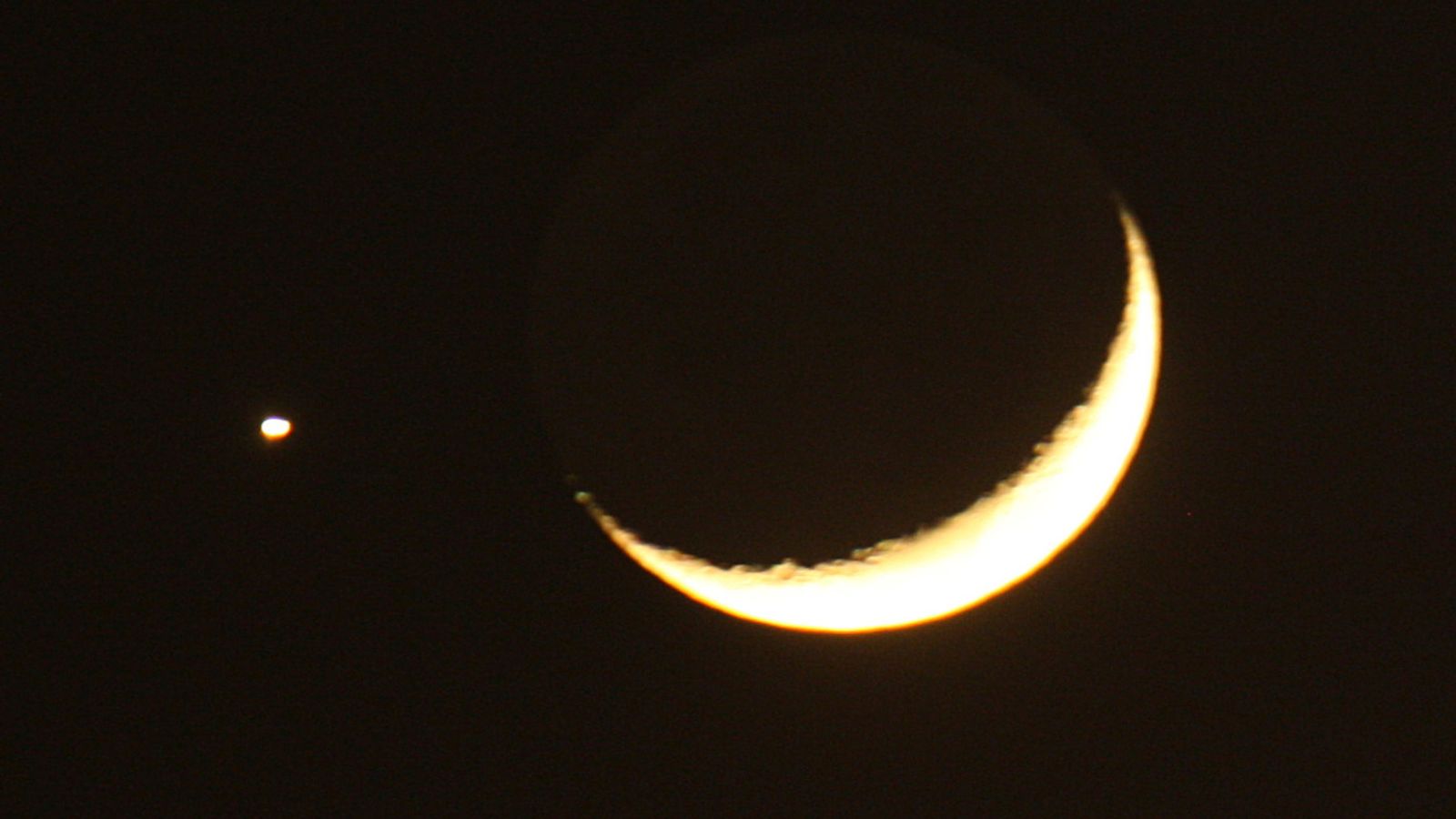
If you’re standing in your backyard tonight looking up, you aren't just seeing stars. Those steady, unblinking lights? Most likely, those are the giants of our solar system. Determining what planets are in the sky tonight feels like a bit of a moving target because, well, the Earth is moving. Everything is moving. It’s a cosmic dance that never actually repeats in exactly the same way during your lifetime.
The gear isn't the point. You don't need a $2,000 Celestron setup to feel the scale of the universe. Honestly, your eyes are plenty. Right now, in early 2026, we’re in a bit of a sweet spot for evening observers. Depending on exactly when you stepped outside, you’re likely seeing the "Lord of the Rings" or the "King of the Planets" dominating the horizon.
The Evening Show: Venus and Jupiter Take Center Stage
If you look toward the west right after sunset, that incredibly bright "star" that seems to outshine everything else isn't a star at all. It’s Venus. Astronomers call it the "Evening Star" when it’s positioned like this. Because Venus is closer to the Sun than we are, it never wanders too far from the horizon. It follows the Sun down like a loyal pet.
Jupiter is the other big player. While Venus is brilliant and white, Jupiter often has a slightly creamier, tan hue. It’s high in the sky during the early evening hours this month. If you have even a basic pair of bird-watching binoculars, try to hold them very still—rest them on a fence post or the roof of your car. You’ll see Jupiter isn't alone. You can actually spot the four Galilean moons—Io, Europa, Ganymede, and Callisto—as tiny pinpricks of light lined up like ducks in a row. It’s a perspective shift that hits you right in the gut. You’re seeing another mini-solar system in real-time.
Why do planets look different from stars?
Stars twinkle; planets don't. That’s the golden rule for anyone asking what planets are in the sky tonight. Stars are so unimaginably far away that they are essentially single points of light. When that light hits our atmosphere, the turbulence of the air bends it, making it "twinkle" or shimmer. Planets are much closer. They appear as tiny physical disks rather than points. This means their light is "fatter" and more stable, slicing through the atmospheric interference without that rapid flickering.
Searching for the Red Planet and the Ringed Wonder
Mars is currently a bit of a shapeshifter. Sometimes it’s the brightest thing in the sky, and other times it’s a faint, rusty dot that’s easy to miss. Currently, it’s hanging out in the late-night to early-morning window. You’ll recognize it by the color. It isn't "fire engine" red, despite what the movies say. It’s more of a burnt orange or a salmon color. If you see a light that looks like it’s glowing with a faint fever, that’s the Fourth Planet.
Then there’s Saturn. Saturn is the connoisseur’s planet. It’s not as bright as Jupiter or Venus, but it has a steady, golden-yellow glow. Seeing the rings for the first time is a rite of passage. You won't see them with the naked eye—you’ll just see a calm, yellowish light. But even a small telescope reveals the gap between the planet and its icy halos. It looks so perfect through an eyepiece that many people think it’s a sticker or a slide placed inside the telescope as a prank.
The Ecliptic: The Highway of the Planets
If you want to find what planets are in the sky tonight without an app, just follow the "Ecliptic." This is the imaginary path the Sun takes across the sky. Since the solar system is relatively flat, like a giant pancake, all the planets stay on this same track. If you can trace the line from where the Sun set to where it will rise, you’re looking at the planetary highway. If you see a bright, non-twinkling light way off that path—say, near the North Star—it’s definitely not a planet.
Rare Sights: Mercury and the Outer Giants
Mercury is the trickiest. It’s the "Fleet-Footed Messenger," and it stays so close to the Sun that it’s usually lost in the glare. You only get a tiny window of maybe 30 minutes after sunset or before sunrise to catch it. It’s low, it’s fast, and it’s usually obscured by trees or buildings. Most people go their whole lives without ever seeing Mercury, which is a shame because it has a distinct, zippy energy to it.
Then we have Uranus and Neptune.
You aren't seeing these tonight without help.
Period.
Neptune requires a decent telescope and a very dark sky. It looks like a tiny, tiny blue dot. Uranus can technically be seen by people with perfect vision in "Bortle 1" skies (the kind of darkness you only find in the middle of a desert), but for the rest of us, it’s a binocular target. It has a subtle greenish tint that’s quite eerie once you finally pin it down.
The Best Way to Plan Your Viewing
The sky is a clock. To know what planets are in the sky tonight, you have to account for your specific latitude. Someone in Sydney is looking at a completely different orientation than someone in Chicago.
- Check the Moon phase: A full moon is beautiful, but it’s essentially a giant flashlight that washes out everything else. If you want to see the faint glow of Saturn or the moons of Jupiter, try to go out during a New Moon or a crescent phase.
- The 20-Minute Rule: Your eyes take about 20 minutes to fully adjust to the dark. If you step outside and immediately look at your bright phone screen to check an app, you’ve just reset your "night vision" clock. Turn the brightness all the way down or use a red light filter.
- Atmospheric "Seeing": Sometimes the stars twinkle violently. This is "bad seeing." It means the atmosphere is turbulent. On these nights, planets will look blurry or like they are underwater through a telescope. You want a still, heavy night for the best views.
Common Misconceptions About the Night Sky
People often think planets only appear in the summer or that they are only visible at 3:00 AM. That’s just not true. Because the Earth orbits the Sun faster than the outer planets, we basically "lap" them. This is called Opposition. When a planet is at opposition, it’s on the opposite side of the Earth from the Sun. This is when it’s closest to us, brightest, and visible all night long.
Another big one: "The Mars Hoax." Every few years, an email or social media post goes viral claiming Mars will look as big as the Full Moon. This is physically impossible. If Mars ever looked as big as the moon, we would be in massive gravitational trouble. Mars will always look like a star-like point to the naked eye.
Your Plan for Tonight
Stop reading and actually go outside. Even if you live in a city with light pollution, Jupiter and Venus are usually bright enough to punch through the glow of streetlights.
- Find West: Look toward the sunset. If you see a beacon of light, that’s Venus.
- Look Up: Trace the line toward the South or Southeast. That bright, steady, creamy light is Jupiter.
- Identify the "Wrestlers": If you see a reddish light nearby, compare it to the star Antares or Aldebaran. If it twinkles, it’s the star. If it’s steady, you’ve found Mars.
- Use an App (Sparingly): Use SkyGuide or Stellarium to confirm your findings, but try to identify them yourself first. It’s more rewarding.
The universe is massive, but the planets make it feel a little more like a neighborhood. Seeing Jupiter isn't just seeing a light; it’s seeing a world with 95 moons, a massive red storm, and a gravitational pull that protects Earth from stray comets. It's out there right now, hanging over your house. Go take a look.