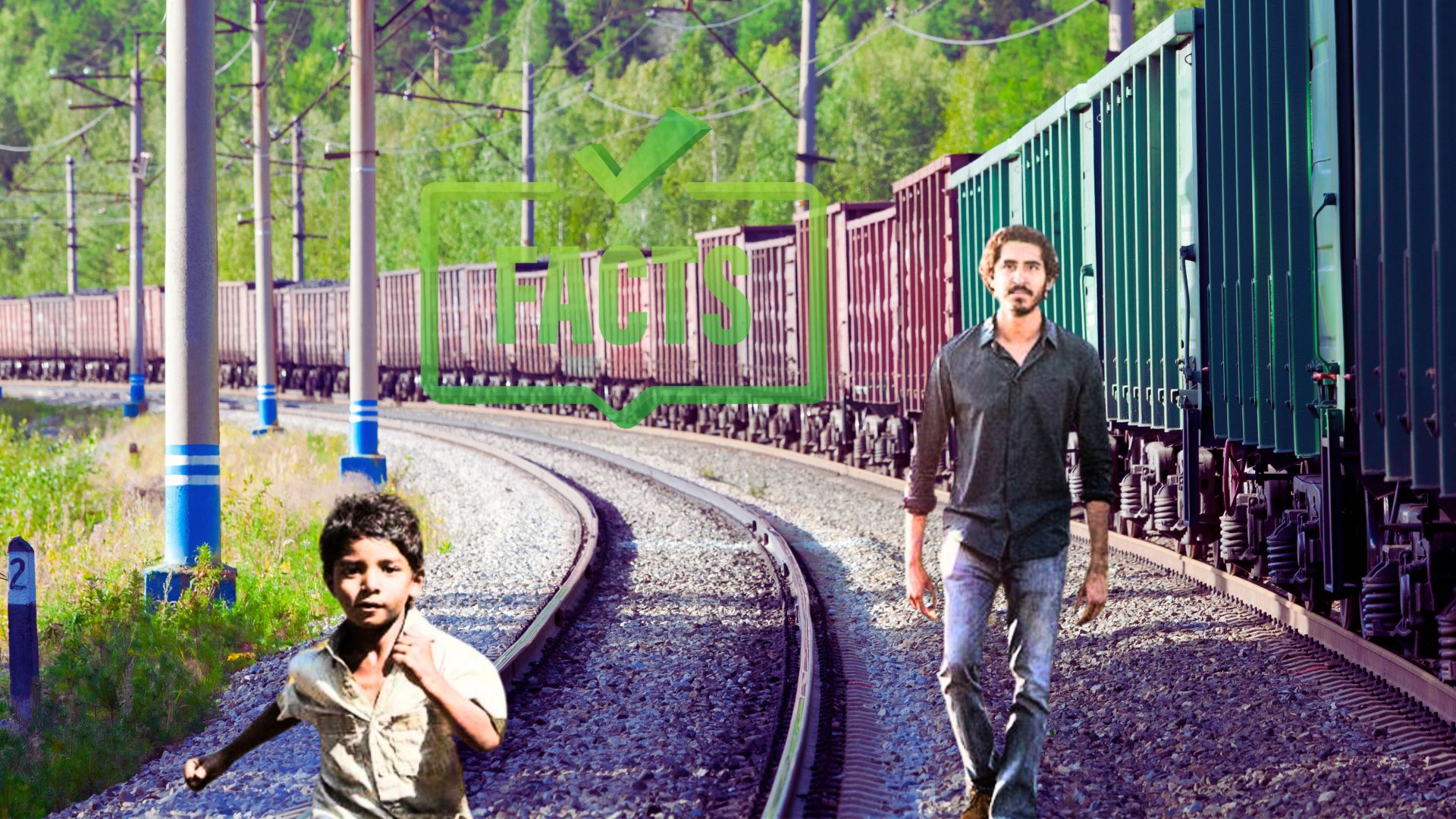
Five years old. Think about that for a second. Most kids that age are just learning to tie their shoes or memorizing their home address. But in 1986, a little boy named Saroo was living a literal nightmare that most of us couldn't even process. If you’ve seen the film starring Dev Patel, you know the broad strokes, but the lion movie a true story is actually way more intense and granular than a two-hour Hollywood production can ever really capture.
It wasn't just a "wrong train" situation. It was a series of terrifying, cascading failures.
Saroo wasn't even supposed to be at the station that night. He followed his older brother, Guddu, to the Khandwa railway station in India. He was tired. He fell asleep on a bench. When he woke up, the platform was empty. Imagine the silence of a train station at 2:00 AM when you're five. Panic sets in. He sees a train, thinks his brother is on it, and climbs aboard. He falls asleep again. When he wakes up this time, he’s hundreds of miles away from home, locked in a carriage heading toward Calcutta (now Kolkata).
The Reality of 1980s Calcutta
The movie does a decent job showing the grit, but the reality was suffocating. Saroo spent weeks on the streets. We're talking about a kid who didn't even know his own last name or the name of his hometown. He called it "Ganestalay," which we later found out was actually Ganesh Talai. To a five-year-old’s ears, words get squashed.
He survived on scraps. He dodged child traffickers. Honestly, it’s a miracle he wasn't swept up into something much darker. Eventually, he ended up in an orphanage, the Indian Society for Sponsorship and Adoption (ISSA). This is where the story shifts from a survival horror to a tale of global connection.
An Australian couple, Sue and John Brierley, adopted him. They lived in Hobart, Tasmania. It’s about as far as you can get from the dusty streets of Madhya Pradesh.
Why the "Lion" Title Matters
You might wonder why it's called Lion. For the longest time, Saroo thought his name was, well, Saroo. It turns out he had been mispronouncing his own name for decades. His birth name was actually Sheru, which translates to "Lion" in Hindi. That realization didn't come until he was an adult, standing back in his hometown. It’s one of those details that feels too poetic to be real, but it’s 100% factual.
The transition to Australia wasn't just about a new house. It was a total identity wipe. Saroo learned English. He forgot Hindi. He became a "typical" Aussie kid, surfing and hanging out with friends. But the memories didn't just vanish. They were like ghosts. He’d look at a map of India and feel this magnetic pull he couldn't explain.
The Google Earth Obsession
This is the part everyone remembers from the movie. The tech. In the late 2000s, Google Earth was still relatively new. Saroo started using it to backtrack.
Think about the math here. He knew the train travelled for roughly 14 hours. He estimated the speed of Indian trains in the 80s. He drew a circle around Calcutta with a radius of about 1,200 kilometers. Then he started looking for landmarks.
- A water tank.
- A bridge near a station.
- A fountain.
He spent years doing this. It wasn't a weekend project; it was an obsession that strained his relationships. He was basically a digital detective looking for a needle in a haystack the size of a subcontinent.
The Moment of Contact
One night in 2011, he found it. Burhanpur station. He followed the tracks to a small suburb. Ganesh Talai. He saw the fountain where he used to play.
He didn't just call a number. He flew there. He walked the streets of his childhood. Everything looked smaller, as things often do when you grow up, but it was unmistakably home. He found his mother, Kamla. She had never moved. She stayed in that village for 25 years, hoping her son would walk back down that path.
The most heartbreaking part of the lion movie a true story that the film glazes over slightly? The fate of his brother, Guddu. On the same night Saroo got lost on the train, Guddu was hit by another train and died. Their mother lost two sons in a single night. She spent decades mourning one and searching for the other.
What the Movie Changed (and What It Kept)
Hollywood loves to tweak things for drama. Surprisingly, Lion is one of the more faithful adaptations out there.
- The Timeline: The movie condenses years of searching into a few montage sequences. In reality, Saroo’s search was grueling and often felt hopeless.
- The Girlfriend: Rooney Mara’s character, Lucy, is a composite of a few different people Saroo dated, though he did have a long-term partner during the peak of his search.
- The Reunion: The emotional weight of the reunion was spot on. Saroo actually met his mother near her home, and she recognized him instantly despite the decades apart.
It's easy to look at this as a "tech saves the day" story. But it's really about the tenacity of human memory. Saroo’s brain held onto the layout of a train station for a quarter of a century. That’s not just luck; it’s a testament to how trauma and love sear images into our minds.
Exploring the E-E-A-T: The Science of "Flashbulb" Memories
Psychologists often talk about "flashbulb memories"—vivid, detailed snapshots of surprising or emotionally arousing events. Saroo’s ability to navigate his hometown after 25 years is a textbook example. When we are in a high-stress state (like a lost five-year-old), the amygdala gears up and helps the hippocampus encode memories with intense clarity.
Experts like Elizabeth Loftus have studied how memories can be distorted over time, yet Saroo’s case shows that certain "spatial anchors" can remain remarkably resilient. He didn't remember names, but he remembered the shape of the land.
Actionable Takeaways for the Curious
If you're fascinated by this story, there are a few things you should do to get the full picture.
- Read the Memoir: The book is called A Long Way Home. It’s much more internal and detailed than the movie. It covers the cultural shock of moving to Tasmania in a way the film can't quite articulate.
- Check the Maps: You can actually find Ganesh Talai on Google Earth today. Seeing the distance between Khandwa and Kolkata on a digital map makes his journey feel much more real—and much more terrifying.
- Support Child Welfare: Saroo’s story had a happy ending, but thousands of children go missing in India every year. Organizations like BBA (Bachpan Bachao Andolan), founded by Nobel Laureate Kailash Satyarthi, work on the ground to prevent the kind of trafficking Saroo narrowly escaped.
- Watch the Documentary: There are several interviews and short documentaries featuring the real Saroo and his mother, Kamla. Seeing the real people behind the actors adds a layer of weight to the narrative.
The lion movie a true story isn't just about a guy who found his house on a map. It's a reminder that the world is huge and scary, but the threads that connect us to home are much stronger than we think.
Next time you're scrolling through a map or looking at a satellite view of your own house, think about Saroo. Think about the kid who used that same technology to find a life he thought was gone forever. It's a miracle of the modern age, built on the foundation of a five-year-old’s stubborn memory.
To really grasp the scale of this, look up the rail distance between Khandwa and Howrah Junction. It's roughly 1,500 kilometers. For a child to survive that alone, in a city where he didn't speak the language, is nothing short of an anomaly.
If you want to dive deeper, start by looking into the Brierley family's ongoing work with Indian orphanages. They didn't just take Saroo and leave; they remained deeply committed to the community that "lost" him.