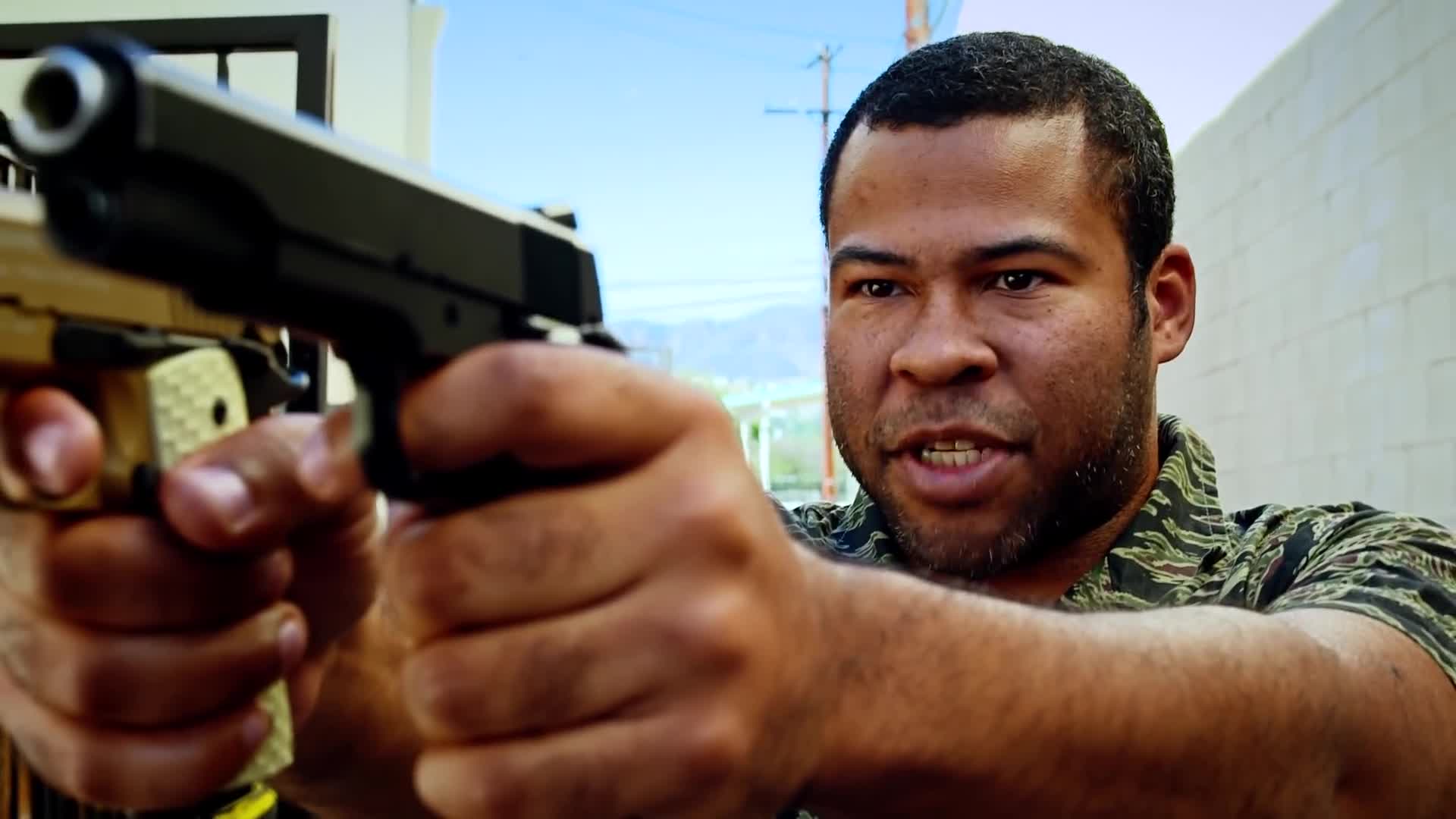
You know that feeling when you're watching a movie and everyone pulls a gun at the same time? The music gets all tense. Sweat beads on foreheads. It’s the ultimate cinematic trope. But leave it to Keegan-Michael Key and Jordan Peele to take that high-stakes moment and turn it into something so absurd it basically broke the concept of action movies forever.
Honestly, if you haven't seen the Key and Peele Mexican Standoff sketch—which, fun fact, was actually a collaboration with Freddie Wong and the RocketJump crew—you’re missing out on a masterclass in "yes, and" comedy. It’s not just a parody. It’s a relentless, escalating nightmare of double-crosses that makes Reservoir Dogs look like a calm afternoon tea.
The Chaos of the Key and Peele Mexican Standoff
The setup is classic. You’ve got two agents (Key and Freddie Wong) cornering a notorious criminal named Cortez (Peele). Standard stuff, right? Guns are drawn. The tension is thick. But within about thirty seconds, the logic of the situation starts to unravel.
It starts with a simple reveal: someone is actually a double agent. Then another. Then someone reveals they’re a triple agent. Then a quadruple agent. It gets to the point where people are pointing guns at their own heads just to prove a point about their loyalty—or lack thereof.
What makes the Key and Peele Mexican Standoff so effective isn't just the writing; it’s the technical execution. Because it was produced with RocketJump, the visual effects and "action movie" cinematography are top-notch. It looks like a real movie. That high production value makes the stupidity of the characters even funnier. You’ve got Jordan Peele delivering lines with the gravelly intensity of a Bond villain while the plot behind him is literally collapsing under its own weight.
A Twist Around Every Corner
Most sketches have a "turn"—that moment where the premise shifts. This sketch has about fifteen of them.
- The Sniper: Just when you think the standoff is contained to the room, we see a sniper.
- The Hacker: Suddenly, a hacker is involved, but he’s also in a standoff with his wife.
- The Kid: There’s even a kid with a toy gun at one point.
Basically, no one in the world of this sketch is safe from being part of the standoff. It perfectly mocks the "I knew you knew that I knew" trope that dominates modern spy thrillers.
Why This Sketch Ranks Among Their Best
Kinda weird to think this wasn't part of a standard Key & Peele episode on Comedy Central, right? It was a special digital collaboration released back in 2013. Yet, it feels more "Key and Peele" than almost anything else they did.
The duo has always been obsessed with the performative nature of masculinity. Whether it's the "Slap-Ass" baseball sketch or the "Substitute Teacher," they love exploring how men try to out-alpha each other. The Key and Peele Mexican Standoff takes that to the extreme. These men are so dedicated to the "cool" image of an action hero that they’re willing to keep the standoff going even when it makes zero sense.
It’s also a testament to their chemistry. Key and Peele have this shorthand where they can escalate a scene's energy without ever losing the audience. You believe the stakes, even when the stakes involve a man admitting he’s a "blueberry" (shoutout to the weirdly hilarious ending).
The "Blueberry" Ending Explained (Sorta)
If you've watched the whole thing, you know it ends in a "Wizard City" alleyway with a detective played by Brian Firenzi. The "detective" looks at a literal splat of blue on the wall and concludes the victim was a blueberry who committed suicide.
It’s completely nonsensical. It’s "anti-humor" at its finest. After minutes of high-octane action parody, the sketch just pivots into a surrealist police procedural. That’s the genius of their work—they aren't afraid to ditch a premise entirely if the new one is weirder and funnier.
How to Apply Key and Peele's Logic to Modern Content
While we aren't all making viral action parodies, there's a lot to learn from how this sketch works.
- Commit to the Bit: Even when the plot becomes ridiculous, the actors never wink at the camera. They play it 100% straight. If you're creating content, whether it's a video or a blog post, your "voice" needs to stay consistent, even when you're being playful.
- Visual Storytelling Matters: The Key and Peele Mexican Standoff works because it looks like the things it’s making fun of. If the lighting was bad or the costumes were cheap, the parody wouldn't land as hard.
- Subvert Expectations: People expect a standoff to end in a shootout. They don't expect it to end with someone revealing they are a fruit.
If you want to revisit this classic, it’s still living on the RocketJump YouTube channel. It’s a great reminder of that specific era of the internet where high-budget YouTube collaborations were the peak of entertainment.
To dive deeper into their filmography, you should check out the "Crossover Wiki" or the official Comedy Central archives. Most of their sketches are now available on Paramount+, but these early digital gems are still the best way to see the raw creativity that eventually led Jordan Peele to win an Oscar.
Start by re-watching the original video and pay attention to the background characters—every single person in that alleyway has a "moment," which is a hallmark of great sketch directing. From there, you can compare the staging of this sketch to the tavern scene in Inglourious Basterds to see exactly what they were parodying.