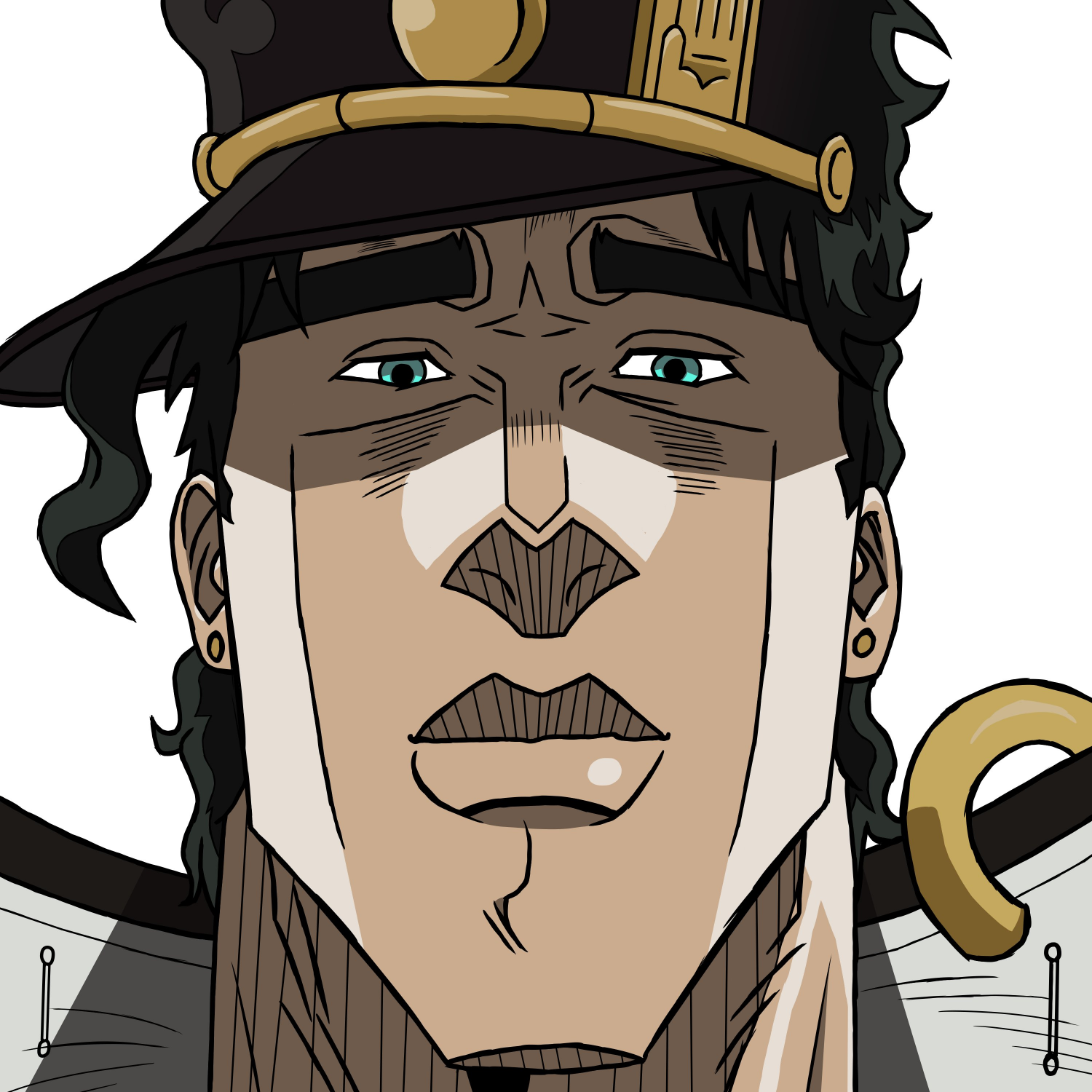
Ever stared at a screen for ten minutes straight just trying to figure out where Jotaro Kujo’s head actually ends? You aren't alone. It’s one of those anime mysteries that lives rent-free in the back of your brain. One second it’s a standard Japanese school cap, and the next, it’s basically an organic extension of his skull. Honestly, the Jotaro Kujo hat hair phenomenon is more than just a weird drawing quirk—it's a deliberate, legendary piece of character design that has confused fans since Stardust Crusaders first hit the pages of Weekly Shōnen Jump in 1989.
Let's be real. It looks like his hair just gave up and decided to become fabric. Or maybe the hat got tired of being an accessory and merged with his DNA. While the internet loves to joke that his hat is actually a "Stand" or some kind of bizarre biological growth, the actual truth is a mix of punk fashion history and a mangaka getting a bit experimental with his pen.
The Mystery of the Fused Cap
If you look at the very early chapters of the Stardust Crusaders manga, the distinction is actually pretty clear. Jotaro is a delinquent. He’s a banchō. In those first few panels, you can see that his hat is just a heavily distressed cap. It’s torn. It’s beaten up. You can see his hair poking through actual holes in the back.
But as Hirohiko Araki—the creator and absolute madman behind JoJo’s Bizarre Adventure—kept drawing, the lines started to blur. Literally.
Araki has mentioned in various interviews, specifically in the Jojonium releases, that he wanted Jotaro to have a silhouette that was instantly recognizable from any angle. If you see that jagged line where the black fabric meets the black hair, you know exactly who you're looking at. He didn't want a clear "border" because, in his mind, the hat is a part of Jotaro’s identity. It’s not just something he wears; it’s who he is.
By the time we get to Part 4, Diamond is Unbreakable, the "fusing" gets even more intense because Jotaro switches to a white hat. You’d think a white hat would make the boundary easier to see, right? Nope. Araki just draws the white fabric transitioning into black hair with these jagged, zig-zagging lines that defy the laws of physics. It’s basically a visual shorthand for his rebellious nature.
Why it actually looks like that
- The "Torn Back" Theory: This is the most "realistic" explanation. The back of the hat is simply ripped away, and Jotaro’s thick, spiky hair blends into the torn fibers.
- The Silhouette Rule: Araki prioritizes "cool" and "readable" over "logical." If a fused hat makes the character look more iconic, the laws of haberdashery go out the window.
- The Delinquent Aesthetic: 1980s Japanese delinquents often modified their uniforms to look tougher. Ripping your hat was a way to say, "I don't care about your rules."
How Does It Stay On?
This is the part that keeps me up at night. During the fight with N’Doul and his Stand, Geb, Jotaro actually loses his hat. It’s a huge moment because it almost never happens. When he picks it up, you can see the back is completely shredded.
Some fans theorize he uses Star Platinum to microscopically weave his hair into the fabric. Others think he just jams it on so hard it gets stuck. There’s even a wild (and slightly gross) theory from a 2014 fan Q&A where someone suggested it’s held on by pure "fighting spirit."
Honestly? It stays on because it has to. It’s part of the Joestar "drip." When he’s underwater, when he’s flying through the air, when he’s being punched through buildings—the hat remains. Except for those very rare, dramatic moments when Araki wants to show Jotaro is truly vulnerable. Taking off the hat is like taking off the armor.
The Evolution Through the Parts
Jotaro’s look doesn't stay static. As he ages from a 17-year-old delinquent to a 40-something marine biologist, the Jotaro Kujo hat hair evolves with him.
In Part 3, it’s all about that gold button and the massive chain on his collar. The hat and hair are black-on-black, making the blend look like a natural shadow. It’s moody. It’s "yare yare daze" personified.
Then Part 4 happens. Suddenly, he’s in all white. The hat now has a dolphin on it (because he loves the ocean, obviously). This is where the design becomes truly abstract. The white hat ends in these sharp, black hair-points. It makes no sense if you try to build it in real life, but on the page, it’s high fashion.
By Part 6 (Stone Ocean), the hat has become even more integrated into his look. It’s got snakeskin patterns. It’s got "JOJO" written all over it. At this point, Araki isn't even trying to pretend it's a normal hat anymore. It’s a piece of wearable art that happens to be attached to a man’s head.
Cosplay: The Ultimate Struggle
If you’ve ever tried to cosplay Jotaro, you know the "hat-hair" is the final boss. You can’t just buy a hat and put it on. It looks wrong.
Professional cosplayers usually have to sacrifice a perfectly good hat to get the look right. They’ll cut out the entire back half of the crown, leaving only the brim and the front panel. Then, they’ll use a wig and literally glue the fibers of the wig to the jagged edges of the cut hat.
It’s a nightmare to transport. You can’t just fold it. It’s a structural engineering project.
A Quick "Cheat Sheet" for DIY Jotaro Hair:
- Get two hats. You will mess the first one up. Guaranteed.
- Cut the back. Don't use scissors; use a craft knife to get those "torn" edges.
- The Wig is Key. You need a high-quality, heat-resistant black wig. Style the "spikes" first, then fit the hat over them.
- Blending. Use black hairspray or even matte black acrylic paint on the edges of the hat where it meets the wig to hide the seam.
What This Design Choice Really Means
Critics often point to the hat-hair as a sign of Araki’s "inconsistency," but that’s missing the point. JoJo is about the "bizarre." If everything looked like a Sears catalog, it wouldn't be JoJo.
The hat-hair represents Jotaro’s refusal to fit into a mold. He’s a student, but he wears a modified uniform. He’s a hero, but he acts like a thug. He wears a hat, but it’s part of his hair. It’s a visual paradox. It tells the reader that this character doesn't follow the rules of your world—or even the rules of his own.
Araki was heavily influenced by the fashion illustrator Antonio Lopez and Italian fashion designers. He views characters as walking sculptures. In sculpture, you don't always separate the hat from the head; sometimes they are carved from the same block of marble. That’s Jotaro. He’s a monolith.
Actionable Insights for Fans and Creators
If you’re a character designer, there’s a massive lesson here: Silhouette is everything. Don't worry about "how it works" in a 3D space if it creates a 2D image that people will remember for thirty years.
If you're just a fan who was confused, now you know. It’s a torn hat, an artistic choice, and a total middle finger to traditional anatomy.
Next Steps for the Curious:
- Check the Manga: Go back to Volume 1 of Stardust Crusaders (Chapter 1-5). Look closely at the "hatless" Jotaro scenes in the jail cell. You'll see his hair is actually quite messy and tall, which explains why it would "fill out" a torn hat so well.
- Watch the OVA: The 1993 OVA series has a slightly different art style where the hat is more "solid." Comparing the two shows you just how much of the "fusing" is specific to Araki’s personal evolution as an artist.
- Art Study: Try drawing the silhouette of five different anime characters. If you can’t tell who they are without their faces, they aren't designed as well as Jotaro.
At the end of the day, Jotaro Kujo’s hat isn't something you understand with your brain. You understand it with your eyes. It’s iconic precisely because it makes no sense. It’s the kind of "bizarre" that kept the series running for decades. So, the next time someone asks you where the hat ends and the hair begins, just tell them the truth: it doesn't matter. It’s just Jotaro.