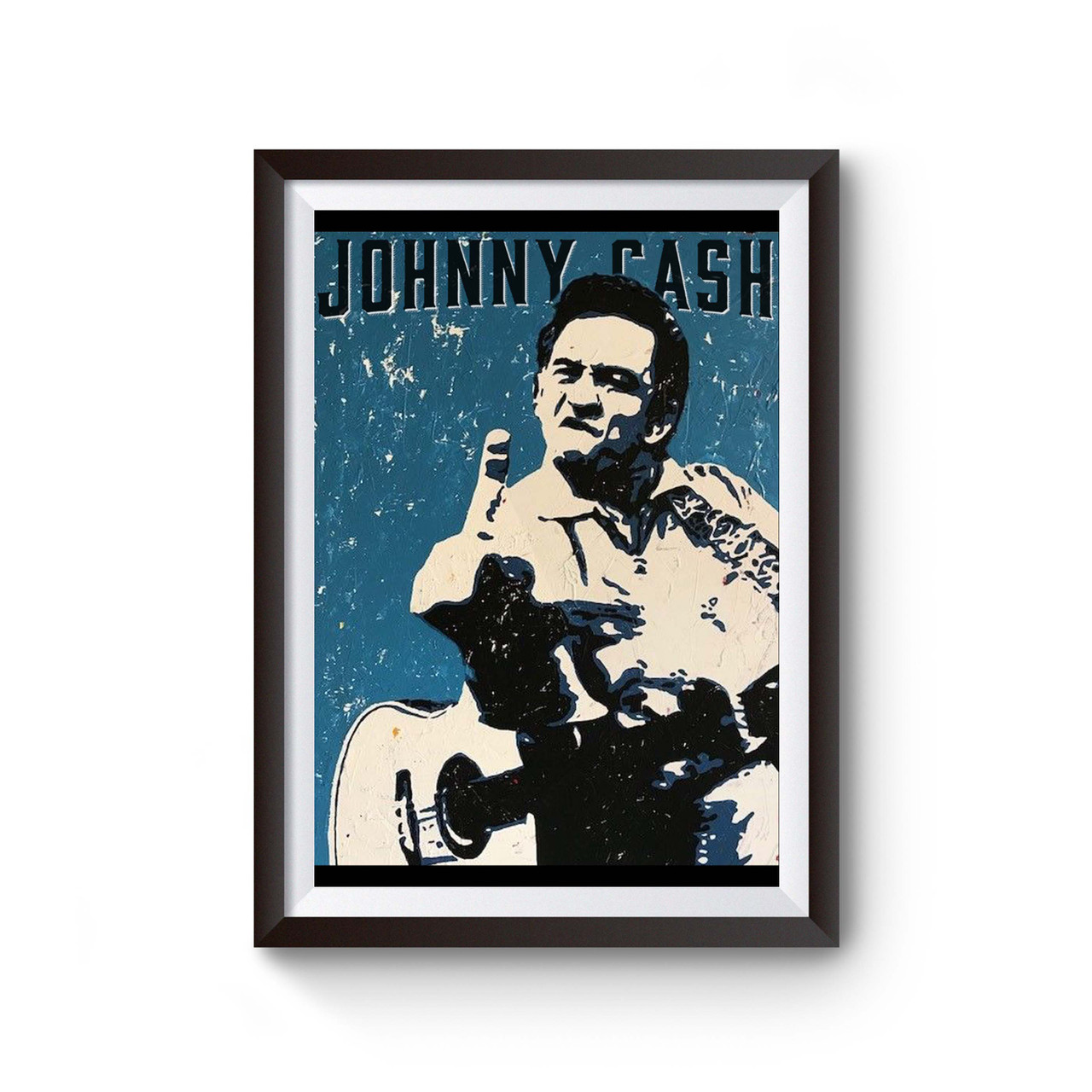
You’ve seen it on t-shirts at Hot Topic, plastered on the walls of dive bars, and probably shared a dozen times on your social feed whenever someone wants to look "rebellious." It’s the ultimate rock-and-roll salute. A grizzled, sweaty Johnny Cash leaning into the lens, face twisted in a snarl, thrusting his middle finger right at the viewer.
But here’s the thing: most people wearing that shirt have no idea who John was actually flipping off.
It wasn't just a general "forget you" to the world. It wasn't a staged PR stunt meant to sell records to edgy teenagers. In fact, for nearly thirty years, that johnny cash middle finger pic was basically a forgotten outtake sitting in a photographer's file cabinet.
The day at San Quentin
The year was 1969. February 24th, to be exact. Johnny Cash was at San Quentin State Prison to record his second live prison album. If you’ve ever listened to the At San Quentin record, you know the energy in that room was electric—and dangerous. The inmates were rowdy, the guards were on edge, and Cash was right in the middle of it, fueled by coffee, dexedrine, and a genuine empathy for the men behind bars.
Jim Marshall was the man behind the camera. He wasn't just some guy with a Nikon; he was the "Godfather of Rock Photography," the kind of guy who lived as hard as the people he shot.
During the soundcheck, things were a bit chaotic. A film crew from Granada TV in the UK was there to document the performance, and they were getting in everyone's way. Huge lights, bulky cameras, and directors shouting orders. Cash was getting annoyed. He wanted to connect with the prisoners, not play for a bunch of suits with clipboards.
"Let’s do a shot for the warden"
The actual moment the johnny cash middle finger pic happened was surprisingly brief. Jim Marshall, sensing John’s frustration and wanting to capture that raw "outlaw" energy, yelled out to him.
"John, let's do a shot for the warden!"
That was it. That was the spark.
Cash didn't hesitate. He didn't look for permission. He leaned in, stuck that finger out, and Marshall snapped the shutter. It was a split-second reaction to a specific suggestion. Cash wasn't necessarily angry at the warden personally, but he hated the authority the warden represented—the system that kept these men caged and the "establishment" that looked down on him.
Honestly, the photo almost didn't make it to the public. It wasn't used for the album cover. It didn't appear in newspapers the next day. It was just a frame on a contact sheet, marked with a yellow pencil by Marshall because he knew it was a "cool" shot, but it didn't fit the curated image Columbia Records wanted for their star at the time.
Why it finally blew up in 1998
So, how did a 1969 outtake become the most famous photo in music history? You can thank Rick Rubin and a whole lot of spite.
By the late 1990s, the Nashville establishment had basically buried Johnny Cash. He was "too old," "too niche," and didn't fit the shiny, pop-country mold that was dominating the airwaves. When his album Unchained won the Grammy for Best Country Album in 1998, despite being almost completely ignored by country radio, Rubin decided to send a message.
He bought a full-page ad in Billboard magazine.
It cost $20,000.
The ad featured that middle finger photo, front and center. The caption read: "American Recordings and Johnny Cash would like to acknowledge the Nashville music establishment and country radio for your support."
It was the ultimate "told you so." That ad single-handedly resurrected the image and cemented it as the definitive symbol of Cash's legacy. It wasn't just about a prison concert anymore; it was about an artist who refused to be told he was finished.
Myths vs. Reality
People love to invent stories about this photo. I've heard people claim he was flipping off a guard who tried to stop the show. Some say he was high and didn't know where he was. Neither is true.
- Was he angry? A little, mostly at the TV crew blocking his view.
- Was it staged? Sorta. It was prompted by the photographer, but the reaction was 100% authentic Cash.
- Is it the most "ripped off" photo? Jim Marshall certainly thought so. He spent years complaining about bootleg shirts and posters using the image without his permission.
The photo works because it isn't "pretty." Cash looks rough. His hair is a mess, his skin looks like parchment, and he isn't trying to be a hero. He’s just a guy who’s had enough.
What this means for you
If you're a fan, or even just a photographer, there's a lesson in the johnny cash middle finger pic. It's about the power of the "unfiltered" moment. In an era where every celebrity photo is airbrushed and approved by a dozen publicists, this image reminds us why we fell in love with rock and country in the first place: the raw, ugly truth.
If you want to dive deeper into the history of that day, I highly recommend checking out the 2000 "Legacy Edition" of the At San Quentin album. You can actually hear the tension in his voice when he talks to the film crew. You can also look for Jim Marshall’s book, Pocket Cash, which shows the other frames taken around that exact second. It’s fascinating to see the transition from a focused musician to a defiant icon in the span of three seconds.
Go back and listen to the performance of "A Boy Named Sue" from that same day. You’ll hear the same grit that’s visible in the photo. It wasn't just a picture; it was the sound of a man who finally stopped caring what the "wardens" of the world thought of him.
Next Steps for the Super-Fan:
- Listen to the Soundcheck: Find the expanded At San Quentin recordings to hear the verbal sparring between Cash and the producers that led to his frustration.
- Study Jim Marshall’s Contact Sheets: Look up the original contact sheets for the session to see the "near-miss" photos that didn't quite capture the same magic.
- The Billboard Ad: Search for the original 1998 Billboard layout to see exactly how the "Nashville snub" was orchestrated by Rick Rubin.