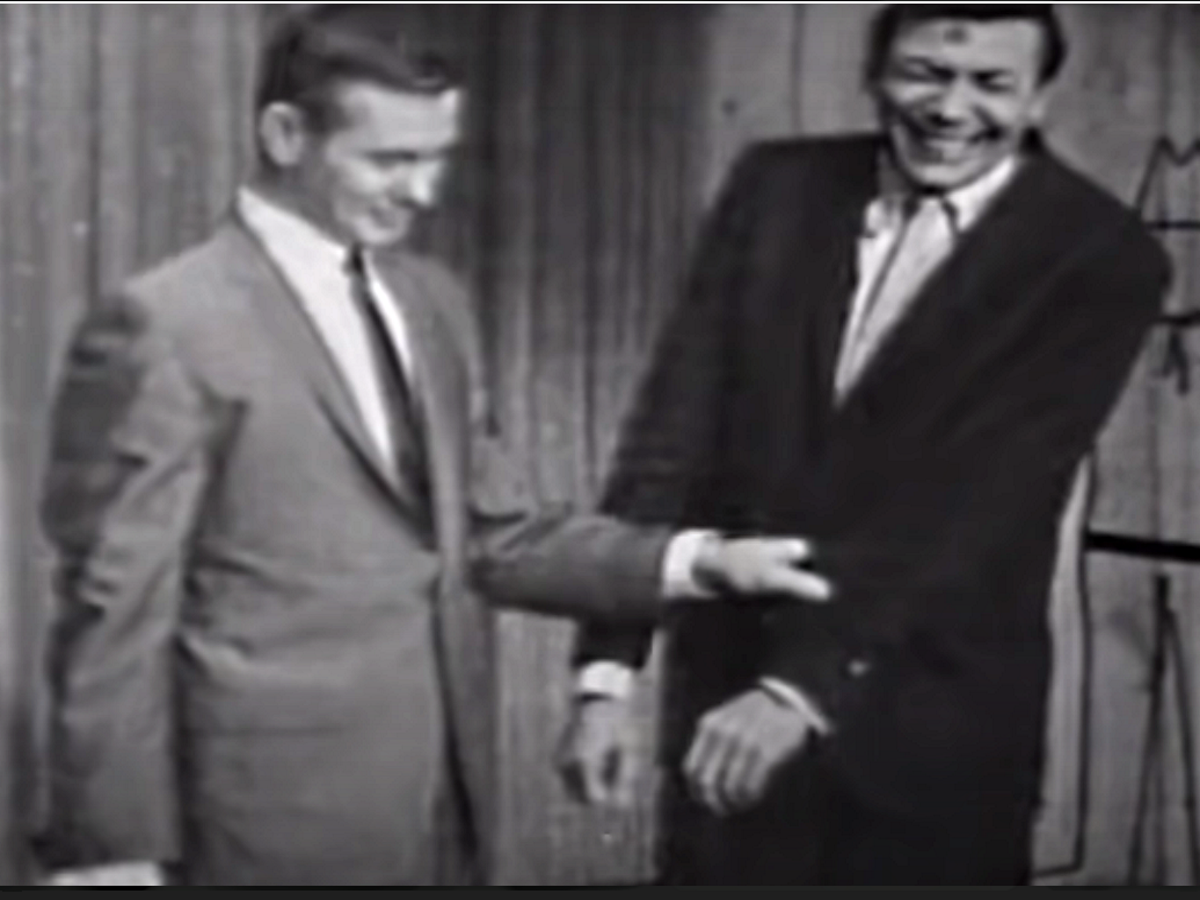
It was April 27, 1965. Television was different back then. No delay. No "cancel culture" safety nets. Just a guy in a suit, a guest with a weapon, and a wooden board. Johnny Carson and Ed Ames were about to make history, though they didn't know it yet. Ames was there to promote Daniel Boone, the hit show where he played Mingo. He’d become pretty handy with a tomahawk. Naturally, Johnny wanted a demonstration.
What followed wasn't just a blooper. It was a masterclass in comedic timing that experts still study sixty years later.
The Throw Heard 'Round the World
The setup was simple. A wooden panel featured a chalk outline of a cowboy. Ames stood back, looked at the target, and let it fly. Most people expected a bullseye or a clean miss. Instead, the tomahawk thudded into the board with a terrifyingly accurate trajectory. It landed handle-up, blade-deep, right in the cowboy's crotch.
The audience didn't just laugh. They exploded.
It was a visceral, rolling wave of sound. Honestly, if you watch the footage today, the sheer length of that initial roar is staggering. Ames stood there, frozen. He looked like he wanted the floor to swallow him whole. Johnny, being the genius of the pause, did absolutely nothing for several seconds. He let the moment breathe. He let the audience exhaust themselves.
Then, he went in for the kill.
"I didn't even know you were Jewish"
When the laughter finally dipped for a split second, Carson leaned in. "I didn't even know you were Jewish!" he quipped. The roof nearly came off the studio. It was the perfect ad-lib. It played on the "Frontier Bris" theme before that phrase even left his mouth. Ames tried to recover. He offered to let Johnny try a throw.
Carson’s response? "I can't hurt him any more than you did."
This exchange between Johnny Carson and Ed Ames is widely cited as the longest sustained laugh in television history. We’re talking about a solid four minutes of airtime where basically nothing happened but pure, unadulterated joy. It wasn't scripted. It couldn't be. You can’t fake that kind of embarrassment or that kind of comedic instinct.
Why the Bit Actually Worked
Comedy is a fragile thing. If Ames had been arrogant, it wouldn't have been funny. If Johnny had been mean, it would have felt like bullying. But Ames was a "straight man" in the best sense—distinguished, talented, and genuinely mortified.
- The Contrast: Ames was a baritone singer and a serious actor. Seeing a dignified man accidentally "circumcise" a chalk drawing is peak absurdity.
- The Silence: Johnny Carson knew that the funniest thing he could do was wait. He adjusted his tie. He looked at the camera. He waited for the audience to start hurting from laughter before he gave them a reason to start all over again.
- The Props: The tomahawk didn't fall out. It stayed there, vibrating. It was a visual punchline that kept delivering.
Beyond the Tomahawk: The Real Ed Ames
It’s actually a bit of a shame that people only remember the tomahawk. Ed Ames was a powerhouse. Before he was Mingo, he was part of the Ames Brothers. They had 49 hits. Forty-nine! He had a solo career with tracks like "My Cup Runneth Over" and "Who Will Answer?" which were huge in the late 60s.
He was also a serious theater actor. He played Chief Bromden in the Broadway version of One Flew Over the Cuckoo's Nest opposite Kirk Douglas. The guy had range. But in the world of late-night TV, one well-placed hatchet can overshadow a decade of Broadway credits.
Johnny and Ed remained friends for years. Ames returned to the show many times. They’d often replay the clip during anniversary specials. Every single time, it killed. Even though everyone knew what was coming, the timing was so perfect that it never got old. It’s the definition of "evergreen" content.
The Legacy of the "Frontier Bris"
What most people get wrong is thinking this was just a lucky break. It wasn't. It was proof of why Johnny Carson and Ed Ames were the titans of their era. Johnny’s ability to handle the "unplanned" is what made The Tonight Show the juggernaut it was. Modern hosts try to recreate these "viral" moments, but they usually feel forced. This was just gravity and a bad aim meeting a comedic genius.
If you want to understand why Carson is the GOAT (Greatest of All Time), you don't look at his prepared monologues. You look at the tomahawk. You look at how he protected his guest while simultaneously roasting him. He didn't step on the laugh. He rode it.
Actionable Takeaways for Comedy Fans
- Watch the original clip: Look for the "edit" points. You'll notice there are none. It’s one long, continuous take of a man losing his mind while another man loses his dignity.
- Study the Pause: If you ever do public speaking or even just tell jokes at dinner, learn from Johnny. The silence is often funnier than the words.
- Respect the "Straight Man": Notice how Ed Ames doesn't try to be funny after the throw. His sincerity is what makes the situation hilarious.
The footage of Johnny Carson and Ed Ames survives today largely because Johnny himself requested a kinescope of it. He knew it was lightning in a bottle. In an era where NBC was routinely wiping tapes to save money, this moment was too precious to lose. It remains the gold standard for what happens when live television goes wonderfully, horribly wrong.
To really appreciate the craft, go back and listen to the audience. Not just the noise, but the gasping. That's the sound of a moment that can't be manufactured by an algorithm or a writers' room. It’s just human. It’s just funny.
For those interested in more late-night history, searching for the "Jack Benny robbery" sketch provides a great companion piece on the power of the long pause in comedy.