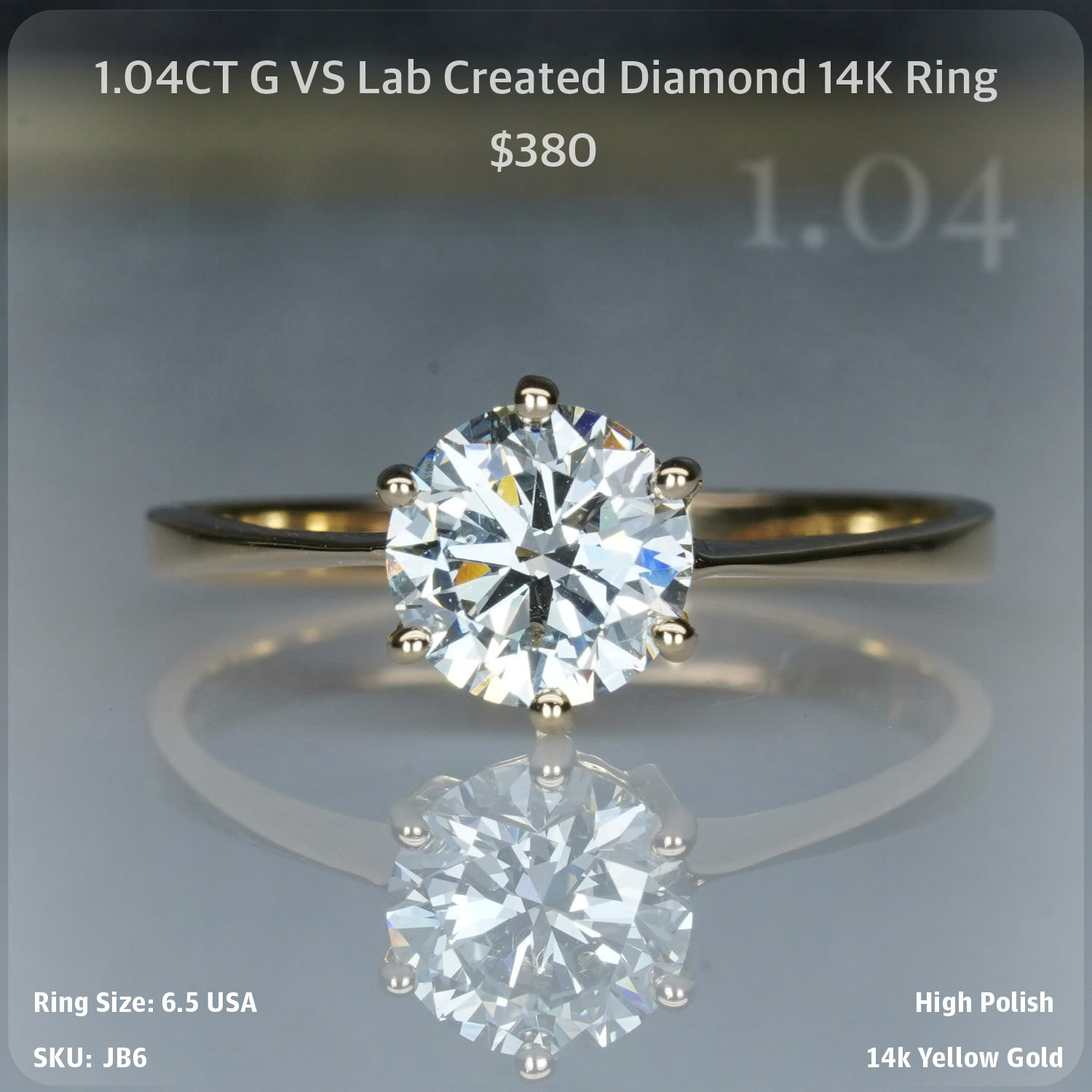
If you walked into a jewelry store five years ago asking for a three-carat diamond, the jeweler probably would’ve sized up your watch before showing you a price tag that looked like a down payment on a house. Fast forward to 2026, and the vibe has shifted. Hard.
Honestly, the biggest shock for people today isn't that lab diamonds are "real"—most folks have figured that out by now. It’s how low the floor has dropped on the price. You can literally get a massive, sparking rock that would’ve cost $40,000 in your parents' day for less than the price of a used MacBook.
But here’s the thing: because prices are falling so fast, it’s easy to get ripped off if you’re looking at old "guides" from 2023 or 2024. So, let's talk about how much do lab grown diamond rings cost right now, in the actual market you're shopping in today.
The Reality of 1-Carat Pricing in 2026
If you’re looking for a standard one-carat round brilliant, you’re looking at a sweet spot that has basically become the "budget-friendly" gold standard.
Back in 2019, a one-carat lab stone would set you back maybe $2,400. Today? We’re seeing high-quality (think F color, VS1 clarity) lab-grown loose diamonds hovering around **$750 to $1,000**. When you add a decent 14k gold setting—which usually runs between $600 and $1,200 depending on how much "extra" you want—you’re walking out the door with a complete ring for roughly **$1,400 to $2,200**.
Compare that to a natural mined diamond of the same specs, which still sits stubbornly around $3,800 to $4,500 just for the stone. It’s a 75% discount. You're basically getting the same chemical lattice and the same "forever" sparkle, but you aren't paying the "scarcity tax."
Why Three Carats Became the New One Carat
This is where it gets fun. Since lab diamonds are grown in reactors (CVD or HPHT processes), it doesn't cost a whole lot more to keep the machine running a few days longer to get a bigger crystal.
In the natural world, a 3-carat diamond is a freak of nature. It’s rare, so the price doesn't just triple—it skyrockets. A natural 3-carat can easily hit $30,000 or $50,000.
But in 2026, a 3-carat lab grown diamond ring costs somewhere in the neighborhood of $3,500 to $5,500 total. Retailers like Rare Carat or James Allen are frequently listing 3-carat centers for under $2,500. It’s the reason why everyone on your Instagram feed suddenly seems to have a rock the size of a grape. It’s not that everyone got rich; it’s just that the tech got better.
The "Price Floor" and Why Quality Still Matters
I’ve heard people ask if these prices will eventually hit zero.
Probably not.
Experts at places like BriteCo and Rapaport have noted that in late 2025 and early 2026, the price drops started to level off. We’re finally hitting the "cost of production" floor. It still takes electricity, high-tech machinery, and skilled cutters to make these.
Also, don't just buy the cheapest thing you see on a random site. Even in the lab-grown world, you can get "duds."
- Blue Nuance: Some HPHT (High Pressure High Temperature) diamonds have a faint blue tint because of boron used in the growth process.
- Stria Lines: Cheaper CVD (Chemical Vapor Deposition) diamonds can have tiny structural grains that make the diamond look "hazy" or "oily" even if the clarity grade is high.
- The Setting: A $500 diamond in a $200 "mystery metal" setting from a sketchy overseas seller is going to lose its side stones in six months. Stick to reputable names like Brilliant Earth, VRAI, or local jewelers who actually offer a warranty.
Breaking Down the Total Bill
When you're trying to figure out your total budget, remember that the "ring" is a two-part purchase.
First, there's the stone. In early 2026, you're looking at roughly $800 per carat for top-tier lab stones, though that price-per-carat actually drops slightly as you go bigger because the market is so saturated with large stones right now.
Second, there's the metal. This is the part people forget. Gold and Platinum prices don't care if your diamond was grown in a lab or dug out of the dirt.
- 14k Gold Solitaire: $600–$900
- 18k Gold Halo/Pavé: $1,200–$2,000
- Platinum: $1,500+
So, if you want a 2-carat lab diamond in a fancy platinum pavé setting, you’re likely looking at $1,700 (stone) + $1,600 (setting) = $3,300.
What Most People Get Wrong About Resale
Kinda gotta be real with you here: if you buy a lab diamond for $2,000 today and try to sell it tomorrow, you’re going to get pennies on the dollar.
A lot of old-school jewelers use this as a "gotcha" to sell natural diamonds. They say natural diamonds "hold their value." While it’s true they hold more value than lab stones, most people still lose 30-50% on a natural diamond resale anyway.
If you're buying a ring as an "investment," buy a house or a mutual fund. If you're buying it because you want a beautiful symbol of your relationship that doesn't put you in debt for the next decade, the lab-grown price tag is unbeatable.
How to Get the Best Price Right Now
- Check the "As Grown" Tag: Look for CVD diamonds that haven't been "post-growth treated." They usually have better light performance and are worth the slight premium.
- The 1.90 Carat Trick: Everyone wants a "2-carat" ring. If you find a 1.85 or 1.90 carat stone, the price often drops significantly, but your eye literally cannot tell the difference once it’s set in a ring.
- Color Grade "G" is Your Friend: You don't need a "D" (colorless) diamond. A "G" or "H" color lab diamond will look perfectly white in a gold setting and save you another 15%.
- Verify the Cert: Even in 2026, IGI and GIA are the only ones you should trust. If a seller shows you a "house certificate," run.
Basically, the era of the "overpriced diamond" is over. You can get a stunning, ethical, and massive ring for under $3,000 if you play your cards right. Just focus on the cut quality—that’s where the sparkle actually comes from—and don't overpay for "flawless" clarity that you can only see with a microscope.
Next Steps for Your Search
If you're ready to start looking, your first move should be to compare loose stone prices on a wholesale-style aggregator to see what the current "market floor" is for your preferred carat weight. Once you have that baseline price, you can shop for settings with a clear head, knowing exactly how much of your budget is going toward the rock versus the metal.