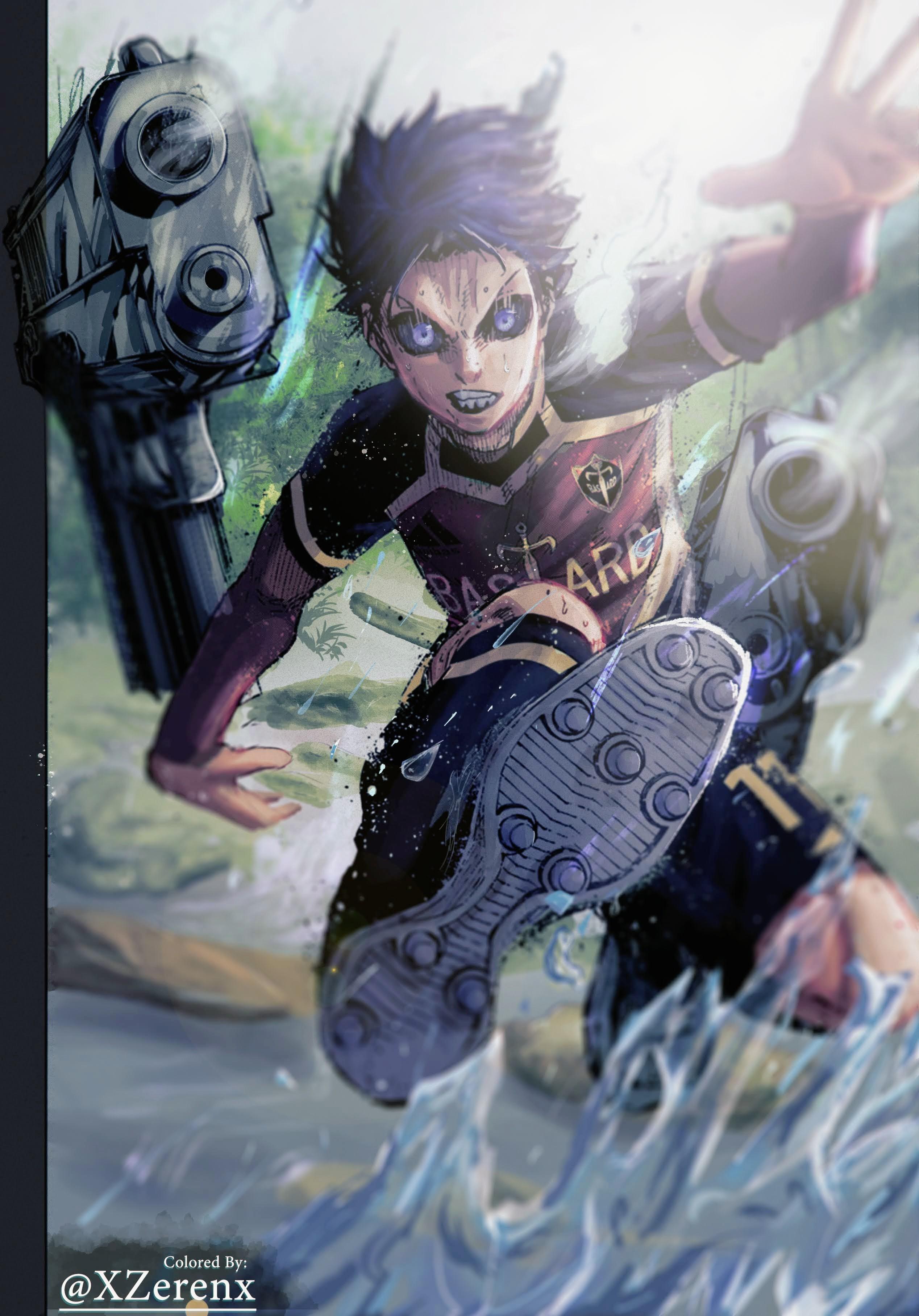
He finally did it. After hundreds of chapters of being the "adaptation guy" who relies on everyone else's scraps, Yoichi Isagi finally birthed a miracle. The Isagi two gun volley wasn't just a flashy move for a manga cover; it was a total structural shift in how we view the protagonist of Blue Lock. It's honestly kind of insane when you think about it. For years, fans complained that Isagi lacked "physicality" or a "finishing weapon" that could rival Kaiser or Rin. Then, in the heat of the Neo-Egoist League, he drops a piece of technical mastery that even the world’s best would struggle to replicate.
It happened during the Bastard München vs. Paris X Gen match. This wasn't just a game. It was a war for the title of the world's best striker. Isagi was being hunted. Ryusei Shidou, Rin Itoshi, and Michael Kaiser were all breathing down his neck, closing off every possible angle for his signature Direct Volley. He was cornered. Most players would have passed. Some would have folded. Isagi? He evolved.
The Mechanics of the Isagi Two Gun Volley
So, what is it exactly? Basically, it’s a mid-air feint combined with a double-touch strike that defies the usual laws of Blue Lock physics. Usually, Isagi’s "Direct Volley" requires him to hit the ball the second it touches his foot. No trapping. No extra touches. Just pure, unadulterated impact. But the Isagi two gun volley adds a layer of deception that nobody saw coming.
As the ball drops from the sky, Isagi leaps. He makes it look like he’s going for the standard right-footed volley. The defenders—specifically Rin and Kaiser—jump to block that exact trajectory. They’ve read his "reflex," or so they think. In mid-air, Isagi uses his left foot not to shoot, but to gently tap the ball, changing its height and momentum just enough to bypass the sliding blocks. Then, before his feet even touch the grass, he blasts it with his right.
Two feet. Two "guns." One goal.
It’s technically a "fake volley into a real volley," all performed without the ball ever hitting the pitch. If you’ve ever played actual football, you know how hard this is. Your core strength has to be elite. Your timing has to be frame-perfect. If you’re a millisecond off, you just kick air and look like a total idiot in front of thousands of fans. Isagi pulled it off against the best defenders in the world.
Why the Left Foot Mattered
For the longest time, Isagi was a one-trick pony. If you forced him onto his left side, he was toast. He knew it. We knew it. Kunigami knew it. That’s why the training arc leading up to this was so vital. Isagi didn't just wake up and decide to use his left foot; he spent weeks of grueling physical conditioning to develop a "secondary weapon."
The left foot isn't as strong as his right. It doesn't need to be. In the Isagi two gun volley, the left foot is the "silencer." It’s the setup. By proving he could use his non-dominant limb to manipulate the ball in mid-air, Isagi effectively doubled the number of variables defenders have to account for. You can’t just "shade him to his left" anymore. If you do, he’ll just use that left to set up a right-handed execution. Or vice versa. It’s a nightmare to defend.
Metavision Meets Physicality
We can’t talk about this goal without talking about Metavision. Honestly, Metavision is kind of a cheat code, but this goal proved that vision alone isn't enough. Isagi had the "eyes of a god," but his body was lagging behind. He could see the future, but he couldn't reach it fast enough to change it.
The Isagi two gun volley is the first time we see Isagi’s physical technique catch up to his mental processing. He saw the "blind spot" created by Rin and Kaiser’s dual pressure. He realized that they were both reacting to the expected timing of his shot. By introducing a "stutter" in mid-air—that second "gun"—he desynchronized their defense.
It’s like playing a rhythm game where the notes suddenly shift half a beat off-tempo. You’re going to miss. Rin missed. Kaiser missed. The ball hit the back of the net, and the hierarchy of Blue Lock shattered.
The Symbolic Death of the Old Isagi
Isagi used to be a player who survived. He was a scavenger. He looked for the "luck" piece. He looked for where the ball might land. With the Isagi two gun volley, he stopped waiting for luck. He started dictating the terms of the engagement.
This goal was a declaration. He wasn't just "the guy who passes to Kunigami" or "the guy who bothers Kaiser." He became a primary threat. The world took notice. The bid for his salary skyrocketed because scouts realized he wasn't just a smart player—he was a clinical finisher with a unique, high-difficulty skill set.
Breaking Down the "Two Gun" Logic
Think about the name for a second. Two guns. It implies a dual-wielding egoist. In the past, Isagi’s ego was often subsumed by others. He would "link up" or "devour." But "Two Gun" suggests a self-contained unit. He provides his own assist. He is both the passer and the scorer in the same motion.
- The First Gun: The left foot. It breaks the rhythm. It’s the feint that clears the path.
- The Second Gun: The right foot. The finisher. The "Direct Volley" evolved into its final form.
This isn't just a move; it's a philosophy. It tells us that Isagi has stopped trying to fit into the cracks of a team and has started creating his own space. It’s a bit scary, honestly. If he can do this, what’s stopping him from developing a "Three Gun" or a "Volley Revolver"? (Okay, maybe that’s pushing it, but you get the point.)
What This Means for the U-20 World Cup
Looking forward, the Isagi two gun volley changes everything for the Japanese national team. Before this, you could argue that Isagi was just a creative midfielder playing out of position. Now? He’s a legitimate Number 9.
Opposing teams in the upcoming U-20 World Cup can’t just mark him with one person. They can’t even just block his shooting lane. They have to account for the "delay." This move makes Isagi "un-blockable" in one-on-one aerial duels near the box. If a defender commits too early, the Two Gun Volley punishes them. If they wait, he just hits the Direct Volley. It’s a classic "damned if you do, damned if you don't" scenario.
The Rivalry Impact
Rin Itoshi’s reaction to this goal was priceless. Total shock. For the first time, Rin wasn't just annoyed; he was genuinely outplayed in a vacuum of his own making. He and Kaiser both tried to "sandwich" Isagi, thinking their combined gravitational pull would crush his options. Instead, Isagi used their presence as a screen, using the Isagi two gun volley to disappear and reappear in the only sliver of space available.
Kaiser, too, had to face a grim reality. His "Kaiser Impact" is faster, sure. It’s more powerful. But it’s predictable in its execution. Isagi’s new move is unpredictable. It’s "human" in its imperfection and "genius" in its adaptation.
How to Apply the Isagi Mindset
You don’t have to be a manga protagonist to take something away from the Isagi two gun volley. It’s basically a masterclass in overcoming a plateau.
- Identify the bottleneck. Isagi knew his right-foot dependency was his ceiling. He didn't ignore it; he spent the "off-season" fixing it.
- Add a layer of complexity. Don't just do the same thing better. Add a "fake." Add a second step. Change the timing of your delivery.
- Trust the "Reflex." This move wasn't calculated in the moment like a math problem. It was the result of thousands of repetitions becoming instinct.
The Isagi two gun volley is more than just a cool drawing in a weekly magazine. It represents the moment Blue Lock stopped being about a kid trying to catch up and started being about a king taking his throne. It’s high-level, high-stakes football, and honestly, we’re just lucky to be watching the evolution.
Next Steps for Blue Lock Fans
To truly understand the weight of this evolution, you should go back and re-read the Bastard München vs. Manshine City match. Look at how many times Isagi's right-footed direct volley was blocked by Prince or Kaiser. Note the frustration on his face. Then, skip forward to Chapter 250+ and watch the Isagi two gun volley frame-by-frame. The difference in his body positioning and confidence is night and day. Once you see the "before," the "after" becomes the most satisfying moment in the series.