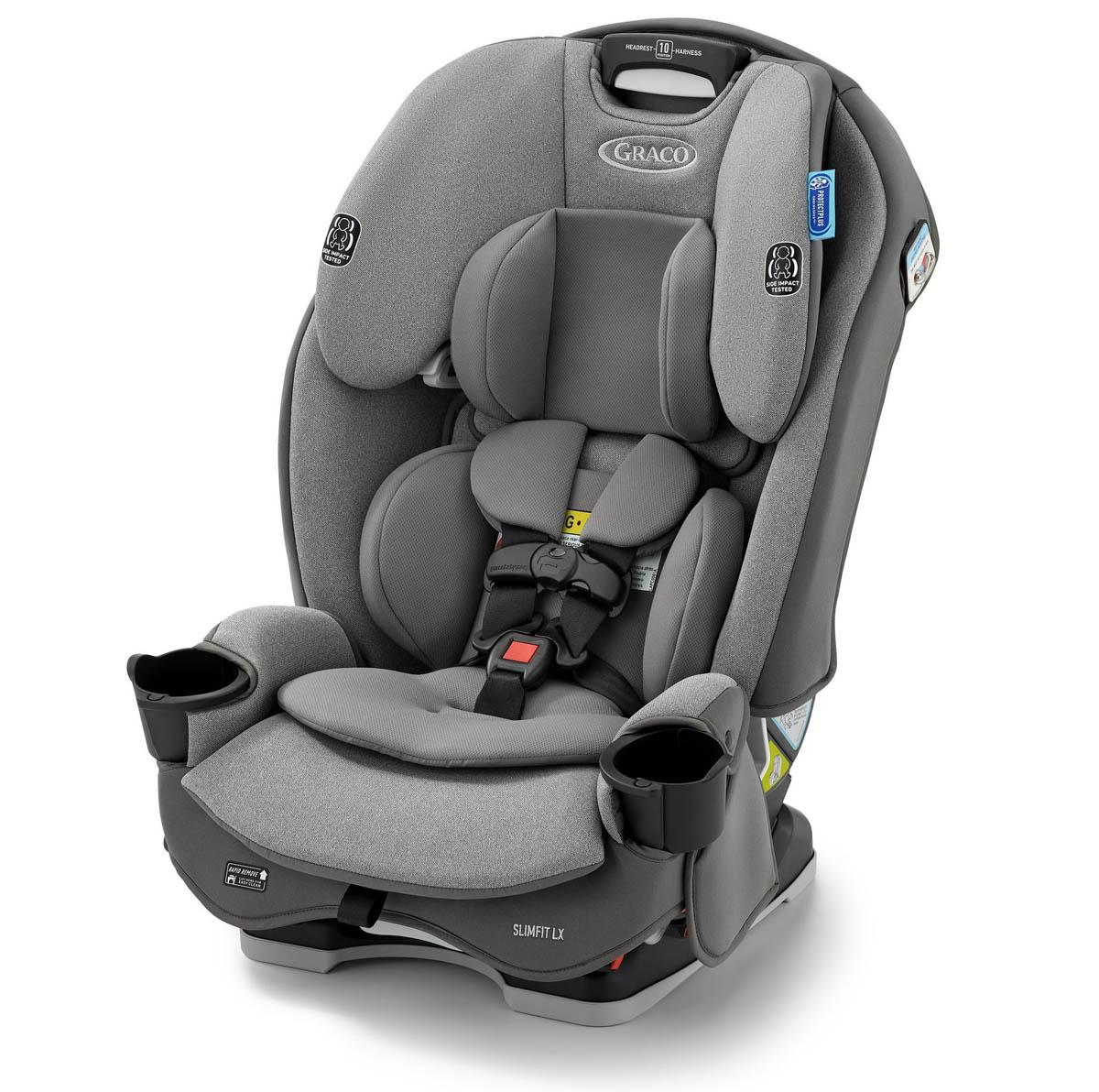
Let's be real. Buying a car seat is usually a headache. You walk into a big-box store, see a wall of plastic and foam, and basically hope for the best while staring at price tags that look like monthly mortgage payments. Most parents just want something that won't take up the entire back seat and, more importantly, keeps their kid safe without a doctoral degree in engineering to install it. That is exactly where the Graco SlimFit LX 3-in-1 convertible car seat enters the chat. It’s one of those rare pieces of gear that actually lives up to the marketing fluff, mostly because it addresses the "three-across" nightmare that haunts anyone with more than one child or a compact sedan.
I've seen plenty of seats that claim to be "space-saving" only to realize they just trimmed a centimeter off the cup holder. This isn't that.
The actual footprint of the Graco SlimFit LX 3-in-1 convertible car seat
The "SlimFit" name isn't just a catchy label; it's a literal description of the frame. Most standard convertible seats are chunky. They’re wide. They force the person in the middle seat to sit sideways like they’re on a crowded bus. This Graco model features rotating cup holders. You might think, "Big deal," but those two inches of saved space when you fold them inward are the difference between closing your car door and denting the interior panel.
It’s about 16.7 inches wide with those cup holders tucked away.
Compare that to some of the beastly All-in-One seats that push 19 or 20 inches. If you’re driving a Honda Civic or a Toyota Corolla, those extra inches are everything. It’s the difference between being able to fit a passenger in the back or telling your mother-in-law she has to take an Uber. Honestly, the LX version specifically adds a bit more "premium" feel than the base SlimFit, mostly in the fabrics and the inclusion of the TrueShield Technology for side-impact protection.
Does it actually grow with the kid?
Graco says this seat lasts ten years.
That’s a decade of spilled milk, crushed Cheerios, and the occasional "I don't feel so well" moment. The 3-in-1 designation means it handles rear-facing for the tiny ones (5 to 40 lbs), forward-facing with a harness (22 to 65 lbs), and eventually turns into a high-back belt-positioning booster (40 to 100 lbs).
Technically, it works. But here’s the nuance: while it can go up to 100 pounds, most kids are going to get too tall for the high-back booster before they hit that weight limit. It’s a great bridge, but don't expect it to be the last seat you ever buy if your child is hitting growth spurts like a sunflower. The height limit for the booster is 57 inches. Keep that number in your head.
Installation: The InRight LATCH situation
If you’ve ever broken a fingernail or bruised a knuckle trying to get a car seat tight enough that it doesn't wiggle, you'll appreciate the LX’s LATCH system. It uses the InRight attachment. It's basically a simple "click" connector rather than those horrible hook-style ones that require the grip strength of a rock climber to remove.
You push it onto the anchor. It clicks. You pull the strap. Done.
However, a common mistake people make with the Graco SlimFit LX 3-in-1 convertible car seat—and really any seat—is not checking the incline. Graco put a level indicator on the side. Use it. If the ball isn't in the right zone for your child's age, the seat isn't safe. It sounds obvious, but you’d be surprised how many people wing it because they're in a rush in a Target parking lot.
Safety tech and that "TrueShield" thing
We need to talk about what makes the LX different from the cheaper versions you see at Walmart. It’s the TrueShield Technology. Basically, these are extra protective pods on the side of the seat. In a side-impact collision, these are designed to absorb energy before it reaches the shell of the seat.
Is it a gimmick? Not really. Side-impact testing is becoming a much bigger deal in the industry. While all seats sold in the US have to meet federal safety standards (FMVSS 213), brands like Graco are adding these extra layers to satisfy parents who want more than just the "bare minimum." The seat is also steel-reinforced. It’s heavy. You’ll feel that weight the second you lift it out of the box. That’s a good thing for safety, but a bad thing if you plan on switching this seat between cars every single morning. If you’re a "one seat, one car" family, it’s perfect. If you’re traveling through airports? Maybe look for something lighter.
Comfort vs. Convenience: The parent's trade-off
Kids are picky. If the foam is too thin, they’ll complain on any drive longer than ten minutes. The LX has pretty plush padding. It also features the "Simply Safe Adjust" harness system. This is a game-changer. You don’t have to unthread the straps from the back of the seat as the kid grows. You just move the headrest up, and the harness moves with it.
It takes three seconds.
One thing that kinda bugs some people is the buckle. Sometimes Graco buckles can feel a bit stiff, especially when the seat is brand new. You might need two hands to pop it for the first few weeks. Also, while the cover is "Rapid Remove," don't expect it to come off in a heartbeat. It’s faster than older models, sure, but you’re still going to be wrestling with some elastic loops.
- Rear-facing: Use it as long as possible. The AAP (American Academy of Pediatrics) suggests staying rear-facing until the child reaches the maximum height or weight allowed by the seat.
- The Recline: There are four positions. Use position 1 for rear-facing infants. If you don't, their head might flop forward, which is a major airway risk.
- The "Pinch Test": Once the kid is buckled, try to pinch the webbing at the shoulder. If you can pinch a fold, it’s too loose.
Where the SlimFit LX falls short
No product is perfect. Let's be honest about the flaws.
First, the "Slim" part only applies to the width. The seat is still quite deep. If you have a very small car and you put this rear-facing, the front passenger might find their knees pressed against the dashboard. It’s a common issue with all convertible seats, but the SlimFit doesn't magically solve the front-to-back space problem.
Second, the cup holders. They rotate, which is great for space. But because they are round and somewhat shallow, some of those oversized toddler "toddler-proof" water bottles won't sit securely in them. They might fly out during a sharp turn.
What to do next: A practical checklist
If you're leaning toward the Graco SlimFit LX 3-in-1 convertible car seat, don't just hit "buy" yet. Take a tape measure to your car. Measure the distance from the back of your driver's seat to the back of the rear seat. If you have less than 30 inches, you're going to have a tight squeeze in the rear-facing position.
Check your car's manual for LATCH weight limits. Most cars have a limit (usually around 65 lbs total for the child and the seat combined). Once your kid hits a certain weight, you have to stop using the LATCH system and switch to using the vehicle's seat belt to secure the car seat. For the SlimFit LX, you'll likely need to switch to a seat belt installation once the child hits 45 lbs.
Lastly, register the seat. I know, it's a boring postcard or a web form. Do it anyway. If there is a safety recall, you want to be the first to know, not the last person finding out via a Facebook post six months later.
Moving forward with your purchase
- Measure your back seat width to ensure that 16.7 inches actually leaves enough room for your other passengers or seats.
- Verify the manufacture date on the box when it arrives; car seats have expiration dates (usually 10 years for this model), and you want a fresh one.
- Practice the installation in your driveway before you actually need to go somewhere with the baby. Use the "towel trick" only if the manual explicitly allows it to achieve the correct recline angle.
- Keep the manual tucked into the storage pocket on the seat itself. You’ll need it in three years when you forget how to convert it to a booster.
The Graco SlimFit LX 3-in-1 convertible car seat is a workhorse. It isn't the fanciest seat on the market—it doesn't have load legs or anti-rebound bars like some of the $500 European models—but for most families, it hits that "Goldilocks" zone of safety, size, and price. It’s a solid investment that genuinely solves the problem of a cramped back seat without compromising on the stuff that actually matters during a crash.