It is that high, frantic note. If you’ve ever sat through the Broadway production of Catch Me If You Can, or even just looped the cast recording on Spotify, you know the one. It is the sound of a man realizing the party is over. When Aaron Tveit, originating the role of the legendary con artist Frank Abagnale Jr., belts the goodbye catch me if you can lyrics, it isn't just a clever musical theater number. It’s a breakdown.
Most people think of the 2002 Spielberg film when they hear the title. You picture Leonardo DiCaprio in a pilot’s uniform, flashing a grin that says, "I'm smarter than you." But the musical, with a score by Marc Shaiman and Scott Wittman, does something the movie couldn't quite capture. It turns Frank's flight into a televised variety show. And "Goodbye" is the moment the cameras stop rolling.
The Story Behind the Final Song
The context matters. Frank has been running for years. He’s been a doctor, a lawyer, a co-pilot. He’s lived a thousand lives before he could legally buy a beer. But by the time we get to the "Goodbye" lyrics, the FBI—specifically Agent Carl Hanratty—has him cornered in a printing press in Perpignan, France.
The song serves as the emotional climax. It’s a 11-o’clock number in the truest sense. In musical theater terminology, that’s the big, show-stopping song where the protagonist has a major realization. Frank realizes that the "live in living color" fantasy he’s been spinning is just... thin air.
Honestly, the lyrics are pretty heartbreaking. You’ve got this kid who started all of this just because his parents got a divorce and he wanted to win enough money to bring them back together. By the end, his father is dead, his mother has moved on, and he's standing alone in a cold French factory.
Breaking Down the Goodbye Catch Me If You Can Lyrics
The song starts out almost defiant. Frank is talking to the "audience"—the imaginary one in his head and the real one in the seats. He says, "I'm not gonna say I'm sorry." It's classic Frank. Brazen. Cocky. He’s spent the whole show telling us that if you don't like the story you're in, you just change the channel.
But then the bridge hits.
The tempo shifts. The brass section in the orchestra starts to swell, and the lyrics move from "I'm leaving you" to "I have nowhere to go." That’s the pivot. When he sings about how he's "flying high" but "looking down at the clouds," he’s acknowledging the vertigo of his own life.
Why the High B4 Matters
If you’re a theater nerd, you talk about the "Goodbye" high note. It’s a B4 (and sometimes pushed higher in live riffs). Why is that important for the lyrics? Because the physical strain of the singer mirrors the psychological strain of the character. Frank is literally straining to keep the facade up.
A lot of people look up the lyrics because they want to understand that specific moment of surrender. He sings, "I've got no more tricks up my sleeve." For a guy whose entire existence was built on sleight of hand, that’s a massive admission. It’s the first honest thing he says in the entire show.
Shaiman and Wittman’s Genius
The songwriting duo behind Hairspray did something sneaky here. They used 1960s variety show tropes to mask a deep, dark character study. If you listen to "Goodbye" right after "Live in Living Color," the contrast is wild.
"Live in Living Color" is all major chords and bright energy.
"Goodbye" uses those same themes but twists them into minor keys and dissonant harmonies.
It’s meta. The lyrics reference the act of performing itself. He talks about the "curtain call" and the "final bow." He’s basically telling Hanratty, "Okay, you caught the performer, but you still don't know the man."
Common Misconceptions About the Song
Wait, is this song in the movie? No. That’s a big point of confusion. John Williams’ score for the film is masterpiece-level jazz, but it’s instrumental. You won't find Frank Abagnale Jr. singing about his feelings in the Spielberg version.
Another thing people get wrong is the "villain" aspect. In the lyrics, Frank doesn't sound like a criminal. He sounds like a lost child. Shaiman and Wittman wrote the song to make us root for the guy who just spent two hours defrauding banks and breaking hearts. It works because the lyrics focus on the why rather than the how.
The Impact of Aaron Tveit’s Performance
You can't talk about the goodbye catch me if you can lyrics without mentioning Aaron Tveit. His version is the gold standard. The way he phrased the line "I'm gonna leave the way I came" suggests a full circle. He started with nothing, and he's ending with nothing.
Later actors like Norbert Leo Butz (who played Hanratty) provided the foil, but the song is a solo marathon. It requires a specific type of "pop-theater" vocal that can sound both effortless and like it’s about to break.
Performance Stats and Cultural Reach
- Original Broadway Run: 166 performances.
- Tony Awards: 4 nominations (including Best Musical).
- Streaming: The song consistently ranks as one of the most-played tracks on the cast album, often outperforming the upbeat numbers.
Learning the Lyrics for Auditions
If you’re a tenor looking at this song for an audition, be careful. It’s a trap. The lyrics are conversational, which means if you sing it too "pretty," you miss the point. You have to sound like you’re running out of oxygen.
The phrasing of "Goodbye, see ya 'round, I'm off to find another town" needs to feel like a reflex. He’s been saying some version of that his whole life. It’s only in the final repetition that the weight of the word "Goodbye" actually sinks in.
The Reality vs. The Musical
The real Frank Abagnale Jr. has had a complicated relationship with his own story. While the musical paints this poetic picture of his capture, the reality involved a lot more legal paperwork and less singing. However, the emotional truth in the lyrics—the exhaustion of the chase—is something the real Frank has alluded to in various interviews and his autobiography.
He once noted that the most tiring part wasn't the running; it was the constant need to be someone else. That’s exactly what the song captures. The lyrics are an invitation to finally stop acting.
How to Analyze the Lyric Structure
If we look at the internal rhymes, Shaiman and Wittman use a lot of "cliché" show-biz talk to illustrate Frank's shallow world. "The lights," "the stage," "the crowd." But as the song progresses, the imagery gets more grounded. He stops talking about the "show" and starts talking about the "cold."
It is a brilliant bit of lyrical architecture. It strips the character naked.
Actionable Steps for Musical Fans
If the goodbye catch me if you can lyrics are stuck in your head, there are a few ways to dive deeper into this specific era of musical theater.
- Listen to the "Live in Living Color" Reprise: It’s often overlooked, but it sets the stage for "Goodbye" by showing the first cracks in Frank’s armor.
- Compare the "Jet Set" Energy: Watch a clip of "Jet Set" and then "Goodbye." Pay attention to the choreography. In the first, he's leading the pack; in the second, he's a stationary target.
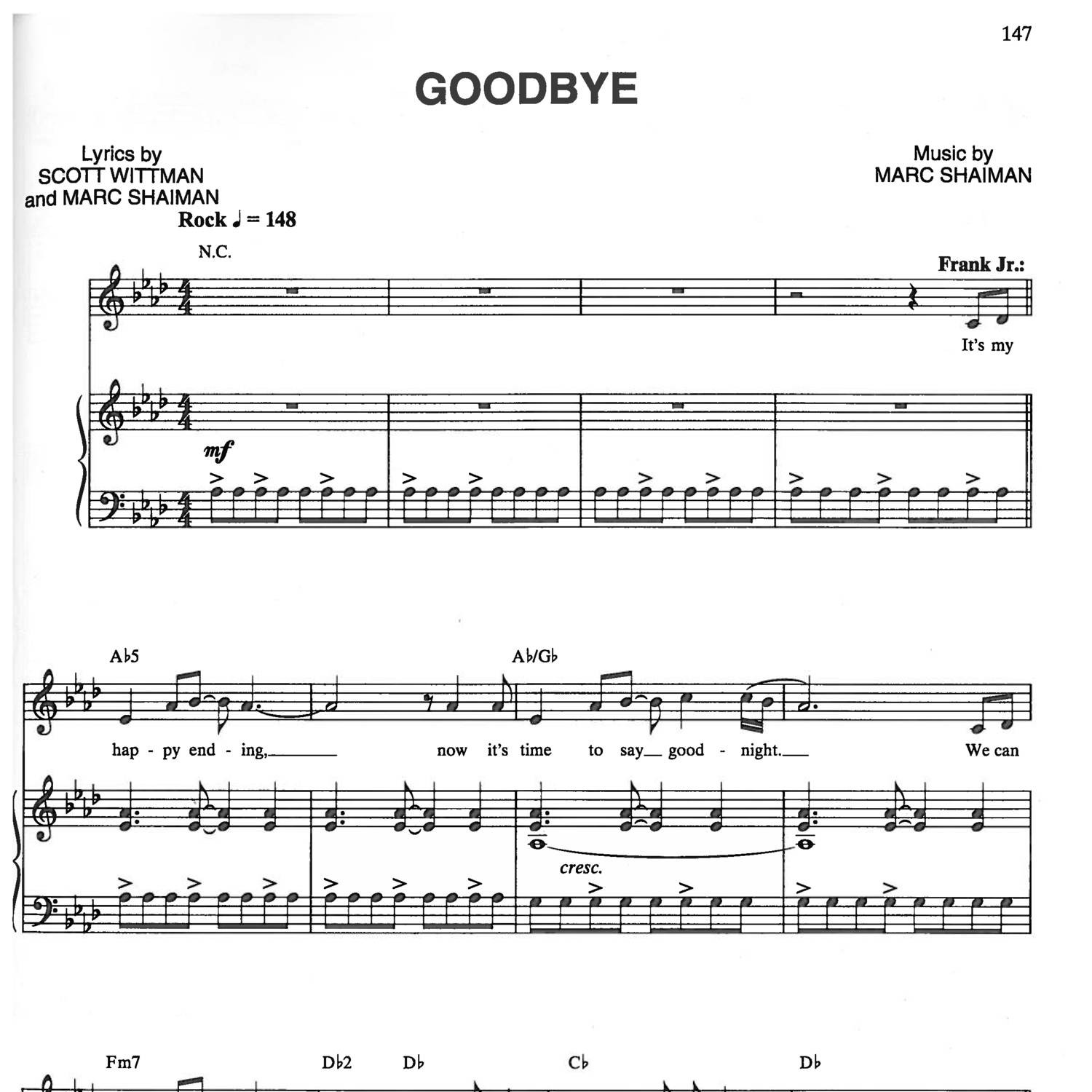
- Study the Sheet Music: If you’re a musician, look at the key changes in the final third of the song. Each modulation marks a moment where Frank tries to "reset" his confidence before eventually failing.
- Watch the 2011 Tony Awards Performance: It’s the definitive live version of the song that shows exactly how the lyrics translate to a massive stage.
The song remains a staple because it taps into a universal fear. Not the fear of being caught by the FBI, but the fear of what happens when you run out of versions of yourself to play. When the music stops and the lyrics end, you’re just left with you. And for Frank, that was the scariest part of all.
Check out the original cast recording if you want to hear the nuance in the lyrics that often gets lost in cover versions. Pay close attention to the way the orchestration drops out right before the final belt—it's a moment of pure, unadulterated vulnerability.
Next Steps for Enthusiasts:
To truly understand the lyrical depth, read Frank Abagnale Jr.'s actual autobiography. You’ll find that while the musical takes liberties with the timeline, the "Goodbye" sentiment—the sheer fatigue of the con—is rooted in Frank's real-life experience of being a young man who just wanted to go home.