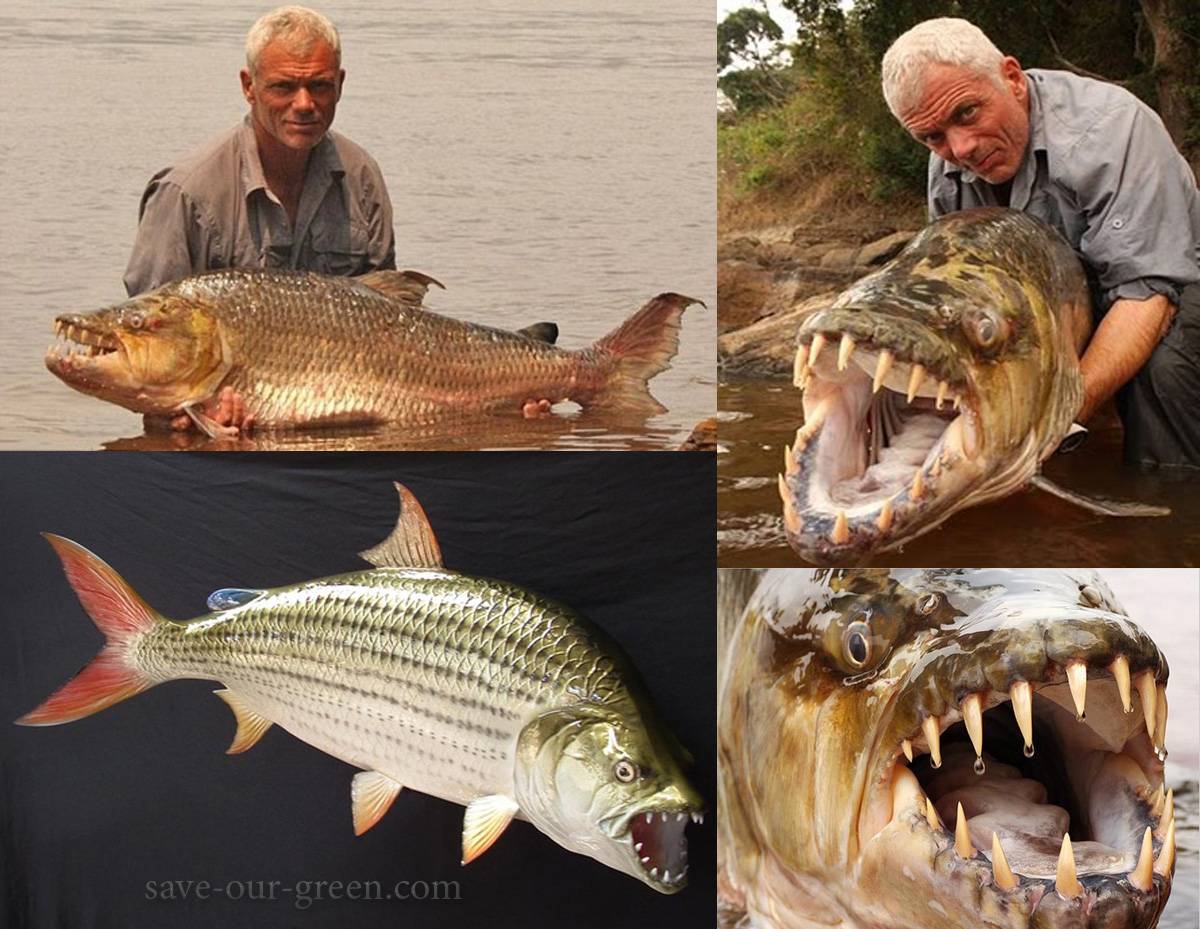
You’ve probably seen the photo. It’s a bit grainy, dating back to 2010, showing a man with sun-bleached hair and a look of pure, exhausted triumph. He’s holding a fish that looks like a piranha designed by a committee of horror movie directors. That man is Jeremy Wade, and the beast in his arms is the goliath tigerfish.
Honestly, that single episode of River Monsters changed how a lot of us look at freshwater. It wasn't just another fishing show. It felt like a dispatch from a place where the rules of nature were different.
The Congo River is a weird, violent stretch of water. It's deep—the deepest in the world, actually—and it hides things that shouldn't logically exist. When Wade set out to find the "mbenga," as the locals call it, he wasn't just looking for a big fish. He was chasing a ghost that supposedly ate people and took chunks out of crocodiles.
The Beast with Great White Teeth
Let’s get the biology out of the way because the reality is cooler than the myth. The goliath tigerfish (Hydrocynus goliath) is basically a giant African tetra. But unlike the little neon tetras in your home aquarium, this thing grows to 5 feet long and can weigh 110 pounds.
The teeth are the main event.
They aren't just sharp; they're massive. We’re talking about an inch long. Wade famously pointed out that they are roughly the same size as the teeth of a Great White Shark. Because the fish has no lips, these daggers just sit there, exposed, interlocking like a biological bear trap.
It’s a specialized killing machine.
Evolution didn't give it those teeth for nibbling on algae. It hits prey with a thunniform body—that’s a fancy way of saying it’s built like a tuna for high-speed bursts. In the turbulent, oxygen-rich rapids of the Congo, the goliath tigerfish is the undisputed king. It’s one of the few fish that isn't intimidated by a crocodile. In fact, they've been known to take bites out of them.
Why the Jeremy Wade Catch Was Different
Before Wade’s expedition, very few Westerners had ever seen a goliath tigerfish in the flesh, let alone caught one on a rod and reel. Most of the "evidence" was blurry photos or tall tales from colonial-era explorers.
Wade spent eight days on that river. Eight days of brutal heat, malaria risks, and the constant threat of civil unrest in the region. He wasn't staying in a five-star lodge. He was basically camping on the mud.
When he finally hooked the monster, it wasn't a clean fight. These fish are notorious for having "bony" mouths. Setting a hook into a goliath tigerfish is like trying to drive a nail into a piece of seasoned oak. Most of the time, the fish just opens its mouth, the hook slides out, and it vanishes back into the brown water.
But this one stayed on.
The Part They Didn't Show (Enough)
There’s a bit of a controversy—or maybe just a misunderstanding—about what happened after the cameras stopped rolling. In most River Monsters episodes, Wade is a stickler for catch-and-release. He’s a biologist at heart. He wants the fish to live.
But the goliath tigerfish episode was different.
The fish he caught didn't survive. By the time it was reeled in after a grueling battle in the heat, it was essentially spent. More importantly, the local guides and villagers saw the fish as a "bad omen" or, conversely, a massive source of protein. In a place where people are literally starving, you don't throw 100 pounds of meat back into the river because of a Western conservation ideal.
Wade eventually handed the fish over to the village. It fed dozens of people. It’s a stark reminder that while we watch these shows for "entertainment," for the people living on the banks of the Congo, the goliath tigerfish is a very real, very dangerous part of their economy and folklore.
Is the Goliath Tigerfish Actually a Man-Eater?
This is what everyone wants to know. Does it actually eat people?
The short answer: Sorta.
There are documented reports of "mbenga" attacking humans. But it’s not like they’re hunting us. The Congo is murky. If you’re splashing around and wearing something shiny—like a watch or a brass ring—the fish sees a flash of light and thinks "prey." It strikes instinctively.
One bite from those teeth can sever a femoral artery or take off a hand. Wade interviewed locals who had horrific scars from these encounters. It’s a "reflex" predator. It hits first and asks questions later.
Lessons from the River
If you're an angler or just a fan of the show, there are a few things to take away from the saga of goliath tigerfish jeremy wade:
- Respect the environment: Wade didn't just show up and throw a line. He spent weeks learning the local myths and water conditions.
- Gear matters: You can't catch a 100-pound tigerfish with a standard bass rod. He was using heavy-duty tackle and steel leaders that could withstand those razor-sharp teeth.
- The "Monster" is often a Mirror: The fear of the goliath tigerfish often says more about our fear of the unknown (the Congo) than the fish itself. It's a predator, sure, but it's also a vital part of a fragile ecosystem.
If you ever find yourself in Central Africa—which, honestly, is a tall order for most—don't go swimming with jewelry on. And maybe keep your hands inside the boat.
The best way to "experience" this fish is still probably through a screen, watching a younger, slightly more stressed-out Jeremy Wade try to hold onto a living dinosaur in the middle of a thunderstorm. It’s a lot safer that way.
To really understand the impact of this catch, you should look into the conservation efforts currently happening in the Congo Basin. While the goliath tigerfish isn't currently listed as endangered, its habitat is under constant threat from pollution and damming. Supporting organizations like the World Wildlife Fund (WWF) that focus on African river systems is the best next step for anyone who wants to ensure these "monsters" stay in the water for another few million years.