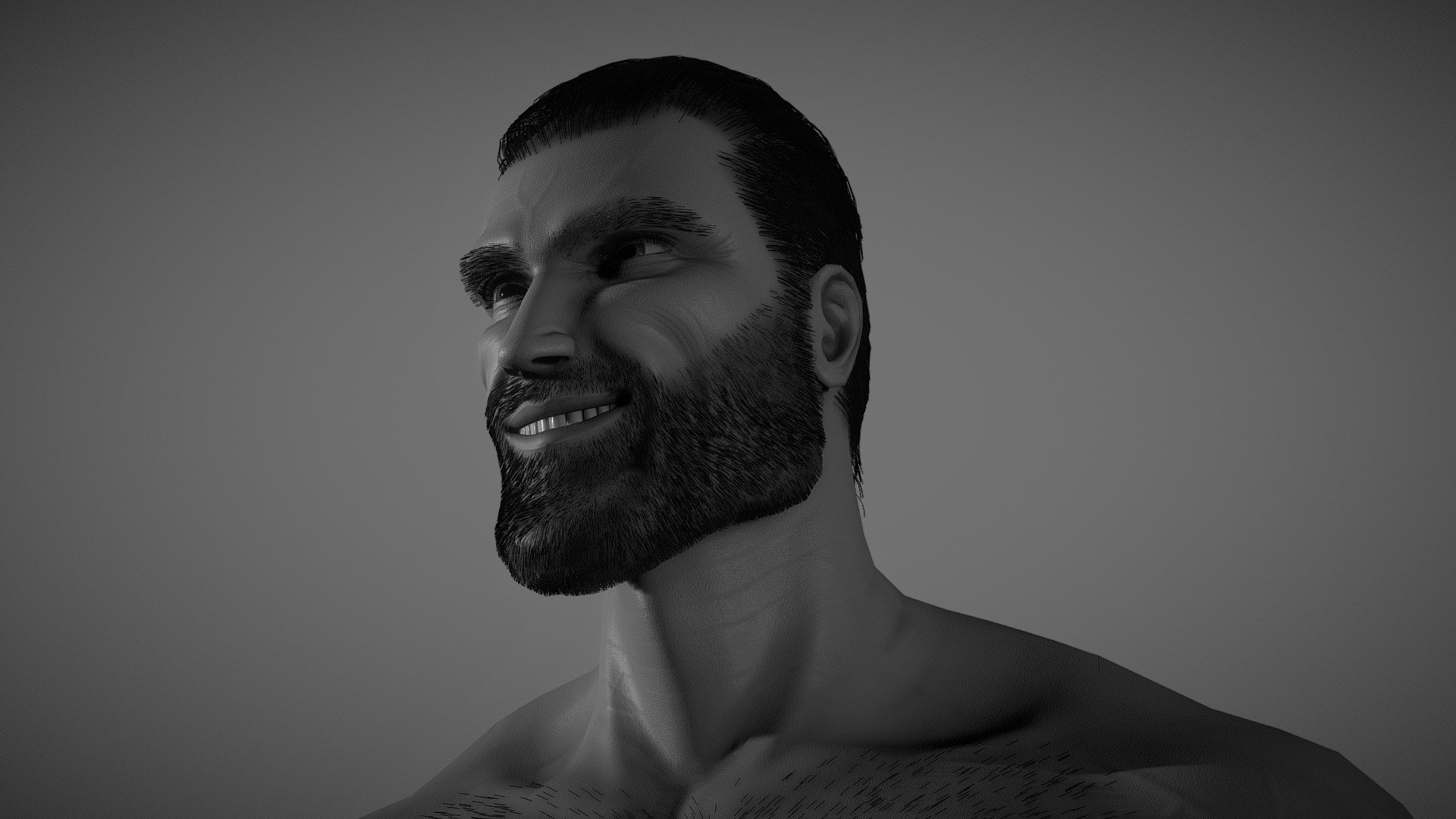
You've seen him. The jawline that could cut glass, the muscles that look like they were chiseled by a Renaissance master, and that monochrome, brooding stare. He is everywhere. In 2026, the image is still the universal shorthand for "peak performance" or the ultimate "alpha." But behind the memes and the heavy metal phonk music tracks lies a weirdly complicated story about digital art, Russian photography, and a guy named Ernest Khalimov who might—or might not—actually exist in the way we think he does.
Gigachad isn't just a picture. It’s a phenomenon.
Where the Gigachad Meme Actually Started
Back in 2017, the internet stumbled upon a series of photos from a project called Sleek'n'Tears. The project was the brainchild of Russian photographer Krista Sudmalis. Her work focused on an extreme, almost hyper-masculine aesthetic. She wanted to capture the "archetype" of the male form. Enter Ernest Khalimov. He was presented as the primary model for these shoots.
When these images hit 4chan and Reddit, people lost their minds. They didn't even call him a person at first; they thought he was a CGI creation meant to represent the platonic ideal of a "Chad." You know the Chad—the guy from the "Virgin vs. Chad" memes who is inexplicably confident and physically dominant.
Honestly, the transition from "impressive fitness model" to "Gigachad" was instant. Users took his already extreme physique and photoshopped it. They made the jaw wider. They made the muscles even more defined. They turned a human being into a living statue. It’s funny because while most memes die in a week, this one has lived for nearly a decade. Why? Because it taps into a weird mix of irony and genuine admiration for self-improvement.
Is Ernest Khalimov Real?
This is the big question. It’s the rabbit hole.
For years, people argued that Ernest Khalimov was a digital composite. Some internet detectives pointed out that in every photo, his pose was nearly identical. Others noticed that the skin texture looked a bit too much like a high-end 3D render. However, an Instagram account under the name @berlin.1969 eventually started posting. The person behind the account—ostensibly Ernest—responded to the fame with a surprising amount of grace and humility.
He basically told the internet that he’s just a "normal person" (which is hilarious given he looks like an action figure) and that he doesn't mind the memes. But here is the catch: there is almost zero video footage of him. No interviews. No "day in the life" vlogs. In an era where everyone is chasing clout, the most famous face on the planet remains a ghost.
Krista Sudmalis has maintained that he is real. She claims he is one of her models. Yet, the consensus among many digital forensic enthusiasts is that while a model likely exists, the "Gigachad" we see is heavily stylized through post-production. It’s a blend of a real human and a digital dream. He is a "hyper-real" entity. He exists in that uncanny valley where we can't quite tell where the skin ends and the pixels begin.
The Cultural Shift: From Irony to "Based"
Initially, the Gigachad was a joke. It was a way to mock people who tried too hard to be masculine.
Then things changed.
The internet started using the image to represent "based" opinions. If you had a controversial take but delivered it with total confidence and zero regard for what others thought, you were a Gigachad. It became a symbol of stoicism. There’s this specific brand of humor where people pair the image with mundane but incredibly "alpha" behavior.
- "Yes, I do enjoy spending time with my parents on a Friday night. How could you tell?"
- "I don't care about the meta; I play the character I think looks cool."
It moved from being about looks to being about a state of mind. It’s about being unapologetically yourself. In 2026, we see this everywhere in "Phonk" culture on TikTok and YouTube Shorts. The music is loud, the bass is distorted, and the Gigachad is there to remind you to hit the gym and stop complaining.
The Physical Standards and the "Chad" Archetype
We have to talk about the biology of it, even if it's exaggerated. The Gigachad features what researchers often call "high-T" markers.
- The Gonial Angle: That sharp, 90-degree jawline.
- The Zygomatic Bones: High, prominent cheekbones that create shadows.
- The Brow Ridge: A heavy, masculine brow that gives that intense "hunter" stare.
In evolutionary psychology, these traits are often linked to high testosterone levels. Whether or not the model has these naturally or they were brushed in via Photoshop, they trigger a primal recognition in our brains. It’s why the image is so effective as a meme. You don't need a caption to know what that face represents.
Why the Meme Refuses to Die
Most memes have a shelf life of about three months. Bad Luck Brian, Overly Attached Girlfriend—those are relics of a different era. But Gigachad is different. It’s because he isn't just a person; he's a template.
He is the "Average Fan vs. Average Enjoyer" guy. You've seen the split-screen videos. On the left, a frantic guy is screaming about something trivial (the Fan). On the right, Gigachad is calmly existing, usually set to "Can You Feel My Heart" by Bring Me The Horizon (the Enjoyer).
This format is infinitely repeatable. You can apply it to politics, gaming, movies, or even what kind of milk you put in your coffee. It provides a shorthand for superiority that feels playful rather than aggressive. It’s a way for people to feel good about their niche interests.
The Dark Side of the Aesthetic
It’s not all just funny pictures and gym motivation. There is a darker side to the Gigachad phenomenon, specifically in "looksmaxxing" communities.
For some young men, the Gigachad isn't a joke—it's a literal goal. This has fueled a rise in body dysmorphia. People spend thousands on "jawline exercisers" or even plastic surgery (genioplasty and jaw implants) to mimic a look that was likely created in a Russian photo studio with a lot of lighting tricks and editing software.
It’s important to remember that the image is art. Krista Sudmalis didn't set out to create a health manual; she set out to create a visual masterpiece. When we mistake the art for the reality, things get weird. The "real" Ernest Khalimov, if he is indeed the man in the photos, is an extreme outlier. He is the 0.00001%.
Navigating the Gigachad Legacy
So, what do we actually do with this? How do we view the Gigachad in a way that’s healthy and, well, "based"?
First, appreciate the irony. The best part of the meme is that it's over-the-top. It’s a caricature of masculinity, not a blueprint. If you’re using it to motivate yourself to get off the couch, that’s great. If you’re using it to feel inferior because you don't have a chin that can break rocks, you're missing the point.
Second, understand the digital nature of fame. Gigachad proves that in the 2020s, you don't even need to be "real" to be the most influential person in the room. You just need the right aesthetic at the right time.
How to use the "Gigachad" Mindset Productively
If you want to actually take something away from this, ignore the jawline and look at the "Average Enjoyer" philosophy.
- Stop seeking validation: The Enjoyer doesn't care if his hobby is "cringe."
- Stay calm: The meme is rooted in stoicism. When the world is screaming, the Chad is silent.
- Focus on the internal: Fitness is good, but the "Gigachad" vibe is really about confidence.
To dive deeper into where this fits in your life, start by looking at your own consumption. Are you the "Average Fan" getting worked up over internet drama, or are you the "Enjoyer" who just likes what they like? Making that mental shift is worth more than any jawline exercise.
Check out the original Sleek'n'Tears portfolio if you want to see the artistic roots. It puts the meme into a much different, more professional context. You'll see that it was never about the jokes—it was about the shadows, the lines, and the raw power of the human form, even if it was "enhanced" for the camera.
The most "Gigachad" thing you can actually do is be comfortable in your own skin, pixels or no pixels.
Next Steps for the Truly Curious
- Research the "Average Fan vs. Average Enjoyer" history: Trace how the meme evolved from a specific set of photos to a global comparison template.
- Explore the Phonk Genre: Listen to the music that gave the meme its "voice," specifically artists like KORDHELL or Hensonn.
- Audit Your Digital Perception: Look at other "hyper-real" influencers and see if you can spot the line between human and digital enhancement.