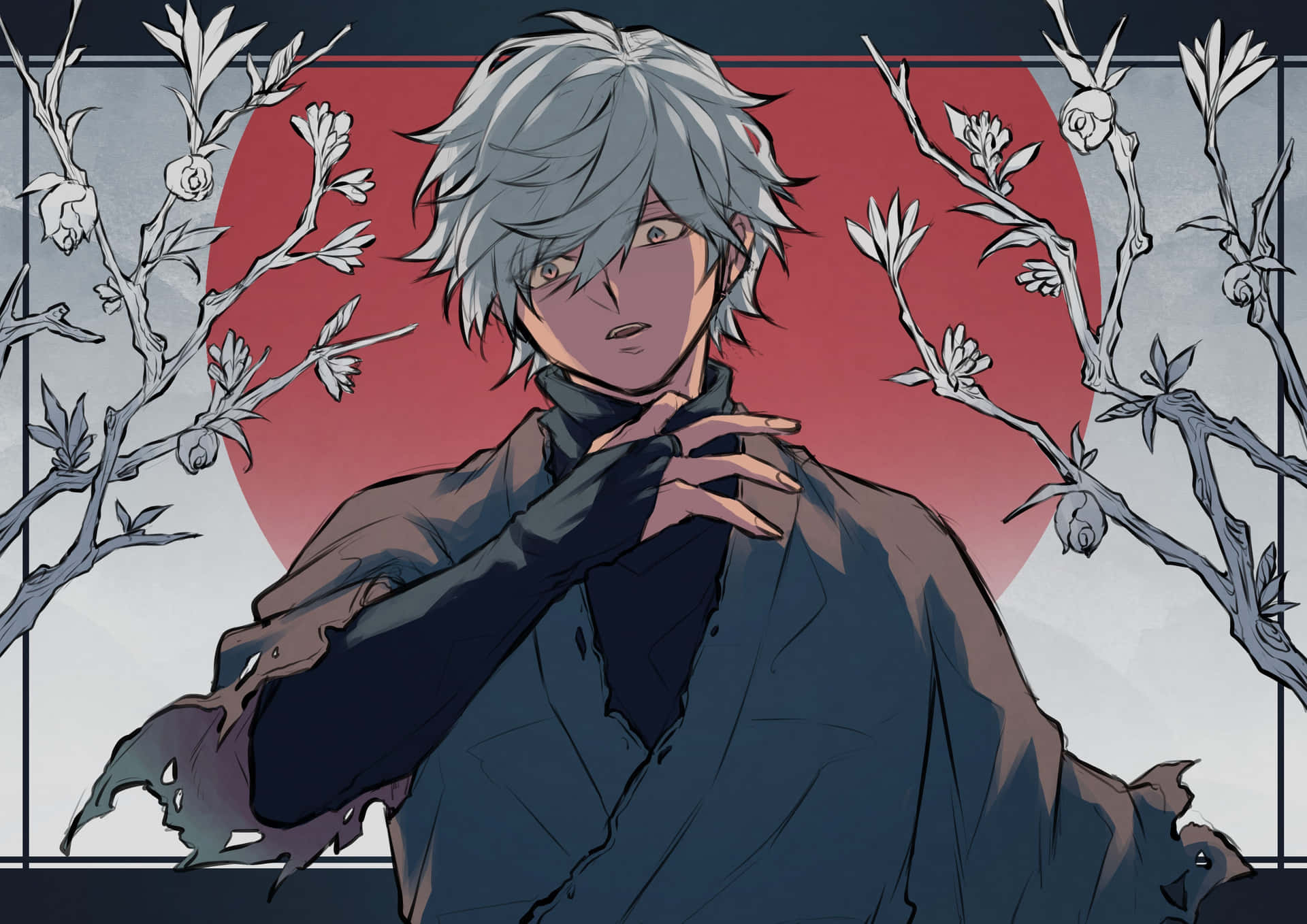
He sits there. Bound by thick ropes, staring blankly while executioners try—and fail—to take his head. It’s a bizarre start for a story, but that’s exactly how we meet Gabimaru, the Hell’s Paradise main character who managed to flip the script on what a "bad guy" protagonist looks like in modern manga and anime.
Most people expect a protagonist in a dark fantasy series to be either a starry-eyed idealist or a brooding edge-lord with no personality. Gabimaru is neither. He’s a mass murderer. He’s a husband. He’s a guy who just wants to go home and eat daikon with his wife.
The Myth of Being Hollow
Gabimaru’s name isn't even Gabimaru. It’s a title. In the village of Iwagakure, "Gabimaru the Hollow" is a moniker passed down to the most effective, cold-blooded shinobi in the corps. When we first see him, he claims to feel nothing. No emotion, no attachment to life, no fear of the blade at his neck. But he's lying to himself.
You see it in the way he subconsciously resists execution. Fire won't burn him. Blades snap against his neck. Boiling oil feels like a lukewarm bath. His body is reacting to a will to live that his mind hasn't fully admitted to yet. It’s this internal friction that makes him such a compelling Hell’s Paradise main character. He’s a man conditioned to be a tool, struggling with the inconvenient fact that he actually has a soul.
Honesty time: most shonen leads gain power through the "power of friendship." Gabimaru’s power comes from a desperate, almost obsessive love for his wife, Yui. She’s the daughter of the village chief, and she’s the one who looked at this "hollow" monster and treated him like a human being. That’s his whole motivation. He’s not trying to become the Hokage or the Pirate King. He just wants a domestic life.
Why Shimoneta Works Where Others Fail
The dynamic between Gabimaru and his executioner/handler, Yamada Asaemon Sagiri, is the heartbeat of the series. It’s not a romance, at least not in the traditional sense. It’s a professional partnership built on mutual observation. Sagiri is the only one who sees through his "hollow" act.
She realizes that his strength doesn't come from being heartless, but from the immense burden of his emotions. This is a massive subversion. Usually, in series like Jujutsu Kaisen or Chainsaw Man, characters get stronger by leaning into their darker impulses. Gabimaru gets stronger by accepting his vulnerability.
When they land on Shinsenkyo—that terrifying, flower-infested island—the stakes shift. It's not just about killing monsters; it's about balance. The concept of Tao is introduced, and it's basically the series' power system. But unlike Dragon Ball Z where you just scream louder to get more energy, Tao requires a balance of opposites. Strength and weakness. Stillness and movement. Life and death.
Because Gabimaru is naturally a killer but desperately wants to be a lover, he’s uniquely suited to master this. He’s a living contradiction.
The Brutal Reality of Iwagakure
If you want to understand why Gabimaru is the way he is, you have to look at the "training" he endured. Yuji Kaku, the creator of the manga, didn't shy away from the horror of the Iwagakure village. Children were forced to kill each other. They were subjected to physical conditioning that bordered on the supernatural.
Gabimaru isn't "overpowered" because of a magic fox or a special bloodline. He’s a survivor of extreme child abuse and systemic brainwashing.
- He can dislocate his limbs to escape restraints.
- His skin is as tough as armor due to constant scarring and healing.
- He uses fire-based ninjutsu (Hibashi) that essentially turns his body heat into a weapon.
It's grim. It's nasty. But it makes his desire for a peaceful life feel earned rather than just a plot point. When he talks about his wife, you actually believe him because you’ve seen the hell he wants to escape.
Mastering Tao and the Transformation of a Killer
The island of Shinsenkyo is a death trap designed to turn humans into "Tan" (an elixir of life). As the Hell’s Paradise main character, Gabimaru has to evolve or die. This evolution isn't just about learning new moves. It's about a mental breakdown.
Midway through the story, Gabimaru suffers from memory loss. He reverts to his "hollow" state—the emotionless killer he was before meeting Yui. This is one of the most stressful arcs for fans. Watching him lose the humanity he fought so hard to find is heartbreaking. But it’s also where we see his peak martial prowess. Without the "clutter" of his heart, he’s a god of war.
However, the story makes a very clear point: the Hollow Gabimaru is weaker than the Human Gabimaru.
Without his connection to Yui and his comrades, his Tao becomes unstable. He burns himself out. It’s a beautiful metaphor for burnout and the necessity of human connection. You can’t survive on spite and skill alone. You need a reason to come back.
Is He Truly a Hero?
Let's be real. Gabimaru has killed hundreds of people. The show doesn't hand-wave this away. He isn't "forgiven" by the world just because he's the protagonist. The weight of his sins follows him into every fight. This moral complexity is why Hell's Paradise stands alongside Berserk or Vinland Saga in terms of character depth.
He’s a man seeking atonement, but he knows some things can’t be fixed. His goal isn't to be a "good person"; it’s to be a person who is allowed to exist in peace.
What You Should Do Next
If you're looking to truly grasp the journey of the Hell’s Paradise main character, don't just stop at the anime. The MAPPA production is stunning, but the manga’s art style by Yuji Kaku has a scratchy, visceral energy that perfectly captures Gabimaru’s mental state.
- Read the Manga from Chapter 1: Even if you've seen the anime, the internal monologues in the early chapters provide much more context on his "Hollow" persona.
- Analyze the Tao System: Pay close attention to the elemental cycle (Wood, Fire, Earth, Metal, Water). Understanding which characters counter Gabimaru's fire element explains why certain fights are harder for him than others.
- Watch the Tensen: Contrast Gabimaru’s growth with the antagonists, the Tensen. They are immortal and "perfect," yet they are stagnant. Gabimaru’s mortality is his greatest advantage because it forces him to adapt.
Gabimaru proves that a protagonist doesn't need to be likable in the beginning to be someone you'll eventually root for with everything you've got. He's a reminder that even the most broken tools can find a purpose beyond their design.