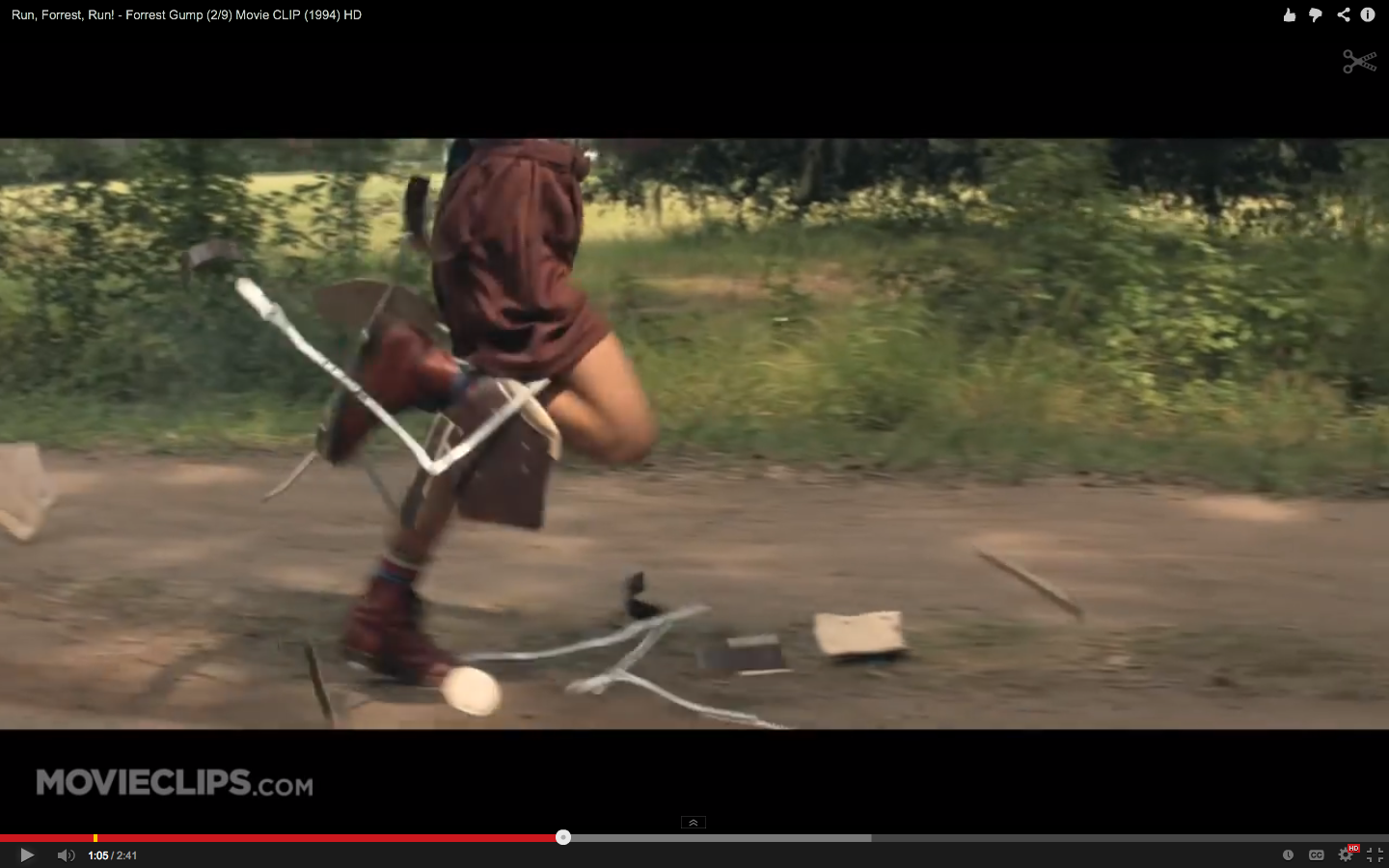
Everyone remembers the moment. Young Forrest is hobbling down a dirt road, gravel crunching under heavy metal, while a truckload of bullies tosses rocks at his head. Jenny screams those three famous words—"Run, Forrest, run!"—and suddenly, the impossible happens. The metal snaps. The leather straps burst. Forrest Gump in leg braces becomes Forrest Gump the track star in a shower of cinematic sparks.
It’s a beautiful scene. Honestly, it’s one of the most cathartic moments in movie history. But if you look at it through a realistic lens, or even compare it to the original book, things get a little weirder.
The "Magic" Behind the Metal
In the movie, the explanation for the braces is pretty straightforward. The doctor tells Mrs. Gump that Forrest’s back is "as crooked as a politician," though his legs are actually strong. To fix his spine, he’s fitted with these heavy, clunky orthopedic devices.
Here’s the thing: those weren’t just random props. They were modeled after real-life KAFO (Knee-Ankle-Foot Orthoses) used in the mid-20th century. Usually, these were for kids dealing with the aftermath of polio or severe scoliosis.
Why the "Breakaway" Scene is Actually Scientific (Sorta)
A lot of people think the braces shattering like glass was pure Hollywood magic. Well, it was. Braces don't just explode because you run fast.
However, there’s an interesting fan theory that actually holds some weight. Because Forrest spent years "fighting" against the resistance of the metal joints—which didn't want to bend—his leg muscles were essentially doing heavy resistance training with every single step. When the braces finally failed under the stress of a full sprint, his legs were basically "overpowered." He wasn't just running; he was unleashed.
- The Actor: Michael Conner Humphreys played young Forrest. He actually walked with a bit of a hitch in real life, which Tom Hanks later adopted for the adult version of the character.
- The Inspiration: The scene where Forrest dances for Elvis while wearing the braces? That was a cheeky way to suggest Forrest’s stiff-legged movement inspired the King of Rock and Roll’s famous hip gyrations.
- The Tech: In 1994, the "shattering" effect was a mix of practical props and early digital editing to make the pieces fly off just right.
Did it happen in the book?
Short answer: No.
Winston Groom’s original 1986 novel is a lot darker and stranger than the Robert Zemeckis film. In the book, Forrest doesn't really have the "crooked spine" issue that requires the iconic leg braces. He’s just a big, neurodivergent guy who happens to be a savant at math and playing the harmonica.
The movie added the braces to give him a physical "underdog" journey to match his mental one. It creates a visual metaphor for breaking free from the things that hold us back. Without Forrest Gump in leg braces, we don’t get that iconic transition from "handicapped" kid to All-American football star.
The Reality of 1950s Orthopedics
If you talk to anyone who actually wore these things in the 50s or 60s, they’ll tell you they weren't exactly "miracle" devices. They were heavy. They chafed.
Real-life braces of that era were made of steel and thick leather. They were designed to lock the knee in place to prevent collapsing. If you tried to run in them like Forrest did, you’d most likely just trip and faceplant into the dirt. But that’s the power of cinema—it takes a cold, clinical medical tool and turns it into a symbol of liberation.
Legacy of the Braces
Today, you can actually find replicas of the Forrest Gump in leg braces on display in various movie museums. One set of the screen-worn braces even sold at auction for thousands of dollars.
For many people with disabilities, that scene is a double-edged sword. On one hand, it’s inspiring. On the other, it feeds into the "supercrip" trope—the idea that a person with a disability just needs to "try harder" to suddenly be "cured." It’s important to remember that for most people, the braces don't just fall off. They are a vital part of daily life and mobility.
Moving Beyond the Screen
If you’re a fan of the film or a student of cinema, there are a few things you should actually do to appreciate this piece of history more deeply:
- Watch the "Magic Legs" scene again: Notice how the adult Lieutenant Dan (Gary Sinise) mirrors Forrest's journey. Forrest gets "magic legs" through a miracle; Dan gets them through titanium technology.
- Compare the book vs. movie: Grab a copy of Winston Groom's Forrest Gump. It’s a wild ride that involves Forrest going to space with a monkey. Seriously.
- Research the Polio era: To understand why audiences in 1994 found the braces so resonant, look into the history of the Salk vaccine and the "iron lung" era. The fear of childhood paralysis was a very real, very recent memory for the Boomer generation watching the film.
The image of Forrest Gump in leg braces remains one of the most enduring symbols of the 90s. It’s about more than just a kid running; it’s about the moment we all wish for—the moment the weights we carry finally just snap and let us fly.