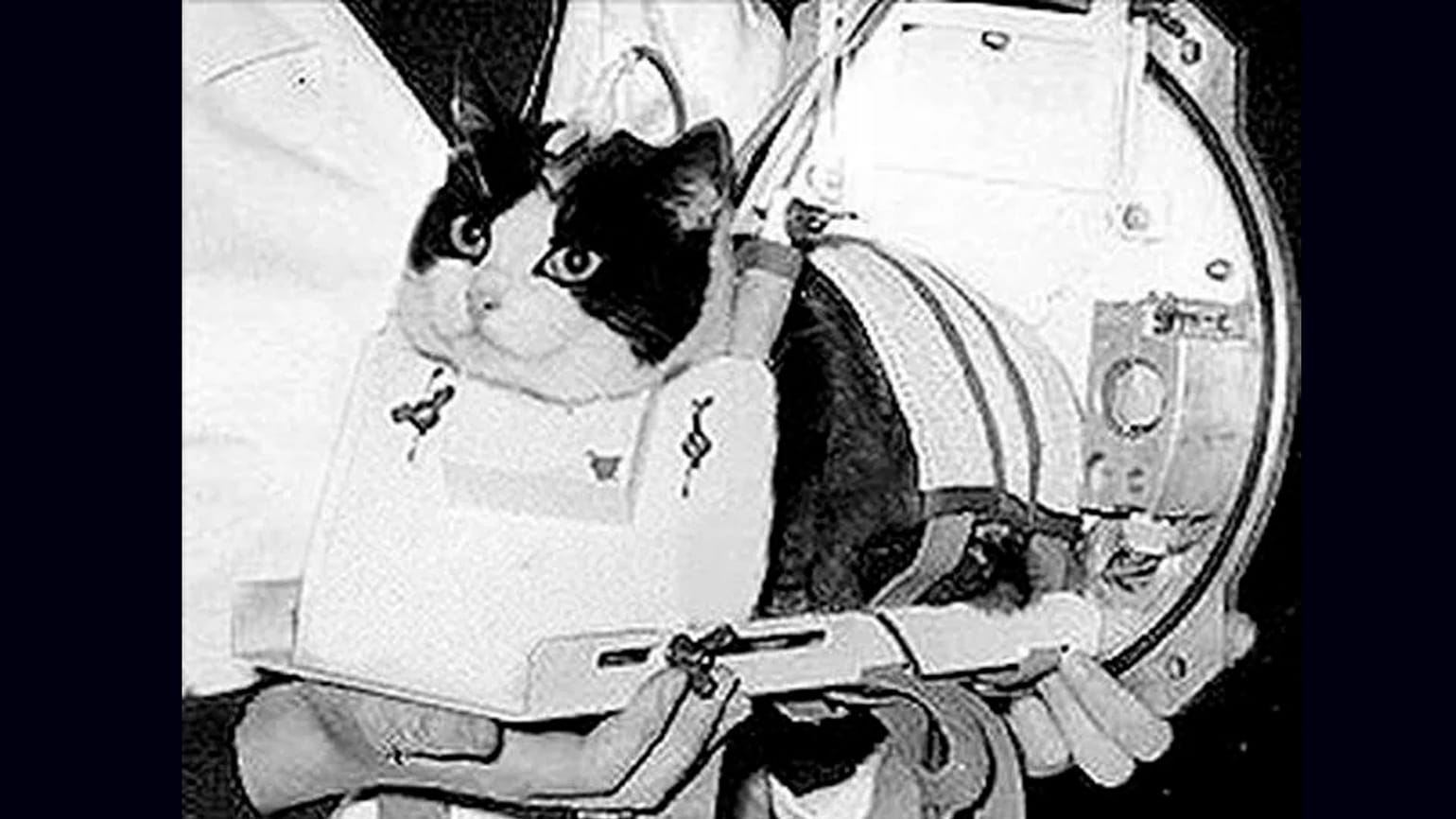
Everyone knows Laika. The stray dog from Moscow who became a global icon, even if her story is heartbreakingly tragic. Then there’s Ham the Astrochimp, whose face is plastered on every "space history" poster in school hallways. But then we have Félicette. She was a tuxedo cat from the streets of Paris who, in 1963, did something no other feline has ever done before or since. She went to space. She didn't just go, though; she came back.
It’s kinda weird that she’s a footnote. Seriously. While the US and the Soviets were busy measuring their rockets, France was quietly running their own program, the Centre d'Enseignement et de Recherches de Médecine Aéronautique (CERMA). They weren't looking for a hero. They were looking for data. They wanted to know how the vestibular system—that's the inner ear stuff that keeps us balanced—handled weightlessness. Cats have incredible biological balance. So, naturally, the French space program went out and bought 14 cats from a pet dealer.
Félicette was one of them. Back then, she didn't even have a name. She was just "C 341."
The Rigorous, Kinda Cruel Training of C 341
The French scientists were serious. They weren't just putting a cat in a box and hoping for the best. These 14 cats went through "flight school," which was basically a feline version of the Right Stuff. They were spun in centrifuges. They were kept in small containers for hours on end to see if they’d freak out.
Most of them did.
Imagine being a cat and being subjected to the roar of simulated engines and high G-forces. It sounds like a nightmare. C 341 was different. She was calm. She stayed chill while the other cats were losing their minds. This lack of "emotional reactivity" is ultimately why she was chosen for the mission. Scientists also surgically implanted electrodes into her brain to monitor her neurological activity. It’s a grim detail, but it's the truth of 1960s science. They wanted to see the brain waves, not just the heart rate.
October 18, 1963: Félicette Becomes the First Cat in Space
The launch happened at the Colomb-Béchar rocket base in the Algerian Sahara. It wasn't a fancy orbital flight like John Glenn's. It was a suborbital hop.
At 8:09 AM, a Véronique AGI sounding rocket ignited.
Félicette was strapped into a container in the nose cone. The rocket pulled 9.5 Gs. Think about that for a second. That is nearly ten times the force of gravity pressing down on a small, five-pound animal. She soared to an altitude of 157 kilometers (about 97 miles). For five glorious, or terrifying, minutes, she drifted in total weightlessness.
While she floated, those electrodes were busy. They recorded her brain activity, sending data back to Earth that showed she was in a state of hyper-vigilance during the ascent, followed by a period of profound sensory confusion in zero-G. Then, the descent. The capsule detached, the parachutes deployed, and she drifted back down to the desert sands.
The recovery team found her alive. She was a celebrity, sort of. The press dubbed her "Astrocat," and eventually, the name Félicette stuck, inspired by the cartoon character Felix the Cat.
Why the World Forgot a Space Pioneer
You’d think a space-faring cat would be a permanent fixture in history books. Instead, she vanished.
There are a few reasons why.
- The French program wasn't trying to win a "race." They were doing niche biological research.
- The imagery wasn't "cute." Most photos of Félicette show her with the electrode plug visible on her head, which isn't exactly PR-friendly.
- She didn't stay alive long.
Two months after her return, the scientists euthanized her. They needed to examine her brain to see if the flight had caused any physical damage to the tissue. It’s the cold, hard reality of early space exploration that we often gloss over. It wasn't about the animal’s life; it was about the autopsy.
The 50-Year Silence and the Bronze Revival
For decades, if you Googled "first cat in space," you might find a few grainy photos and a Wikipedia stub. People actually started getting her confused with a male cat named Felix. There was this weird urban legend that a cat named Felix escaped on launch day and C 341 was a last-minute replacement.
That’s actually a myth. Felix never existed.
The real push to remember Félicette started in 2017. A guy named Matthew Serge Guy started a Kickstarter campaign to build a permanent memorial for her. He realized it was absurd that Laika had statues and Félicette had nothing. He raised over $50,000.
Today, if you visit the International Space University in Strasbourg, France, you’ll see a bronze statue of a cat perched on top of a globe, looking up at the stars. That’s her.
Lessons From the Feline Frontier
What did we actually learn from Félicette? Honestly, she proved that mammals—even those with highly sensitive balance mechanisms—could survive the transition to and from weightlessness without immediate neurological collapse. This paved the way for more complex biological experiments in later years.
If you're looking for the "so what" of this story, it’s about the cost of progress. Félicette didn't choose to be a pioneer. She was a stray who ended up in a lab, then in a rocket, then in a bronze statue.
Next Steps for History Buffs and Space Enthusiasts:
- Visit the Memorial: If you’re ever in Strasbourg, head to the International Space University. The statue is a powerful reminder of the animals that paved the way for human astronauts.
- Audit the Data: You can actually find the declassified CERMA reports if you dig into the French National Archives. They detail the exact neurological responses recorded during the flight.
- Support Animal Ethics in Research: Use Félicette’s story as a jumping-off point to look into how NASA and ESA have shifted toward non-invasive monitoring for modern biological studies on the ISS.
- Fact-Check the Myth: Next time you hear someone mention "Felix the Space Cat," politely correct them. Names matter, and Félicette earned hers through 9.5 Gs of pure grit.
The era of sending domestic pets into the thermosphere is over, but the data Félicette provided is still tucked away in the foundations of aerospace medicine. She wasn't just a cat; she was the proof that life could handle the void.