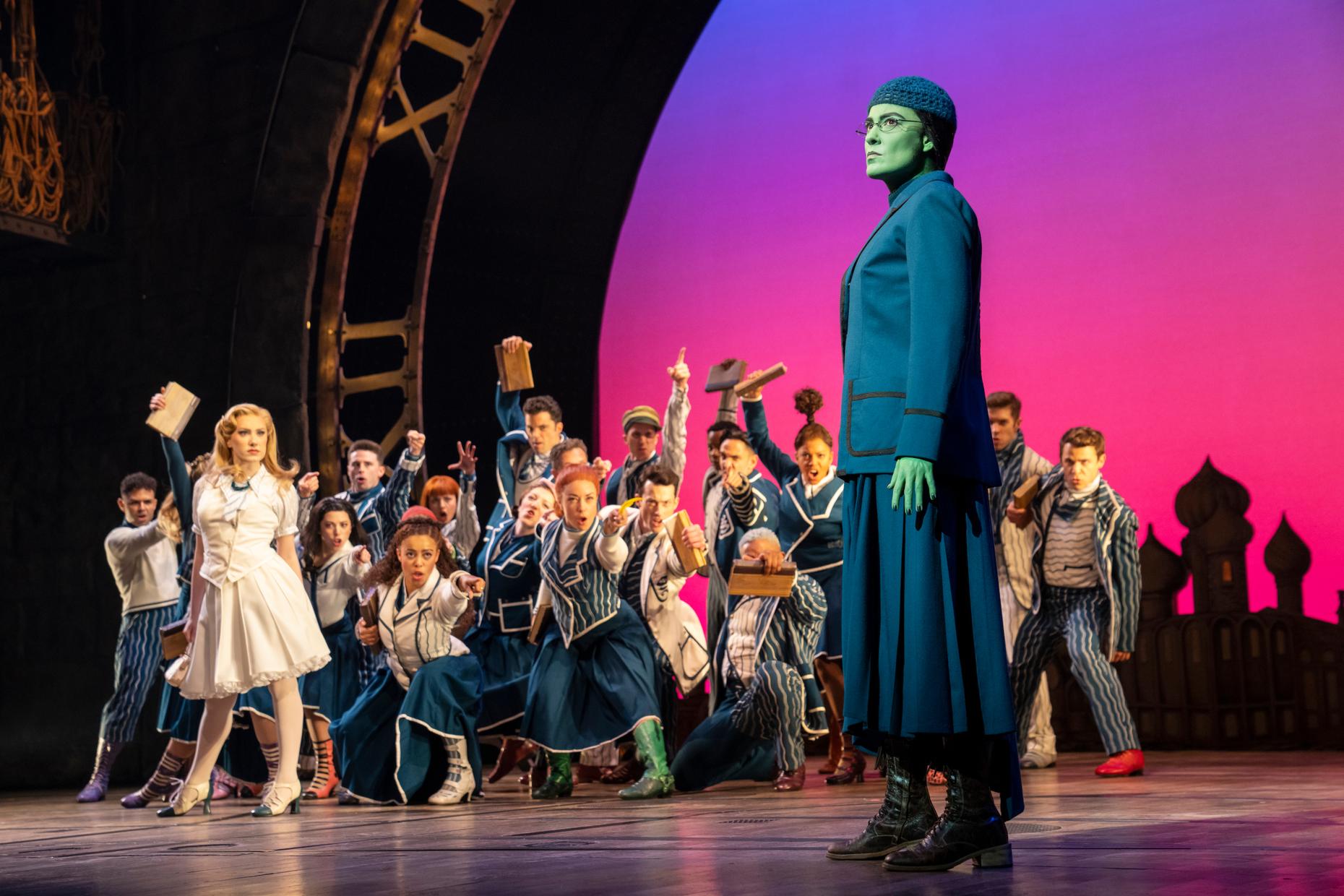
If you’ve seen the Broadway show or the 2024 film adaptation, you probably spent the first half of the story thinking Fiyero Tigelaar was just a shallow prince with a penchant for "Dancing Through Life." He's the guy who seemingly has everything—the looks, the status, and the girl (Glinda, at least initially). But the real kicker in Gregory Maguire’s reimagining of Oz is the tragic, beautiful transformation that redefines everything we thought we knew about the 1939 classic.
In the world of Wicked, who turns into the scarecrow is a question with a deeply emotional answer: it's Fiyero.
It isn't a random occurrence or a curse from a villain. It’s a desperate act of love. When Elphaba is cornered and Fiyero is captured by the Gale Force guards at Kiamko, she performs a spell to save his life. The irony? She thinks she failed. She believes he's dead, or worse, suffering. In reality, she changed his very nature to protect him from the pain of the physical world.
The Moment Fiyero Becomes the Scarecrow
The shift happens during a chaotic sequence in the second act. Fiyero, having fully defected from the Ozan regime to be with Elphaba, allows himself to be captured so she can escape. As the guards drag him away to be tortured for information on Elphaba’s whereabouts, she is miles away, clutching her Grimmerie.
She chants a spell intended to make him "impervious to pain."
She’s frantic. The lyrics in "No Good Deed" capture this perfectly. Elphaba is spiraling, convinced that every good intention she’s ever had has resulted in disaster. She literally sings, "Let his bones never break, let him never feel the pain again."
You've got to realize that in the original L. Frank Baum books, the Scarecrow is just a being brought to life by a bit of luck and some magic stuffing. In Wicked, the Scarecrow is a man who was literally un-made so he couldn't be killed. When Fiyero is beaten and presumably left for dead by the guards, the magic takes hold. His skin becomes burlap. His insides become straw. He loses his human form but retains his soul—and his love for the woman the world calls the Wicked Witch.
Why the Movie and Musical Handle This Differently
While the core beat remains the same, the visual execution varies. In the stage play, we don't see the physical transformation happen. We see the guards take him, and later, a Scarecrow appears to help Elphaba escape the melting. It's a "reveal" moment.
The 2024 film, directed by Jon M. Chu and starring Cynthia Erivo and Ariana Grande, leans heavily into the emotional weight of this sacrifice. In the cinematic version, the stakes feel even higher because we see the political machinery of Oz moving against Fiyero. He isn't just a love interest; he’s a political dissident.
Honestly, the tragedy is that Glinda has to watch this happen too. She’s the one who inadvertently puts the guards on their trail, thinking she's helping, only to realize she’s contributed to the "death" of the man she loved. It’s messy. It’s human. It’s exactly why Wicked has stayed relevant for decades.
Debunking the Myths About the Scarecrow's Origin
A lot of casual fans get confused about the timeline. They ask, "Wait, if Fiyero is the Scarecrow, how does he not recognize Dorothy later?"
In the context of the Wicked universe, Fiyero is playing a very long game. He has to stay in disguise. If the Wizard or Madame Morrible knew he survived, they’d go after Elphaba again. By the time Dorothy Gale drops her house on Nessarose, Fiyero has been living as a "brainless" straw man to stay under the radar.
- Myth 1: Fiyero was cursed by the Wizard. False. He was transformed by Elphaba’s protection spell.
- Myth 2: He actually lost his brain. False. The "no brain" bit is an act he puts on for Dorothy and the others to avoid suspicion. He’s actually quite brilliant, or at least strategically sound.
- Myth 3: It’s a permanent tragedy. Not exactly. The ending of the musical shows them reuniting, proving that while he's made of straw, he's still very much "him."
The Symbolism of the Straw Man
There is something incredibly poetic about a "shallow" prince becoming a man made of the humblest materials.
Early in the story, Fiyero claims he wants to be "brainless." He prides himself on not thinking too hard because thinking leads to caring, and caring leads to pain. By the end, the universe grants his wish in the most literal, twisted way possible. He becomes a creature that technically cannot think in the human sense, yet he's the only one wise enough to sacrifice everything for the truth.
Maguire’s original novel is much darker than the musical. In the book, Fiyero is actually murdered by the Gale Force, and his transformation into the Scarecrow is more of a metaphorical/spiritual suggestion rather than the literal "he’s definitely the guy" ending of the Broadway show. However, for the millions who know the story through the stage and screen, the literal transformation is canon. It’s the ultimate "happily ever after" for two people who the world refused to let be happy.
What This Means for Future Oz Stories
If you're following the new film cycle, the revelation of who turns into the scarecrow in Wicked serves as the emotional pivot for the entire second half of the story. It changes the way you look at the 1939 film. Suddenly, the Scarecrow’s journey to find a brain isn't just a whimsical quest; it’s a cover story for a political refugee who lost his humanity to save the woman he loved.
Next time you watch the sequence where Elphaba is "melted," look at the Scarecrow. In the Wicked continuity, he isn't just a bystander. He’s the architect of her escape. He knows about the trap door. He knows she isn't really dead.
The Scarecrow is the secret hero of Oz.
Identifying the Transformation in the Wild
To fully appreciate the narrative arc of Fiyero's transition, pay attention to these specific details in the production:
- The Costume Cues: Look at Fiyero’s captain of the guard uniform. In many stage productions, the patches or colors of his uniform are subtly mirrored in the Scarecrow’s rags later on.
- The "No Good Deed" Lyrics: Listen closely to the Latin-esque chanting Elphaba does. It isn't gibberish. It's a specific set of instructions to the forces of Oz to alter Fiyero's physical composition.
- The Final Scene: Notice how the Scarecrow moves. In the final moments of the musical, his gait changes from the clumsy "straw man" stumble to a more confident, regal walk that mirrors Fiyero’s entrance in Act 1.
The best way to experience this is to compare the "Dancing Through Life" sequence with the "No Good Deed" sequence back-to-back. You see the evolution of a character from a man who refuses to take a stand to a man who literally gives up his skin to stand by the person he loves. It's a masterclass in character subversion.
Check out the original Gregory Maguire novel if you want the grittier, more political version of this transformation, though be warned: it’s significantly less "magical" and much more tragic than the version you see on Broadway. For those sticking to the films, keep an eye on how Part 2 handles the physical transition—it's expected to be a major visual centerpiece of the sequel.