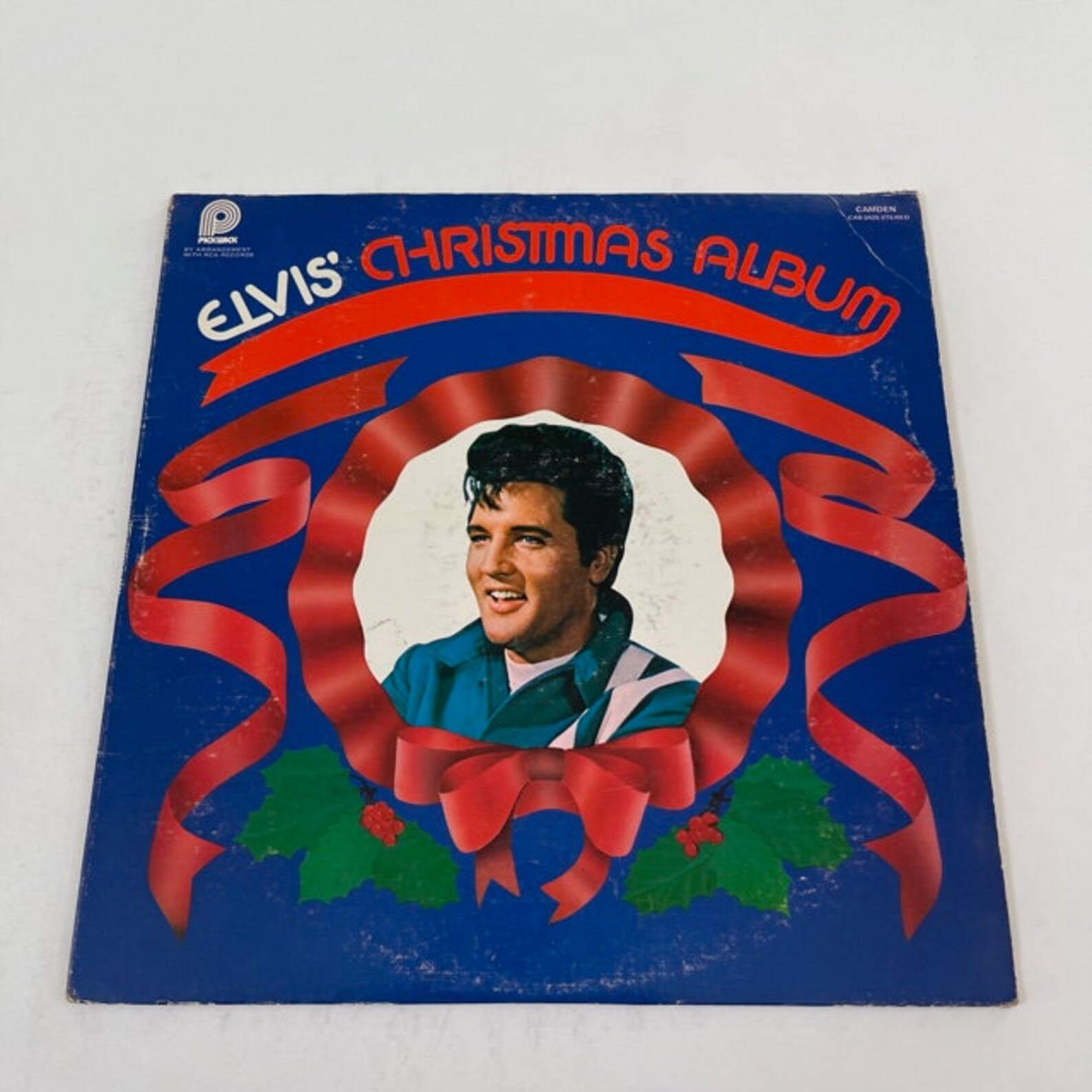
You’re digging through a crate of old vinyl at a flea market and you see it. The King. He’s looking sharp in a dark suit, leaning against some festive greenery. It says Elvis' Christmas Album. You check the back—it's RCA Camden. You might think you’ve found a rare holiday gem from the turn of the decade, but the story of the Elvis' Christmas Album 1970 release is actually a bit of a chaotic marketing scramble.
It wasn't a new recording. Not even close.
By 1970, Elvis Presley was back on top of the world thanks to his 1968 Comeback Special and his residency in Las Vegas. He was "The King" again. RCA, his label, wanted to squeeze every dime out of that regained momentum. Their solution? Take the legendary 1957 holiday tracks, strip away some of the "gospel" songs that were on the original LP, toss in a couple of non-holiday tracks from a 1966 session, and slap a budget price tag on it.
It’s a weird piece of music history. It’s also one of the best-selling holiday albums of all time, despite being a Frankenstein-style reissue.
Why RCA Messed With Perfection
The original 1957 Elvis' Christmas Album was a masterpiece of rock 'n' roll meets traditional crooning. It had "Blue Christmas," "Santa Bring My Baby Back (To Me)," and those incredible gospel numbers like "Peace in the Valley." But by 1970, the industry was moving toward "budget" lines. RCA Camden was their specific label for cheaper, shorter records aimed at casual shoppers in drugstores or grocery stores.
To make the Elvis' Christmas Album 1970 version fit the budget format, they chopped the tracklist down. They removed the four gospel tracks that rounded out the 1957 original. Why? Likely because they wanted to keep it strictly "Christmas" and perhaps to save on royalties or just to hit a specific runtime.
To fill the gap, they added "If Every Day Was Like Christmas" and "Mama Liked the Roses."
Wait, "Mama Liked the Roses"? That’s not even a Christmas song. It was the B-side to "The Wonder of You," released in early 1970. It’s a tear-jerker about Elvis’ mother, Gladys. It mentions roses, but it has zero to do with Santa Claus or Bethlehem. Yet, there it was, sitting on a Christmas record. Honestly, it’s that kind of bizarre 1970s record executive logic that makes this specific pressing so fascinating for collectors today.
The Tracklist Shuffle
If you bought this at a Sears in 1970, here is what you actually heard. Side one kicked off with "Blue Christmas," obviously. Then "Silent Night," "White Christmas," and "Santa Claus Is Back In Town." Side two gave you "I'll Be Home For Christmas," "If Every Day Was Like Christmas," "Here Comes Santa Claus," "Santa Bring My Baby Back (To Me)," and that oddball "Mama Liked the Roses."
It’s short. It’s punchy. It’s incredibly effective.
The 1970 reissue actually became the version of the album that most Boomers and Gen X-ers grew up with. While the 1957 original is the "purist" choice, the Camden 1970 version is the one that stayed in print for decades. It went Diamond. Think about that. A budget-line reissue of 13-year-old songs went on to sell over 10 million copies. That is the power of Elvis Presley in the seventies.
Identifying Your Copy: Is It Really the 1970 Version?
Collectors get confused here because there are so many versions of this thing. The Elvis' Christmas Album 1970 edition is very specific. Look at the cover. It’s a close-up of Elvis from the mid-60s (specifically from the film Spinout). He’s wearing a blue suit and looking slightly to the side.
If your copy has a photo of Elvis in a red tuxedo from 1957, that’s the original or a later "restored" reissue. If it has the blue suit and the RCA Camden logo (CAS-2428), you’ve got the 1970 budget beast.
There are variations within this release too. Some have a "Pickwick" logo on them from when that company took over the RCA budget catalog in the mid-70s. Those are generally worth less, but they contain the same specific track sequence. The real money—if you can call it that for a budget record—is in the early 1970 pressings with the bright blue labels.
Sound Quality and the "Stereo" Lie
Here is something most people get wrong about these old records. The 1970 Camden release is often labeled as "Electronically Reprocessed Stereo."
That is code for "fake stereo."
Since the 1957 tracks were recorded in mono, RCA engineers in 1970 used equalizers to push the bass frequencies to one speaker and the treble to the other. It sounds... okay. Kinda thin. If you’re an audiophile, you’ll hate it. But for a lot of people, that slightly phasey, echoey sound is exactly what Christmas sounded like in their living room in 1974. It’s nostalgic as hell.
The Cultural Impact of a "Cheap" Record
We tend to look at "budget" releases as throwaway items. But for Elvis, this 1970 release was a bridge. It kept him in the ears of the public during the gaps between his massive live albums like On Stage and That's the Way It Is.
It also solidified "Blue Christmas" as a seasonal staple. Before the mid-70s, it was a hit, but it wasn't necessarily the "must-play" it is now. Constant radio play from the ubiquitous Camden reissue changed that.
Interestingly, this version of the album is the reason "Mama Liked the Roses" stayed in the public consciousness. It’s a beautiful, haunting song, but it would have been buried as a B-side if it hadn't been tacked onto this Christmas LP. It fits the mood of the holidays—that mixture of joy and melancholy that Elvis did better than anyone else.
The 1970 release also proved that the "Elvis Brand" was bulletproof. Even a repackaged product with missing songs and unrelated B-sides could conquer the Billboard charts. It reached number one on the Christmas charts multiple times throughout the 70s.
How to Value and Collect the 1970 Pressing
If you're looking to buy or sell the Elvis' Christmas Album 1970 edition, don't expect to retire on the profits. Because RCA pressed millions of these, they are incredibly common.
However, condition is everything.
Most of these were played to death on cheap turntables at holiday parties. Finding one with a "Mint" jacket and a quiet vinyl surface is surprisingly tough. Look for the "Black Label" RCA Camden pressings; these are usually the earliest runs from late 1970 and 1971. Later "Blue Label" or Pickwick versions are much more common.
- Value Range: $5 to $15 for a standard copy.
- Pristine Copy: Up to $30 if the shrink wrap is still on it with the original price sticker.
- Rare Variation: Look for the versions where the "Mama Liked the Roses" title is misspelled on the label—though these are rare and mostly for the hardcore completionists.
Comparing it to the 1957 original is like comparing a steak dinner to a really good burger. The 1957 version is the "event," but the 1970 version is the comfort food. It’s the one you aren't afraid to get a little eggnog on.
The Modern Legacy
Today, if you stream Elvis' Christmas music on Spotify or Apple Music, you’re usually getting the full 1957 tracklist. The 1970 Camden configuration has mostly faded away in the digital age because there's no need to "cut" tracks for space or price points anymore.
But for those who still spin vinyl, the Elvis' Christmas Album 1970 remains a staple. It represents a specific moment in music history where the industry was learning how to recycle legends for a new generation. It’s a testament to the fact that you can’t keep a good song—or a good King—down.
Actionable Steps for Fans and Collectors
If you want to experience this specific era of Elvis history properly, here is what you should do:
- Check the Catalog Number: Look for CAS-2428 on the spine or the top right corner of the sleeve. This confirms you have the 1970 budget reissue and not a later compilation.
- Inspect the "Stereo" Labels: If you prefer the original, punchy sound, seek out the rare mono pressings of the 1957 material instead. The 1970 "Electronic Stereo" has a very distinct, somewhat artificial reverb that is an acquired taste.
- Audit the Tracklist: Make sure "Mama Liked the Roses" is on there. If it isn't, you’re looking at a different version of the album. This track is the "fingerprint" of the 1970 release.
- Pair It With the 1968 Special: To get the full context of why this album was such a hit in 1970, watch the "Blue Christmas" segment from the '68 Comeback Special. It shows Elvis at his charismatic peak, which is exactly why people were rushing to buy this reissue two years later.
- Don't Overpay: Unless it is literally factory sealed, do not pay more than $20 for this record. There are plenty of copies out there in the wild waiting to be found for five bucks.