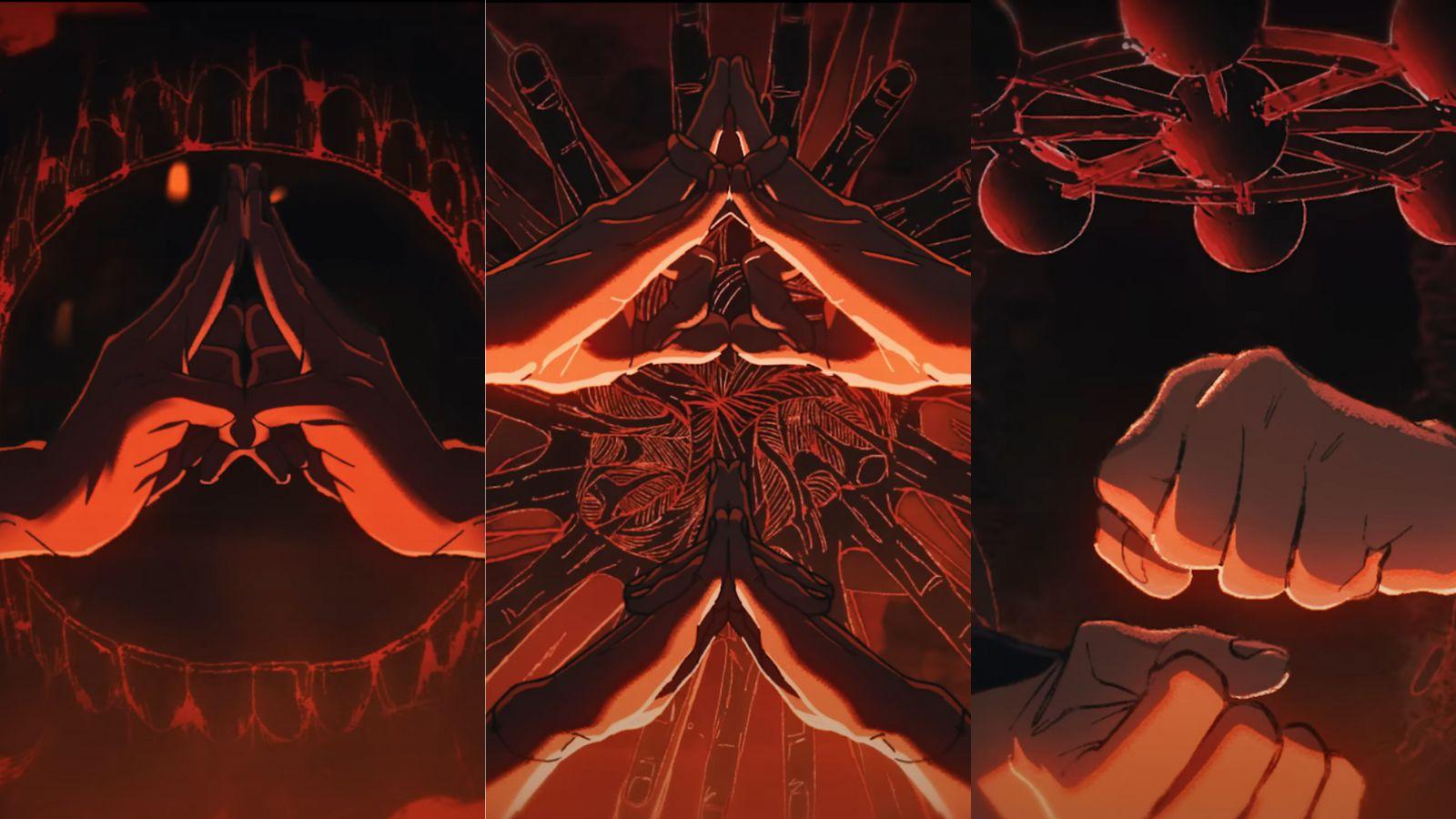
You’ve seen them. Even if you haven't watched a single episode of Gege Akutami’s Jujutsu Kaisen, you've definitely seen someone on TikTok or at a convention crossing their middle and index fingers while looking intensely into a camera. It's the Gojo Satoru effect. But domain expansion hand signs aren't just cool-looking poses designed to sell merchandise or create viral memes. They’re actually deeply rooted in Buddhist and Hindu traditions. They represent the bridge between a sorcerer’s internal spirit and the physical manifestation of their "Innate Domain."
Honestly, it’s one of the most brilliant bits of world-building in modern manga. Akutami didn't just pick random finger positions. Most of these signs are "Mudras"—symbolic or ritual gestures in Dharmic religions. In the context of the show, these hand signs act as a "spark." Think of them as a physical shortcut that helps the sorcerer mold their cursed energy into a complex, barrier-based reality. Without the sign, the domain usually doesn't happen.
The Connection Between Mudras and Cursed Techniques
Why do they use their hands? Well, in real-world esoteric Buddhism (specifically Shingon Buddhism), mudras are used to communicate with the divine or to focus the mind during meditation. In Jujutsu Kaisen, the hand sign is the final "vow" or "condition" needed to release the most powerful move in a sorcerer's arsenal.
Take Satoru Gojo. His hand sign for Unlimited Void (Muryōkūsho) involves crossing the middle finger over the index finger. This is the mudra for Shaka Nyorai (the historical Buddha, Gautama). It represents a state of being where all knowledge is granted at once, which is literally what his domain does to your brain. It floods you with infinite information until you're catatonic. It’s terrifying. It’s also incredibly accurate to the spiritual lore it draws from.
Then you have Ryomen Sukuna. The "King of Curses" uses a sign for Malevolent Shrine (Fukuma Mizushi) that looks like a simplified version of the Enma-ten mudra. Enma is the King of Hell, the judge of the dead. It makes sense. Sukuna isn't just a strong guy; he’s a deity of calamity. When he brings his hands together in that specific, claw-like alignment, he isn't just activating a power. He’s essentially summoning his own throne room and passing a death sentence on everything within a 200-meter radius.
Why Domain Expansion Hand Signs Actually Matter for the Plot
A lot of fans think these signs are just flavor text. They aren't. They are tactical vulnerabilities. If a sorcerer's hands are bound, or if they lose a limb, they usually can't expand their domain. We see this play out in high-stakes fights. When Mahito fights Yuji and Nanami, his hand signs for Self-Embodiment of Perfection (Maho Hanjunka) are a huge deal because he has multiple hands. He can cheat the system.
Mahito's sign is particularly creepy. It involves several hands forming a cage-like structure. It’s a variation of the mudra for the Kannon Bodhisattva, but twisted. While the original represents compassion and reaching out to save souls, Mahito uses it to reshape souls into monsters. It's a dark irony. He’s the "human" curse, after all. His sign reflects the complexity and the inherent selfishness of the human soul.
Megumi Fushiguro and the "Unfinished" Sign
Megumi is a weird case. His domain, Chimera Shadow Garden, is often described as "incomplete." Interestingly, his hand sign changed as the series progressed. Initially, it was a messy, high-effort interlocking of fingers. It looked strained. That’s because his domain was strained. He was forcing it.
The hand sign for Megumi’s domain is the Bhaisajyaguru mudra, associated with the Medicine Buddha. This is a bit of a deep cut for theorists. Some believe it hints at Megumi’s true potential not being destruction, but creation—or perhaps it's a nod to his ability to "heal" the world by summoning Mahoraga to reset a situation. Whatever the reason, the physical struggle Megumi shows when forming the sign tells you everything you need to know about his growth as a sorcerer. He isn't a natural like Gojo. He’s a grinder.
The Physicality of Cursed Energy
Most people get wrong the idea that any hand sign will work. It’s about the "composition" of cursed energy. In the manga, it’s explained that sophisticated sorcerers can sometimes use "binding vows" to skip certain steps, but the hand sign remains the most efficient way to dump massive amounts of energy into a barrier.
- Dagon’s Sign: He draws it on his stomach. He doesn't even use a mudra in the traditional sense initially, which shows his "curse-first" nature.
- Hakari’s Sign: It’s fast. It’s snappy. It’s based on the Benzaiten mudra (goddess of luck and music). Fits a guy who runs a gambling-themed domain, right?
- Kenjaku/Geto: Their signs are often more traditional and formal, reflecting their ancient knowledge and "orthodox" approach to jujutsu.
The sheer variety of domain expansion hand signs serves a dual purpose. For the animator, it’s a keyframe that signifies a climax. For the reader, it’s a moment of recognition. You see the fingers move, and you know the stakes just hit the ceiling. It’s a visual shorthand for "the rules of reality are about to break."
Beyond the Screen: The Cultural Impact
It's actually kinda wild how these have permeated pop culture. You see NBA players doing the Gojo sign after a three-pointer. You see artists using the geometry of these hands as reference points for occult illustrations. It works because the shapes are inherently pleasing—or inherently disturbing.
There’s a reason people don't just mimic the dialogue; they mimic the hands. It’s tactile. It feels like you’re "doing" the move. This is why Jujutsu Kaisen has such a high "stickiness" factor in the SEO world and on social media. The visual language is universal. You don't need to speak Japanese to understand that when Sukuna puts his hands together, someone is about to get diced into cubes.
How to Recognize the Real-World Inspiration
If you’re interested in the "why" behind the designs, you should look into the Vajrayana or Shingon Buddhist practices. The use of Kuji-in (the nine hand seals) is a real historical practice used by ninja and mountain ascetics (Yamabushi). Akutami took these ancient concepts and modernized them.
For instance, the way Jogo forms his sign for Coffin of the Iron Mountain mimics the shape of a volcano, but it also mirrors the Daikoku-ten mudra. Daikoku-ten is a god of wealth but also of the household and the earth. Jogo represents the earth—specifically the anger of the earth. The sign isn't just a "volcano pose." It’s a claim to a divine right to exist.
Actionable Insights for Fans and Creators
If you’re a cosplayer or a fan artist trying to get these right, precision is everything. A slightly tilted pinky can change the meaning of a mudra in real life, and it definitely changes the "vibe" of the domain expansion.
- Study the finger layering: In Gojo’s sign, the middle finger must be on top. If the index is on top, it's just a regular "good luck" sign.
- Watch the thumb placement: For Sukuna’s sign, the thumbs are often tucked or specifically angled to create the "shrine" silhouette.
- Context matters: A domain expansion sign is always accompanied by a "closure" of the barrier. If you're drawing it, the background should reflect the "inside" of the sorcerer's mind.
The study of domain expansion hand signs is basically a study in how to translate ancient spirituality into modern "cool." It’s not just about the fingers; it’s about the intent. Every time a character brings their hands together, they are making a statement about who they are at their core. Gojo is the enlightened one. Sukuna is the judge. Mahito is the mirror of humanity’s ugliness.
To truly appreciate the depth of Jujutsu Kaisen, you have to look at the hands. They tell the story that words usually can’t. Next time you see a domain expansion, don't just look at the flashy colors. Look at the fingers. That’s where the real magic—and the real history—is happening.
Practical Next Steps for Deepening Your Knowledge:
- Research the Shingon Mudras: Look up the Kuji-in to see the direct ancestors of the signs used by Gojo and Sukuna.
- Compare Manga vs. Anime: Check out Chapter 224 and onwards in the manga to see how Akutami’s line work for the hands differs from MAPPA’s animation. The manga often has more "spiritual" detail.
- Trace the Lore: Look into the deity Enma-ten to understand why Sukuna’s hand sign is a harbinger of literal hell for his opponents.
- Practice the Shapes: If you're a cosplayer, practice the muscle memory. Some of these, like Mahito’s or Megumi’s early versions, actually require significant finger flexibility.