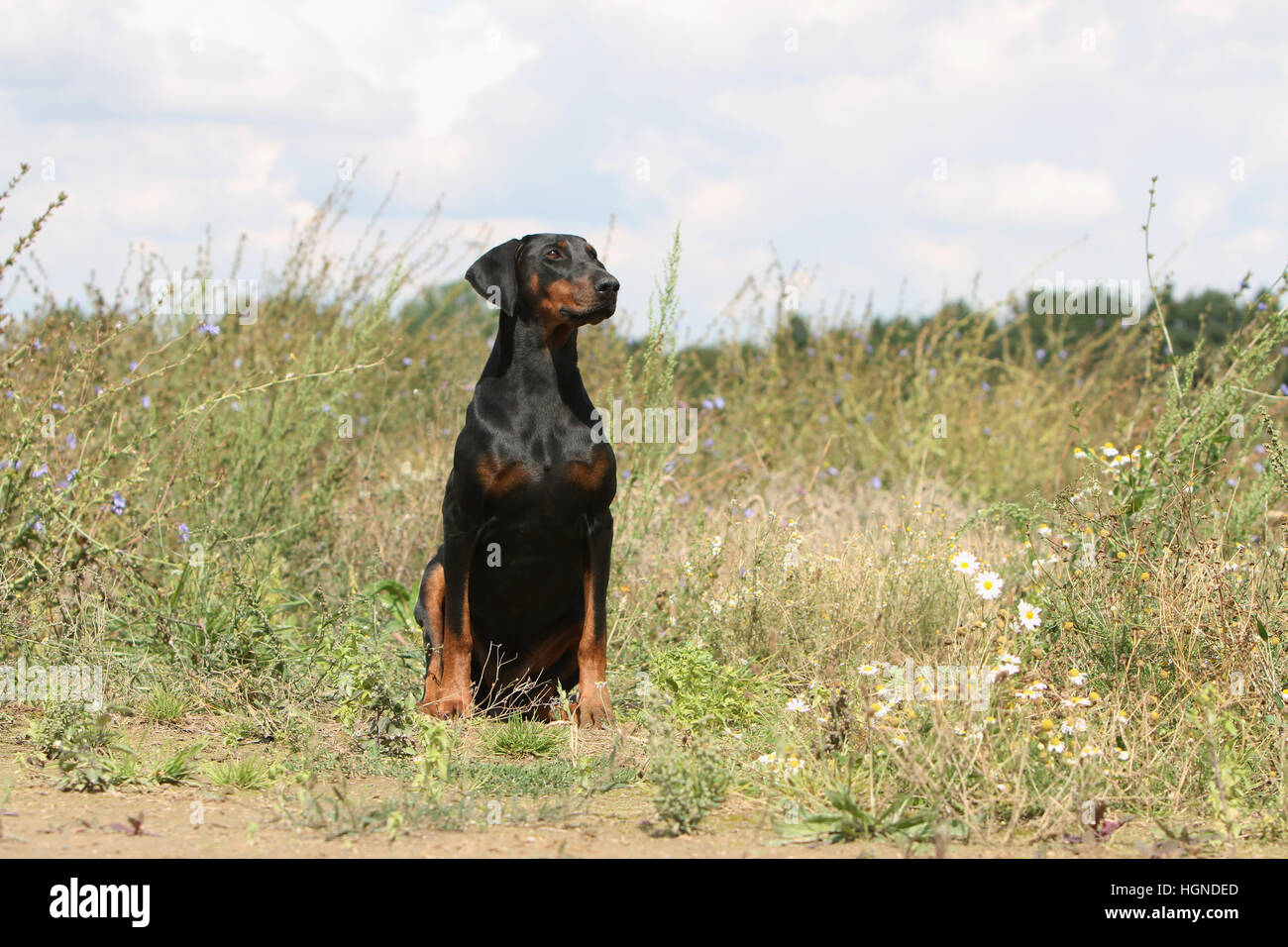
Walk into a dog park today and you might not even recognize the dog standing next to you. It’s a Doberman. But instead of the sharp, alert, triangular ears and the tiny nub of a tail we grew up seeing in movies like The Doberman Gang, this dog has long, velvety ears that flop against its cheeks and a whip-like tail that doesn't stop wagging. The Doberman Pinscher with natural ears and tail is becoming the new face of the breed, and honestly, it’s causing quite a stir in the dog world.
For decades, the "look" of a Doberman was non-negotiable. If it didn't look like a high-end security guard, was it even a Dobie? Times change. People are starting to realize that the fierce silhouette was largely a construction of human preference rather than biological necessity.
The Reality of the Doberman Pinscher with Natural Ears and Tail
Let's get one thing straight: a Doberman is born with a tail. It’s long. It’s strong. And it can definitely knock a coffee cup off a low table. Their ears are naturally pendant, much like a Lab or a Coonhound. When you see a Doberman Pinscher with natural ears and tail, you're seeing the dog exactly as nature intended, before the surgical interventions of docking and cropping take place.
Historically, Louis Dobermann, the German tax collector who created the breed in the late 19th century, wanted a dog that was intimidating. Cutting the ears to stand upright and removing the tail served a dual purpose. It eliminated "handles" that a bad guy could grab in a fight, and it made the dog look perpetually "on" and alert. But unless you're patrolling 1890s Thuringia with a bag of gold coins, those reasons don't carry much weight anymore.
The Welfare Debate and Legal Shifts
This isn't just about aesthetics. It’s a massive ethical conversation. In much of Europe, including the breed's homeland of Germany, cropping and docking are flat-out illegal. The Federation Cynologique Internationale (FCI), which governs dog standards for much of the world, has shifted its requirements. In many countries, you can't even show a dog that has been "altered" for cosmetic reasons.
In the United States, the American Kennel Club (AKC) still maintains that these procedures are "integral to defining and preserving breed character." However, the American Veterinary Medical Association (AVMA) has long opposed cosmetic surgery for pets. They argue it’s painful and unnecessary. Most Doberman Pinscher with natural ears and tail owners will tell you their dogs are just as protective and loyal without the surgery. They might even say the dogs are more expressive. A tail is a communication tool. When you chop it off, you’re essentially muting a significant part of the dog's body language.
Handling the "Not a Real Doberman" Comments
You'll get them. If you walk a Doberman with natural ears and tail, someone will eventually ask if it's a Black and Tan Coonhound or a "weird-looking" Rottweiler mix. People are conditioned to see the cropped look as the "standard." It takes a second for the brain to register the floppy ears on that sleek, athletic frame.
Honestly, the natural look softens the breed's image. This can be a huge advantage for owners living in urban environments or apartment complexes where "aggressive-looking" breeds are often scrutinized. A natural Doberman looks more like a family pet and less like a weapon. That "softness" is only skin deep, though. Underneath those hound-like ears is the same high-intelligence, high-drive working dog that can solve puzzles and outrun a sprinter.
Health and Practicality
Is there a health benefit to the natural look? Some claim that docking prevents "happy tail"—a condition where a dog hits its tail against hard surfaces until it bleeds. While this happens, it’s relatively rare in Dobermans compared to, say, Great Danes or Pit Bulls. On the flip side, the ears. Proponents of cropping used to argue it prevented ear infections. Modern veterinary science basically debunked this; there’s no evidence that upright ears have fewer infections than floppy ones.
Maintaining a Doberman Pinscher with natural ears and tail actually requires less work in the puppy stage. If you've ever seen the "posting" process—where a puppy’s ears are taped to sticks and foam for months—you know it’s an ordeal. It’s messy, it’s stressful for the pup, and it requires constant vigilance to ensure no infections crop up under the tape. Going natural means you skip the surgery, the anesthesia risks, and the months of head-bandaging.
Training the Natural Doberman
Don't let the floppy ears fool you. This is still a Doberman. They are "Velcro dogs." They want to be in your lap, or at least touching your leg, at all times. Whether they have a tail or not, they require massive amounts of mental stimulation.
- Socialization: Because they look "friendlier," people (and kids) might approach them more impulsively. You need to ensure your natural Doberman is bulletproof with strangers.
- The Tail "Whip": A natural Doberman tail is powerful. You’ll need to "tail-proof" your home by moving breakables off low shelves.
- Ear Cleaning: Floppy ears trap more moisture than cropped ones. A quick weekly wipe-down is usually enough to keep them healthy.
What to Look for in a Breeder
If you’re looking for a Doberman Pinscher with natural ears and tail, you have to be careful. In the US, many high-end "show" breeders will crop the entire litter by default at 7 to 9 weeks old. If you want a natural dog, you often have to commit to a puppy before they are born or find a breeder who specifically supports the natural look.
Make sure the breeder isn't just "skipping the surgery" to save money. A reputable breeder still does health testing for Von Willebrand's Disease (a blood clotting disorder), Dilated Cardiomyopathy (DCM), and hip dysplasia. A "natural" dog from a backyard breeder is still a high-risk dog. Look for breeders who talk about "working lines" or "European lines," as these communities have been more accepting of the natural look for a longer period.
The Visual Impact of the Natural Tail
Watching a Doberman run with a full tail is a different experience. They use it like a rudder. In agility or dock diving, that tail provides balance that a docked dog has to compensate for using other muscles. It’s a beautiful, fluid sight. The tail is usually carried in a slight curve, often with a little "brush" of hair on the underside, though the coat remains short and sleek.
The Doberman Pinscher with natural ears and tail isn't a "diluted" version of the breed. It’s the original version. As we move further into a world that prioritizes animal welfare over traditional "stiff" aesthetics, the silhouette of the Doberman is going to keep evolving. It’s okay to love both looks, but it’s vital to understand that the dog's soul—that intense, loyal, "thinky" personality—isn't located in the tips of its ears or the end of its spine.
Actionable Steps for Potential Owners
If you're leaning toward a natural Doberman, your first step is vetting your breeder specifically on this issue. Ask if they are willing to leave a pup "un-docked" for you; many won't because they believe it makes the puppy "unsellable" if you back out. You might need to put down a larger, non-refundable deposit to secure a natural dog.
Once you bring your pup home, focus heavily on "spatial awareness" training. Dobermans are clumsy teenagers, and a long tail on a 80-pound dog can be a liability in a small house. Use positive reinforcement to reward "calm settles" early on. Finally, join online communities like the "Natural Doberman" groups on social media. They are great resources for finding vet recommendations and dealing with the inevitable "What breed is that?" questions from neighbors. Embrace the look—it's the future of the breed.
Key Resources for Research
- The Doberman Pinscher Club of America (DPCA): For the official (though traditional) stance on breed standards.
- The AVMA Policy on Cosmetic Alteration: To understand the veterinary perspective on docking and cropping.
- FCI Breed Standard No. 143: To see the international requirements for natural Dobermans.
Check your local laws as well. While rare in the US, some specific municipalities or insurance carriers have different "optics" regarding breed-specific legislation, and a natural dog often bypasses the "aggressive" label more easily in legal or insurance contexts.