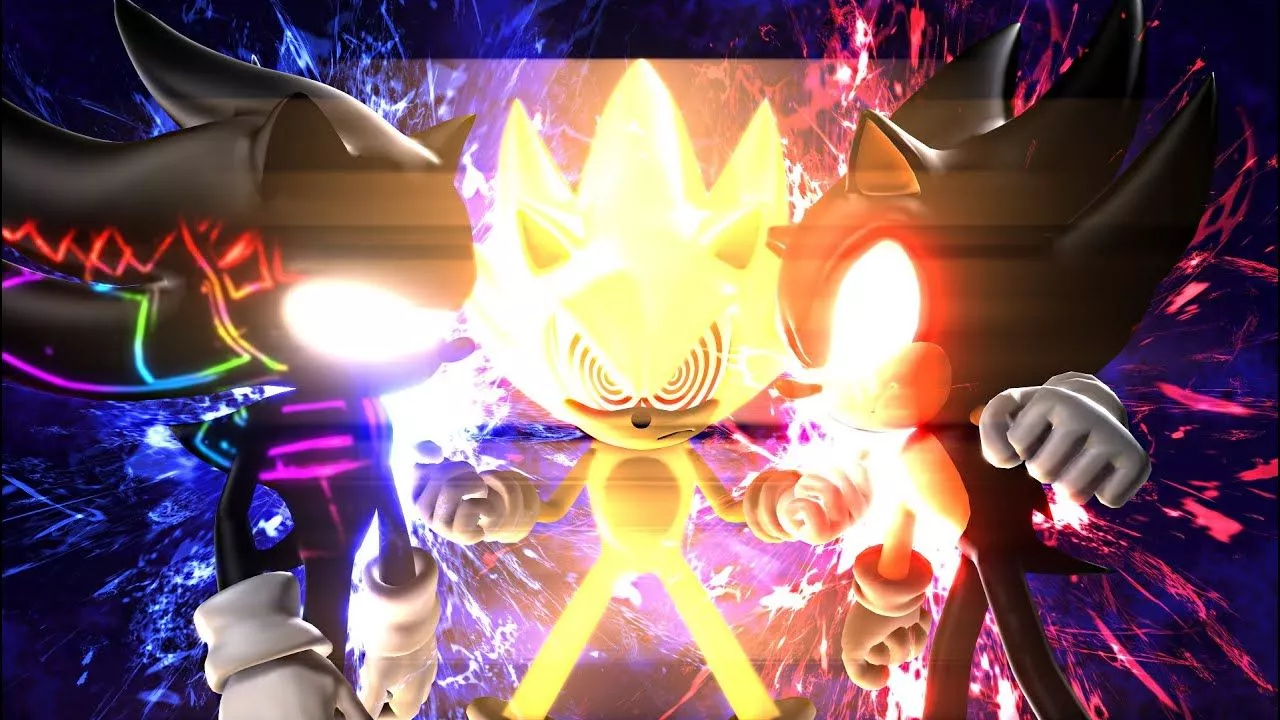
You’ve seen the fan art. You’ve probably watched those hyper-edited YouTube videos with the heavy metal soundtracks. If you’ve spent more than five minutes in the Sonic the Hedgehog community, you know that the debate over Dark Hyper Sonic and the legendary Super Sonic is basically a rite of passage. But here’s the thing—half of what you’ve read online is probably total headcanon.
Let's get real.
Sega has a weird relationship with its own power scaling. One day Sonic is outrunning black holes, and the next, he’s getting knocked out by a stray badnik because the plot demands it. But when we talk about Super Sonic, we’re talking about the gold standard. When we talk about "Dark" forms, we’re entering a murky territory of obscure Japanese spin-offs and 1990s arcade secrets that most casual fans completely miss.
There's a massive difference between what actually exists in the games and what the internet wants to exist.
The Super Sonic Foundation: More Than Just a Color Swap
Super Sonic isn't just a power-up. It’s the literal embodiment of positive Chaos energy. Ever since Sonic the Hedgehog 2 hit the Sega Genesis in 1992, this form has been the ultimate "get out of jail free" card. You collect the seven Chaos Emeralds, you jump in the air, and suddenly you’re invulnerable. It’s simple. It's iconic.
But the mechanics are deeper than just "being fast and yellow."
According to the Sonic Channel (the official Japanese hub for lore), Super Sonic’s power is directly tied to the user's heart. It’s why Shadow or Silver can also transform. It’s not just about the gems; it’s about the resonance. In games like Sonic Frontiers, we saw this pushed to the absolute limit. Sonic wasn't just flying; he was parrying attacks from celestial-sized titans. That’s the baseline. That is the peak of what is considered "canon" power.
The Legend of Hyper Sonic: A One-Hit Wonder?
Before we can even touch the "Dark" side of things, we have to talk about Hyper Sonic. This is where things get complicated. Hyper Sonic only appears in Sonic 3 & Knuckles. To get him, you need the Super Emeralds, which are essentially Chaos Emeralds that have been "leveled up" by the Master Emerald on Angel Island.
He flashes colors. He can breathe underwater. He has a screen-clearing "Flash" jump that nukes everything in sight.
So, why haven't we seen him since 1994?
Christian Whitehead and other developers have touched on this, and the consensus from Sega of Japan has always been that Hyper Sonic was a "bonus" for completing the locked-on expansion. He's arguably too powerful for modern game design. If Super Sonic is a 10, Hyper Sonic is a 50. But because he hasn't appeared in a 3D mainline game, many fans treat him like a myth. He is the bridge that leads people to start imagining even crazier forms, like the elusive Dark Hyper Sonic.
What is Dark Hyper Sonic, Honestly?
If you search for Dark Hyper Sonic, you’ll find thousands of images of a black-and-purple Sonic with glowing eyes. Is he in the games?
No. Not officially.
The concept of "Dark Hyper Sonic" is a fan-made amalgamation. It combines the raw power of the Hyper form with the "Dark" transformation seen in the Sonic X anime. In episode 67 of Sonic X, Sonic sees his friends trapped and tortured by the Metarex. He snaps. Using the energy of "fake" Chaos Emeralds (which were filled with negative emotions), he becomes Dark Sonic.
He was onscreen for about sixty seconds.
He didn't have the "Hyper" flashes. He was just a void of pure rage. He moved so fast the camera couldn't track him and dismantled two high-tier robots in the blink of an eye. Fans took that one minute of footage and ran with it for twenty years. They wondered: What if he used the Super Emeralds while he was that angry? That’s where Dark Hyper Sonic comes from. It’s a "What If" scenario. It represents the absolute ceiling of destructive potential—the idea that Sonic could lose his mind and use the most powerful artifacts in the universe to just... erase things.
Comparing the Power Scales
Trying to compare these forms is like comparing a controlled nuclear reactor (Super Sonic) to a collapsing star (Dark forms).
- Super Sonic: Powered by positive Chaos energy. Grants flight, invulnerability, and "Chaos Control" (warping time and space). It’s sustainable as long as there are rings or energy to feed it.
- Dark Sonic: Powered by negative Chaos energy (anger, hatred). It seems to have a higher "instantaneous" speed but lacks the refined control of the Super form. It’s volatile.
- Hyper Sonic: The peak of positive energy. Features the "Sonic Boom" dash and a complete immunity to most environmental hazards that even Super Sonic struggles with.
- The "Dark Hyper" Theory: Fans theorize this form would use "Negative Hyper Energy." If Hyper Sonic can clear a screen, Dark Hyper Sonic would theoretically clear a zip code.
Interestingly, Sega did give us a "Dark" equivalent in the games, but it wasn't Sonic. In Sonic Adventure 2, we saw the "Devil Doom" and other negative entities, but Sonic himself has stayed mostly pure in the game canon. The closest we got was Sonic Unleashed with the Werehog, but that’s a biological mutation, not a Chaos transformation.
Why the Internet is Obsessed with the "Dark" Variations
There is a psychological pull to seeing a hero go dark. It’s the "Superman with Red Kryptonite" trope. Sonic is usually the "cool, blue, and easy-going" guy. Seeing him lose his cool is satisfying for the audience because it raises the stakes.
Also, let's talk about the Sonic modding community. It's huge.
If you go to GameBanana or Steam Workshop, you can find hundreds of mods for Sonic Generations or Sonic Frontiers that let you play as Dark Hyper Sonic. These mods often give him custom move sets—teleporting strikes, dark energy blasts, and a permanent "rage" aura. Because the official games are often focused on being family-friendly, the "Dark" forms have become the playground for the older fanbase who wants something a bit more "edgy" (in the vein of Shadow the Hedgehog 2005).
The Role of Chaos Energy: It’s Not Just Magic
To understand why these forms differ, you have to look at the "science" Sega has laid out. Tikal’s prayer in Sonic Adventure explicitly states: "The servers are the seven Chaos. Chaos is power, power is enriched by the heart."
The heart is the catalyst.
If your heart is filled with the desire to protect, you get the golden Super Sonic. If your heart is filled with pure, unadulterated malice, the Emeralds respond differently. We saw this with Chaos (the creature) in Sonic Adventure. He absorbed the negative energy of the emeralds to become Perfect Chaos—a giant water dragon that leveled Station Square.
When fans talk about Dark Hyper Sonic, they are essentially imagining a "Perfect Chaos" version of Sonic. A being of pure destruction that doesn't care about the consequences. It’s a fascinating concept because it flips the "Super Sonic" trope on its head. Instead of the emeralds making Sonic a hero, they make him a monster.
Clearing Up the Misconceptions
People often confuse Dark Sonic with Fleetway Super Sonic.
In the old UK-based Sonic the Comic (published by Fleetway), Super Sonic was actually a separate, psychotic personality that lived inside Sonic. When Sonic got too stressed or absorbed too much radiation, the "Golden Eyed" Super Sonic would take over and start attacking everyone—friend or foe.
This version of Super Sonic is actually closer to the "Dark" fan theories than the official game version. He was chaotic, evil, and had swirling red eyes. If you’re looking for a "Dark" version of Sonic that is actually "official" (in a licensed capacity), Fleetway Super Sonic is your guy. But he’s not "Dark Hyper." He’s just a very, very mean version of the standard Super form.
What’s Next for Sonic’s Transformations?
Sega seems to be moving away from the "new form every game" trend. Sonic Frontiers introduced the "Cyber" energy influence, which gave Sonic a blue-and-red digital aura, but it didn't replace Super Sonic. It enhanced him.
The reality? We probably won't see a "Dark Hyper Sonic" in a game anytime soon.
Ian Flynn, the lead writer for many Sonic comics and a consultant on the games, has often mentioned the strict mandates Sega has regarding Sonic’s character. They want him to be a symbol of hope. Making him a dark, brooding god of destruction might sell some toys, but it dilutes the brand they’ve spent decades building.
However, the "Hyper" form is a different story. With the success of Sonic Mania and the "Classic" sub-brand, there is always a chance the Super Emeralds could return. If they do, the power scaling of the franchise will reach a level we haven't seen since the 90s.
How to Navigate the Lore Yourself
If you want to dive deeper into these power-ups without getting lost in fan fiction, here is a quick roadmap of what to actually check out:
- Play Sonic 3 & Knuckles (Origins version): This is the only place you will see the true Hyper Sonic in action. Pay attention to the "Super Emerald" shrines.
- Watch Sonic X Episode 67: This is the birth of Dark Sonic. It’s the only official animated appearance of a "Dark" transformation for the Blue Blur.
- Read the IDW Sonic comics (Issue 25-29): While it doesn't feature a "Dark" form, it explores the limits of Sonic’s "Metal Virus" resistance, which shows how his body handles extreme energy shifts.
- Avoid the "Wiki" traps: Be careful on Fandom wikis. Many of them allow "Fanon" entries where people write backstories for Dark Hyper Sonic as if they were real. Always check for game citations.
The "Dark" side of Sonic isn't just about cool colors. It’s a reflection of the fans' desire to see the character pushed to his absolute limit. Whether it's the official Super Sonic or the imagined Dark Hyper Sonic, the fascination remains the same: how much power can one hedgehog actually handle before he breaks the world?
Stick to the games for the facts, but don't be afraid to enjoy the mods. They're usually way more fun than the lore anyway.