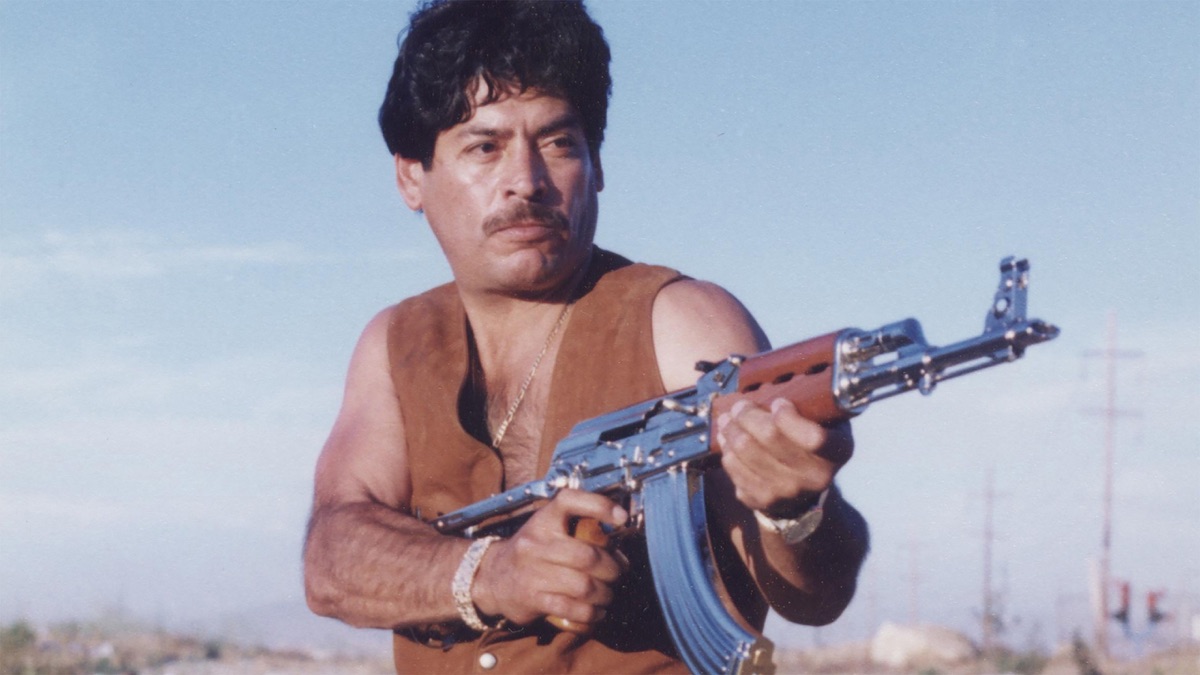
You’ve seen it in the movies. You’ve heard it mentioned in a hundred narcocorridos blasting from a passing truck. If you’ve spent any time looking into the security crisis south of the border, the phrase "cuerno de chivo" pops up like a recurring character.
But what is it, really?
Basically, the cuerno de chivo gun is just a nickname. It’s the Mexican slang for the AK-47, or more accurately, the entire family of Kalashnikov-style rifles. The name translates literally to "goat’s horn." If you look at the iconic 30-round banana magazine sticking out of the bottom of one of these rifles, the curvature looks exactly like the horn of a mountain goat. Simple. Visual. Memorable.
But the story of how a Soviet-era weapon became the unofficial scepter of power in Mexican narcoculture isn't just about a cool nickname. It’s a messy mix of Cold War leftovers, legal loopholes in the United States, and a design that is, frankly, too good at its job.
Why the AK-47 Became the "Cuerno"
The AK-47 didn't start as a "cuerno de chivo." It started in 1947 in the hands of Mikhail Kalashnikov. He wanted something that wouldn't jam in the Siberian mud. He succeeded.
Honestly, the rifle is a mechanical masterpiece of simplicity. It has huge clearances between moving parts. This means even if you drop it in a swamp or drag it through the dust of the Chihuahuan Desert, it’s probably still going to go bang when you pull the trigger.
The nickname itself supposedly traces back to the 1960s. Legend has it—and this is a story that gets passed around in Culiacán—that a man nicknamed "El Culichi" started the trend. He allegedly carried an AK around his neck constantly. When people asked about it, he’d point to the curved magazine and call it his "goat’s horn."
Whether El Culichi actually started it or not, the name stuck. By the 1980s, it was the gold standard for traffickers. Why? Because it outperformed the lighter, more finicky rifles of the era.
The "Iron River" and the 2026 Landscape
Where do these guns actually come from?
Most people assume they are smuggled from Russia or China. While some Chinese Norinco Type 56s (the Chinese AK variant) certainly make their way over, a massive percentage of the cuerno de chivo gun supply actually flows from the north.
It’s called the "Iron River."
In the United States, buying a semi-automatic AK-style rifle is relatively easy in states like Texas or Arizona. These aren't fully automatic military weapons when they leave the shop, but they are high-powered and rugged. Once they cross the border, they are often illegally modified.
"It’s easier for a cartel member to get a rifle from a gun show in Houston than it is for a law-abiding Mexican citizen to buy a handgun in Mexico City."
That’s a common sentiment among security analysts. Mexico only has two legal gun stores in the entire country—both run by the military. Compare that to the thousands of licensed dealers just across the border.
Recent legal battles, like the Smith & Wesson v. Mexico case that reached the U.S. Supreme Court in 2025, have highlighted this tension. Mexico tried to sue U.S. gun makers, arguing their marketing and distribution fueled the violence. The court ultimately shot that down, essentially saying manufacturers aren't responsible for what happens to a product once it's legally sold and then illegally smuggled.
Technical Stats: What Makes it Dangerous?
If you're looking at a standard cuerno de chivo gun, you're usually looking at these specs:
- Caliber: 7.62x39mm. This is a "punchy" round. It’s heavier than the 5.56mm used in the AR-15.
- Capacity: Usually a 30-round magazine (the "horn").
- Rate of Fire: In semi-auto, as fast as you can pull the trigger. If modified to full-auto, about 600 rounds per minute.
- Reliability: You can literally pour sand into the action, and it will likely keep cycling.
There is a psychological element, too. The sound of a 7.62mm round is distinct. It’s a deep, rhythmic thud-thud-thud that sounds very different from the high-pitched crack of an AR-15. In the mountains of Guerrero or the streets of Michoacán, that sound is a signal of presence and power.
The Cultural Weight of the Cuerno
The cuerno de chivo gun isn't just a tool in Mexico; it’s a symbol. It’s the "Excalibur" of the underworld.
You’ll see them gold-plated. You’ll see them encrusted with diamonds. In the world of cultura pesada (heavy culture), the rifle is a fashion statement. It represents the transition from a "nobody" to someone with the power of life and death.
It’s all over the music. Songs by artists like Peso Pluma or the older "Movimiento Alterado" bands mention the cuerno constantly. They use it as a shorthand for bravery or status. This creates a cycle where the gun becomes more than a weapon—it becomes an aspirational object for young men in impoverished areas.
Misconceptions People Still Believe
One of the biggest myths is that every cuerno de chivo gun is a fully automatic machine gun.
In reality, many are semi-automatic rifles that have been poorly "converted" in backyard shops. These conversions often make the gun unreliable or even dangerous to the shooter.
Another big one? That the "cuerno" is the only gun that matters. While it’s the most famous, the AR-15 (often called the R-15 in Mexico) and the .50 caliber Barrett sniper rifle have become just as common. The AK is the old guard; the AR is the new, more customizable "tactical" choice. But the AK’s nickname is the one that captured the public imagination.
What Happens Next?
If you are tracking the security situation in 2026, keep your eye on the "ghost gun" trend.
While the traditional cuerno de chivo gun is still the king of the hills, 3D-printed parts and "80% lowers" are starting to show up in seizures. It’s becoming harder to trace the "Iron River" when the river is starting to flow from a printer in a basement rather than a gun shop in El Paso.
For anyone looking to understand the mechanics of the conflict in Mexico, you have to look past the headlines. The cuerno is a symptom. It’s the physical manifestation of a global arms trade that doesn't care about borders.
Actionable Next Steps:
- Research the Tracing Data: If you want to see the real numbers, look up the ATF’s "eTrace" reports for Mexico. They provide the most factual breakdown of where seized "cuernos" actually originate.
- Understand the Laws: Check the difference between "Semi-Automatic" and "Select Fire." Most people use these terms interchangeably, but knowing the difference is key to understanding why these guns are so easily moved across borders.
- Follow the Court Cases: Keep an eye on the ongoing legislative attempts in the U.S. to regulate "straw purchases." This is the primary way these rifles get from a legal shelf to an illegal convoy.