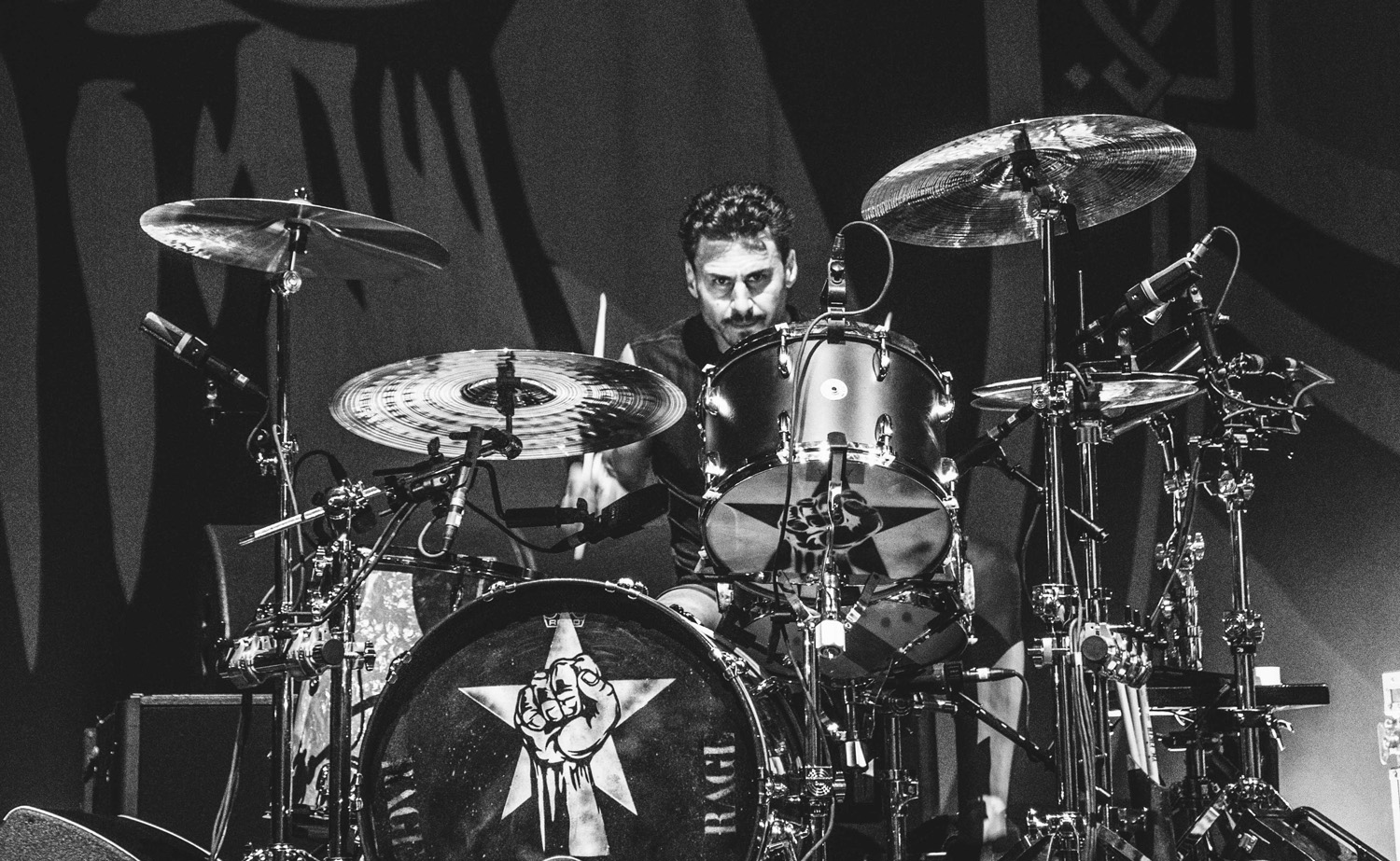
If you’ve ever felt like a snare hit could actually knock a wall down, you were probably listening to Brad Wilk. The guy is a human metronome with a heavy hand and a soul for funk. Honestly, it’s rare to find a drummer who can sit in the pocket of a hip-hop groove and then pivot to a doom-metal sludge without missing a beat. Most people know him as the backbone of Rage Against the Machine, but that’s just the tip of the iceberg when it comes to brad wilk music groups.
The man is a magnet for legendary frontmen. Chris Cornell? Check. Zack de la Rocha? Obviously. Chuck D and B-Real? Yep. He’s even played for Black Sabbath. Most drummers struggle to find one band that changes the world. Brad Wilk has essentially done it three times over, usually with the same two guys (Tom Morello and Tim Commerford) following him into battle.
The Core Legacy: Rage Against the Machine
It all started because of a failed audition. In 1991, Wilk tried out for a band called Lock Up. He didn't get the gig, but the guitarist, Tom Morello, liked his style. Morello called him later to see if he wanted to start something new. They hooked up with a local rapper named Zack de la Rocha and a bassist named Tim Commerford.
The rest is history.
Rage Against the Machine wasn't just a band; it was a political earthquake. Wilk's drumming was the engine. Think about the intro to "Bull on Parade." That’s not just rhythm. It’s a statement. Between 1991 and 2000, they released four albums that defined a generation. Then, things got messy. Zack left. The band imploded.
For a long time, fans thought that was it. But RATM has a habit of coming back. They reunited in 2007 for Coachella and toured sporadically until 2011. Then they went quiet again. The big "Public Service Announcement" reunion tour was supposed to be the victory lap in 2020, but the pandemic and Zack’s Achilles tendon injury had other plans. By early 2024, Wilk himself took to Instagram to tell the world that the band was officially done with live shows. It was a heavy pill to swallow for fans who’ve been waiting decades for a proper goodbye.
When Audioslave Redefined the Supergroup
When Rage ended the first time in 2000, the trio of Wilk, Morello, and Commerford didn't want to stop playing together. They had this telepathic connection. They just needed a voice. Rick Rubin suggested Chris Cornell, the legendary singer of Soundgarden.
At first, it sounded like a weird experiment.
Would the funky, political groove of the Rage guys work with Cornell’s soaring, melodic vocals? The answer was a resounding yes. Audioslave was born in 2001 and basically saved rock radio for the next five years. Songs like "Like a Stone" and "Cochise" showed a totally different side of Brad’s drumming. He leaned more into the classic rock swing of John Bonham—who is one of his biggest idols—and less into the rigid hip-hop backbeat.
They released three albums:
- Audioslave (2002)
- Out of Exile (2005)
- Revelations (2006)
They even became the first American rock band to play an open-air concert in Cuba. That’s a huge deal. But like all supergroups, the ego and creative differences eventually took their toll. Cornell left in 2007 to go back to his solo work, and the band folded. They did have a brief one-off reunion in 2017 for an Anti-Inaugural Ball, which sadly ended up being one of Cornell’s last performances before his passing.
Prophets of Rage and the Return to Politics
By 2016, the political landscape in the U.S. was getting wild. Morello, Commerford, and Wilk felt like they couldn't just sit on the sidelines. Since Zack de la Rocha wasn't interested in a reunion at the time, they called up Chuck D from Public Enemy and B-Real from Cypress Hill.
They called it Prophets of Rage.
The mission was simple: "Make America Rage Again." They played the hits from Rage Against the Machine, Public Enemy, and Cypress Hill. Wilk was back in his element, hammering out those massive rap-metal grooves. They even released a self-titled album in 2017. It was high-energy, loud, and exactly what the fans needed while waiting for the "real" Rage to return. They disbanded in 2019 specifically because the original Rage Against the Machine announced they were coming back for the 2020 tour.
The Deep Cuts: Side Projects You Probably Missed
Brad Wilk isn't just a one-trick pony. He's been the "hired gun" or the secret weapon for several massive projects that aren't household names.
Before the fame, he was in a band called Greta. They were a mid-90s alt-rock band that actually released an album called This Is the New That. It’s a fun listen if you want to hear Brad before he became the "Rage guy."
Then there's the Black Sabbath connection. This one is wild. When the original metal pioneers were recording their final album, 13, in 2013, they had a falling out with their original drummer, Bill Ward. Producer Rick Rubin called Brad. Can you imagine getting a call to fill in for Bill Ward? Wilk actually played drums on the entire album, helping Sabbath get their first-ever #1 album in the US.
He’s also popped up in:
- The Smashing Pumpkins: He played live with Billy Corgan’s crew during their 2014-2015 tour.
- Puscifer: He’s contributed to Maynard James Keenan’s experimental project.
- The Last Internationale: He played on their album We the People and toured with them for a bit.
- Sound City Players: He was part of Dave Grohl’s massive documentary project and supergroup.
Why Brad Wilk Still Matters in 2026
Look, drumming has changed. Everything is on a grid now. It's all quantized and perfect. Brad Wilk is the opposite of that. He plays with a "swing" that’s hard to replicate. If you listen to "Know Your Enemy," he's actually pushing and pulling the beat. It feels alive.
He's also been open about his struggles, which makes him more relatable than your average rock star. He’s lived with Type 1 diabetes for decades, often managing his blood sugar in the middle of two-hour, high-intensity sets. He’s an advocate for the JDRF and shows that you can be an elite athlete (and let’s be real, drumming for Rage is an athletic feat) while managing a chronic illness.
Currently, with Rage officially retired from the road again, Brad is in a bit of a transition phase. But if history tells us anything, he won't be sitting still for long. Whether it's a new collaboration or another supergroup, that snare sound is too iconic to stay silent.
Actionable Insights for Music Fans
- Listen to the "Coda" Influence: If you want to understand Brad's style, go listen to John Bonham’s "Bonzo's Montreux." You can hear the DNA of that solo in almost everything Brad plays.
- Check out Greta: If you're a completionist, find the 1993 Greta album. It's a trip to hear him in a more "traditional" rock setting before the funk-metal revolution.
- Watch the Sound City Documentary: You get to see Brad in the studio with Dave Grohl and other legends. It really highlights his technical ability and his gear setup.
- Track the Supergroups: Keep an eye on Tom Morello’s social media. Where Tom goes, Brad usually follows. If a new project is brewing for 2026, that’s where you’ll see the first hint.
To truly appreciate brad wilk music groups, you have to listen to the space between the notes. He knows when to hammer the kit and when to let the riff breathe. That's why he's the guy every legendary singer wants behind them.
Check your local vinyl shop for the Audioslave 20th-anniversary pressings if you want to hear his drum tones in their purest, uncompressed form. The "Revelations" album especially has some of the best recorded drum sounds of the early 2000s.