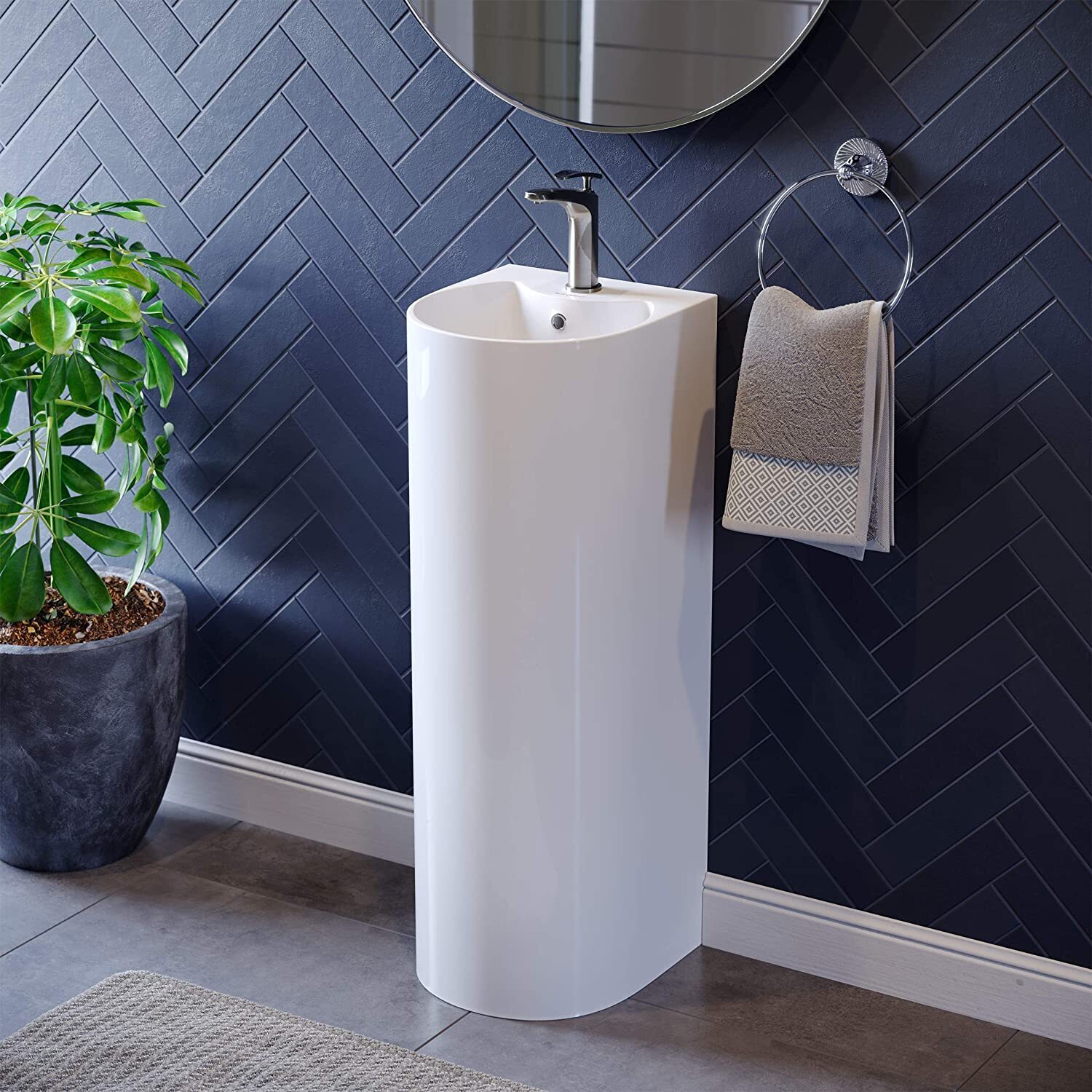
You’re standing in a bathroom so small you can basically touch both walls at once. It’s frustrating. You want a space that feels like a spa, or at least a place where you don't bang your elbows every time you brush your teeth, but the square footage just isn't there. Most people think their only option is one of those chunky, generic vanity cabinets from a big-box store. They’re wrong. Honestly, choosing bathroom sinks for small bathrooms is less about "making do" and more about understanding the geometry of your specific room. If you pick the wrong shape, you’ve killed your floor space. Pick the right one, and suddenly that tiny powder room feels intentional.
The biggest mistake? Scale. People see a sink they love in a showroom and forget that the showroom is five times the size of their guest bath. When that "standard" sink arrives, it swallows the room whole.
The Wall-Mount Revolution
Wall-mounted sinks are the unsung heroes of tiny renovations. They’re basically floating. By keeping the floor clear, you trick your brain into thinking the room is larger than it actually is. It’s a visual trick that architects have used for decades. Look at the Duravit Vero series. It’s a classic for a reason. The lines are sharp, and because it sits directly on the wall, you can tuck a small basket of towels underneath or just enjoy the open air.
But there’s a catch.
You can’t just slap a wall-mount sink onto any drywall and call it a day. You need blocking. That means opening up the wall and adding heavy-duty timber between the studs to support the weight of the ceramic and the pressure of someone leaning on it. If you’re not prepared to go behind the tiles, a wall-mount might be a pipe dream. Also, your plumbing is going to be visible. Unless you’re into the industrial look with a polished chrome P-trap, you might find the exposed pipes a bit messy. Some people love it; some hate it. It's a vibe check you have to perform before buying.
Corner Sinks and the Geometry of Efficiency
Sometimes the middle of the wall is the worst place for a sink. If your door swings inward and hits the vanity, you’re stuck. This is where the corner sink shines. Companies like Kohler and American Standard make specific vitreous china models designed to nestle into that 90-degree graveyard.
Think about the Kohler Tyrell. It’s compact. It’s tucked away. By moving the sink to the corner, you open up the entire center of the room. It’s the difference between shimmying past a sink and actually walking. However, corner sinks can feel a bit "airplane bathroom" if you aren't careful. To avoid the cramped feeling, pair a corner sink with a large, frameless mirror that extends across both walls. It doubles the light and makes the corner feel like a feature rather than an afterthought.
Let's Talk About Pedestals
Pedestal sinks are the "old reliable" of small bathroom design. They have a tiny footprint. They look elegant. They’ve been around since your grandmother’s house was built because they work. But let’s be real for a second: they have zero storage. None. If you go with a pedestal, where does the extra toilet paper go? Where’s the hairdryer?
If you choose a pedestal like the TOTO Promenade, you’re making a trade-off. You're trading storage for style and physical space. This works perfectly in a powder room where guests only need a place to wash their hands. It works less well in a primary bathroom where you have seventeen different skincare serums. If you must have a pedestal in a high-use bathroom, you better have a recessed medicine cabinet or some high-level shelving elsewhere. Don’t ignore the "landing strip" problem either. Some pedestals have almost no flat surface around the basin. Good luck putting your soap bottle down without it sliding into the bowl.
Semi-Recessed: The Middle Ground
Semi-recessed sinks are kind of weird, but in a good way. The sink basin sits on a very shallow cabinet, but the front of the sink hangs off the edge. You get the storage of a vanity but the footprint of a much smaller unit. It’s basically a cheat code. You get to keep your drawers for toothpaste and shaving cream, but the cabinet doesn't stick out so far that it blocks the walkway.
Materials and Why They Matter
When space is tight, you’re going to be bumping into things. Hard edges suck. While a concrete ramp sink looks cool in a magazine, in a small bathroom, those sharp corners are hip-bruisers.
- Vitreous China: The standard. It’s glassy, easy to clean, and handles bleach like a champ.
- Fireclay: More durable than standard ceramic. It’s fired at higher temperatures, so it’s less likely to chip if you drop a heavy glass bottle of cologne.
- Stainless Steel: Rare in bathrooms, but incredible for a modern, ultra-slim profile.
- Resin/Solid Surface: Brands like Badeloft use stone resin to create incredibly thin walls. Thinner walls mean a larger interior basin without increasing the exterior size of the sink.
Thin-edge sinks are a game changer for bathroom sinks for small bathrooms. Older ceramic sinks have thick, 2-inch rims. Modern resin sinks can have rims as thin as half an inch. That’s three extra inches of actual "sink space" in the same footprint. It’s math that makes sense.
The Faucet Factor
You cannot talk about small sinks without talking about faucets. A massive, high-arc faucet on a tiny 12-inch sink is a disaster. You’ll turn the water on, and it’ll splash right off the bottom and onto your shirt. You need a short-reach faucet.
Or, better yet, go with a wall-mounted faucet.
By moving the faucet to the wall, you can buy an even narrower sink. You’re effectively reclaiming the 4 inches of "deck space" behind the basin. It looks high-end. It’s easier to clean because water doesn't pool around the base of the handles. But like the wall-mount sink, this requires moving plumbing lines inside the wall. It’s an "expensive-looking" upgrade that actually costs quite a bit in labor if you aren't already doing a full teardown.
Vanity Units That Actually Work
If you absolutely need a vanity, look for "petite" or "cloakroom" units. Brands like Swiss Madison specialize in this. We’re talking about vanities that are only 10 to 12 inches deep. They’re slim. They’re sleek.
Don't buy a floor-standing vanity if you can avoid it. Get a wall-hung vanity. It’s the hybrid of a wall-mount sink and a traditional cabinet. You get the storage drawers, but because you can see the floor underneath, the room doesn't feel "closed in." It’s also much easier to mop. No more disgusting dust bunnies hiding in the dark corners under the cabinet kickplate.
Common Myths About Small Sinks
Myth 1: Bigger is always better for washing. Not really. You only need enough space to cup your hands. Anything more is luxury. If you’re just washing your face and brushing teeth, a 16-inch wide sink is plenty.
Myth 2: Vessel sinks are bad for small spaces. Actually, they can be great. Because the "bowl" sits on top of the counter, you can sometimes use a much narrower counter. The bowl can even overhang slightly. The downside? They are a pain to clean where the bowl meets the stone.
Myth 3: You have to use white. People think dark colors make a room feel smaller. Sometimes, a dark navy or matte black sink creates a focal point that adds depth. It makes the back wall "recede" visually. Don't be afraid of a little drama.
The Reality of Installation
Listen, DIY-ing a sink in a small space is a nightmare. It’s tight. You’re laying on your back with your head inside a cabinet or jammed between a toilet and a wall. If you’re replacing an old pedestal with a wall-mount, remember that your floor tiles might not go all the way under the old sink. You might find a "hole" in your flooring where the old pedestal sat.
Always check your rough-in dimensions. The "rough-in" is where the pipes come out of the wall. If your new small sink is significantly higher or lower than the old one, you’re going to be cutting into the wall to move those pipes. It’s never "just a simple swap."
Specific Models to Research
If you’re starting your search, look into these specific lines. They aren't the only options, but they are the gold standards for small-space engineering.
- Scarabeo Teorema: Extremely thin walls, very modern, multiple sizes.
- Kohler Vox: A great rectangle vessel that doesn't feel bulky.
- Laufen Pro S: Designed specifically for European "cloakrooms" (which are tiny).
- IKEA Enhet/Tvallen: Don't sleep on IKEA for small spaces. Their plumbing is weird (it uses a flexible accordion pipe), but it allows for full-sized drawers under the sink.
Practical Steps to Choosing Your Sink
Stop looking at Pinterest and start measuring.
First, measure the "clearance" of your door. If the door can't open at least 90 degrees without hitting the sink, the sink is too big. Period.
Second, check your plumbing. Is it coming from the floor or the wall? Floor plumbing is much harder to hide with a wall-mount sink.
Third, think about your "landing zone." Where does your toothbrush go while you're washing your face? If the sink has no edge, you’ll need a shelf nearby.
Fourth, consider the "splash zone." Very shallow sinks look cool but require low-pressure faucets to avoid soaking your bathroom floor.
Finally, choose your mirror. A mirror that is too small will make a small sink look like a toy. Go big. A wide mirror balances the narrowness of a small vanity.
Ultimately, the best bathroom sinks for small bathrooms are the ones that you don't notice. They should fit so perfectly into the flow of the room that you stop thinking about how small the space is and just start using it. Pick a sink that solves your storage needs while respecting your floor space. If you do that, the "small" part of the bathroom stops being a problem and starts being a design choice.
Actionable Checklist
- Map the door swing: Ensure a 24-inch clearance for comfortable entry.
- Identify wall studs: Essential if you're eyeing a floating or wall-mount model.
- Select the faucet first: Ensure the reach matches the drain hole to prevent splashing.
- Audit your storage: If you lose the cabinet, plan for floating shelves or a recessed cabinet.
- Check the floor tile: Ensure you don't have a "bald spot" under your current vanity before switching to a pedestal.
The right sink changes everything. It turns a cramped, awkward room into a functional, stylish part of your home. Take the measurements, check your plumbing, and don't be afraid to go with a non-traditional shape. Your elbows will thank you later.