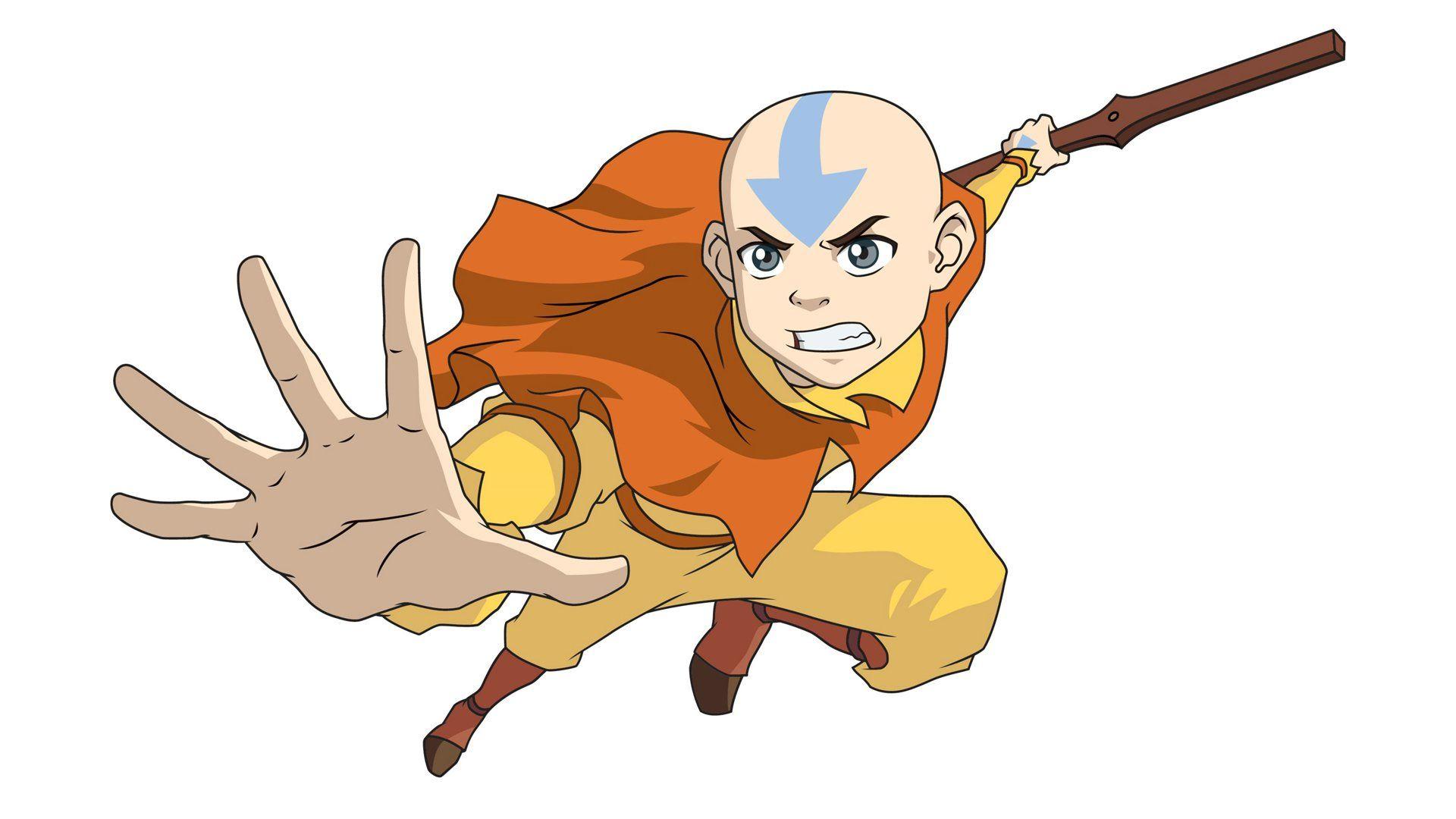
You know that feeling when you've watched a show a hundred times and a single frame still catches you off guard? For Avatar: The Last Airbender fans, that moment is usually the start of Book 3. Specifically, seeing Avatar Aang with hair. It is jarring. Honestly, after two seasons of a perfectly smooth, arrow-clad dome, seeing Aang wake up with a full head of shaggy black locks feels like looking at a different character entirely.
It isn't just a random design choice. It’s actually one of the most brilliant bits of visual storytelling in the whole series.
Most of us grew up thinking Aang was just... naturally bald? I mean, he’s twelve. But as the lore expanded, we realized the truth is much more deliberate. Air Nomad culture is deeply rooted in monastic traditions. Shaving their heads isn't about hair loss; it’s about sensing the wind. Think of those bald heads like high-definition sensors. Without hair in the way, an Airbender can feel the slightest change in air pressure. It makes them better fighters. More "in tune."
So, when does the hair actually happen?
Why Aang actually grew hair in Book 3
Basically, it comes down to a coma.
After Azula nearly ends the Avatar cycle at the end of Book 2 in Ba Sing Se, Aang is out for the count. He spends several weeks unconscious on a stolen Fire Nation ship. During that time, life happened. His body did what bodies do. His hair grew back. When he finally wakes up in the episode "The Awakening," he’s greeted by a reflection he barely recognizes.
It’s weirdly emotional. He feels like he failed the world. Looking in the mirror and seeing hair instead of his traditional Monk appearance just hammers home how much things have changed. He isn't the carefree kid from the Southern Air Temple anymore. He is a refugee in the heart of enemy territory.
The stealth factor
You've probably noticed that the hair serves a massive practical purpose too. The Gaang is trying to hide in the Fire Nation. If you’re the most wanted kid on the planet, walking around with a giant blue arrow on your head is a bad move.
The hair covers the arrows.
By wearing his hair out and throwing on a Fire Nation headband, Aang effectively disappears. He becomes "Kuzon," a normal student. He goes to school. He learns Fire Nation history (mostly propaganda). He even hosts a secret dance party. Without that hair, he’s a target. With it, he’s just another kid in a red uniform.
The secret detail most people miss
If you watch Book 3 closely, the animators did something really cool. Aang’s hair doesn't stay the same length. It grows.
Seriously. From "The Awakening" to "The Headband" and all the way to "The Day of Black Sun," the hair gets progressively shaggier. It’s a subtle way of showing the passage of time. Most cartoons keep character models static, but Avatar was always built different. You can see the weeks passing just by looking at the floof on Aang's head.
By the time they reach the invasion, his hair is thick enough that it actually changes his silhouette. He looks older. He looks tired.
Why did he shave it off?
A lot of fans actually preferred the hair look. It made him look a bit more "mainstream" hero-like. But Aang is an Air Nomad at his core. Before the invasion of the Fire Nation, he takes a ritualistic moment to shave it all off.
It’s a huge symbolic beat.
Shaving the hair was his way of saying, "The Avatar is back." He wasn't hiding as Kuzon anymore. He was ready to face Ozai as the last Airbender. He returned to his roots—literally and figuratively. There's a parallel scene where Zuko lets his hair down, symbolizing his own shift in identity. While Zuko was letting go of the rigid Fire Nation "top-knot" honor, Aang was embracing his monastic duty.
Cultural roots and real-world inspiration
The creators, Bryan Konietzko and Michael Dante DiMartino, didn't just pull this out of thin air. The Air Nomads are heavily inspired by Tibetan and Shaolin monks.
In these real-world cultures, shaving the head represents a detachment from vanity. It’s a commitment to a spiritual path. When Aang has hair, he is "disconnected" from his culture because it's all gone. He's the only one left. Having hair makes him look like everyone else, which is exactly what he doesn't want to be in the long run.
- Realism: Aang’s hair is black, which is consistent with the Asian-inspired ethnicities of the Four Nations.
- The "Shadow" Look: In the episode "Nightmares and Daydreams," we even see Aang with various hallucinated hairstyles due to sleep deprivation.
- The Legend of Korra: We see older Aang in flashbacks, and he's back to being fully bald with a beard. It seems once he hit adulthood, he stuck to the traditional look for good.
What you should do next
If you want to see the progression for yourself, go back and do a "hair-watch."
Start with Season 3, Episode 1, "The Awakening." Take a screenshot of Aang's hair. Then skip to Episode 9, "Nightmares and Daydreams," right before the invasion. Compare the two. The difference in length is significant and shows just how much detail the production team at Studio Mir and JM Animation poured into the show.
It’s also worth checking out the Avatar comics like The Promise or The Search. You get to see Aang navigate his identity as a world leader, and while he usually stays bald, the way he treats his appearance always ties back to those early Book 3 struggles. Understanding Aang's hair is basically understanding his journey from a scared kid in hiding to a realized Avatar ready to end a century-long war.