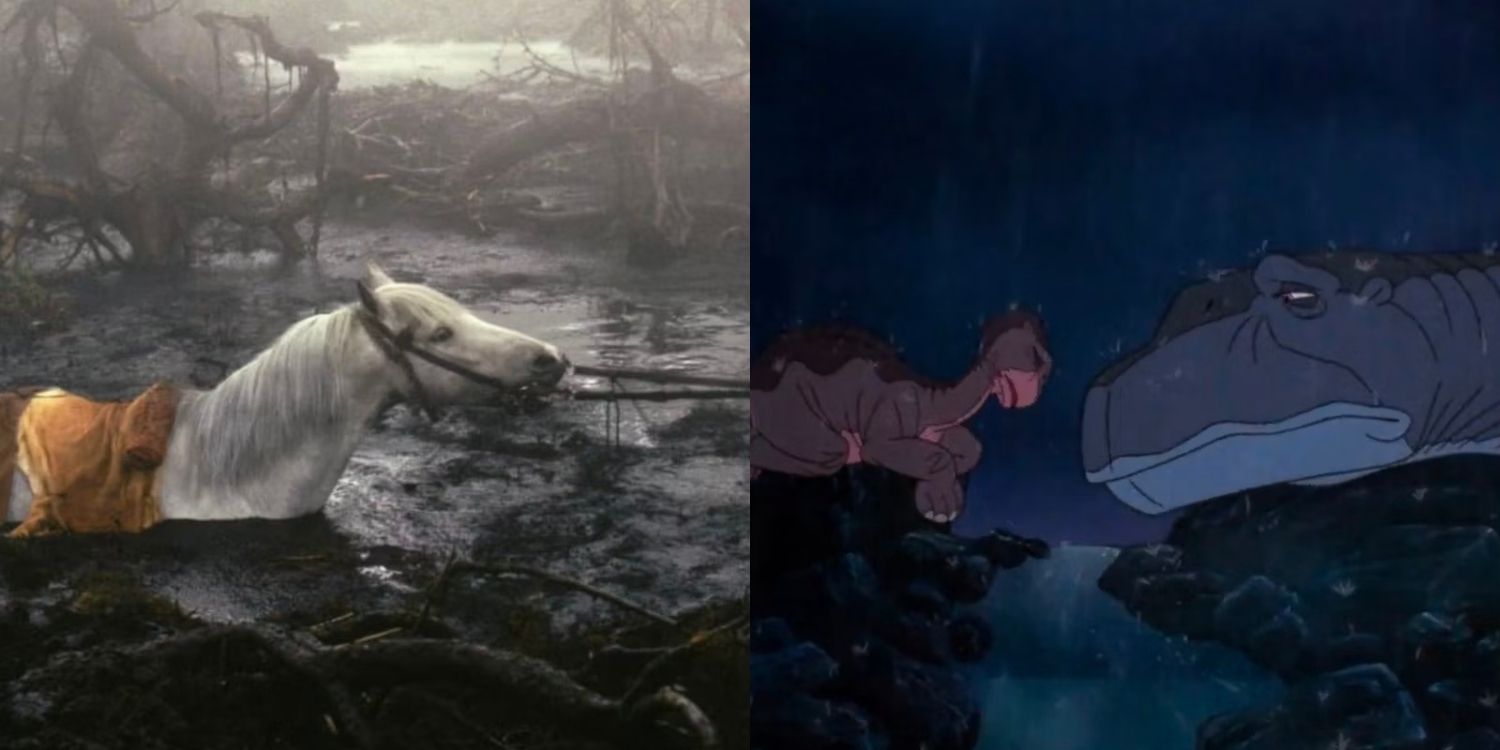
If you grew up in the eighties or nineties, you probably have a specific core memory involving a white horse, a lot of mud, and a kid screaming his lungs out. It’s a moment that defined a generation’s understanding of loss. Honestly, Artax in the Swamp of Sadness isn’t just a movie scene. It’s a cultural scar. It is arguably the most devastating sequence in children's cinema, rivaling the death of Bambi’s mother or Mufasa’s fall. But why does it hit so hard? Why does a puppet horse sinking into a puddle of grey sludge feel more real than most modern CGI blockbusters?
It’s about the hopelessness.
In Wolfgang Petersen’s 1984 masterpiece The NeverEnding Story, we don't just see a character die. We see a character give up. That’s the kicker. Artax doesn't die because of a wound or a villain. He dies because he stops caring. For a child watching that, it’s a heavy introduction to the concept of depression and the weight of the world.
The Mechanics of a Nightmare: How They Filmed Artax in the Swamp of Sadness
People always ask if the horse was okay. Let's clear that up right now. Despite the persistent urban legends that floated around playgrounds for decades, the horse did not actually die. There was a rumor—one of those pre-internet myths that refused to go away—that the hydraulic platform failed and the horse actually drowned on set.
That is 100% false.
The horse, whose real name was actually two different horses used for the production, was perfectly fine. They spent weeks training the horse to stand on a platform that slowly lowered into water treated with peat to make it look like thick, viscous mud. One of the horses used was actually gifted to Noah Hathaway (the actor who played Atreyu) after filming, though he couldn't keep it due to the logistics of transport back to the US. He ended up leaving it at a ranch in Germany where it lived out its life in luxury.
But knowing the horse lived doesn't make the scene easier to watch.
The filming took two months. Two months for just that one sequence. You can see the exhaustion in Noah’s eyes. He wasn't just acting. He was cold, he was tired, and he was covered in muck. The production design by Rolf Zehetbauer used a massive soundstage at Bavaria Studios in Munich. They built the swamp with a level of tactile detail that modern green screens just can’t replicate. You can practically smell the decay.
Why the "Sadness" is a Metaphor for Clinical Depression
Michael Ende, who wrote the original 1979 novel, was a master of using fantasy to explore the human psyche. In the book, Artax actually speaks. He tells Atreyu to leave him. He explains that the sadness is too heavy to carry.
The movie makes a different choice.
By keeping the horse silent, the film forces us to project our own feelings onto him. We see the wide, panicked eyes of a creature that has simply lost the will to move. It’s a perfect, albeit brutal, representation of how depression feels—the sense that you are sinking and the more you struggle, the faster you go, until eventually, you just stop struggling.
Atreyu’s reaction is what seals the deal. He isn't a stoic hero in this moment. He’s a desperate kid. He screams, "You have to try! You have to care!" It’s a plea to the universe. When he finally loses the grip on the reigns and Artax disappears completely under the surface, the silence that follows is deafening. There’s no big orchestral swell right away. Just the sound of bubbling mud.
It’s visceral.
The Lasting Impact on Gen X and Millennials
Most kids' movies today are softened. There's a safety net. But Artax in the Swamp of Sadness offered no such protection. It taught us that sometimes, despite your best efforts, you can’t save the things you love. That is a dark lesson for an eight-year-old, but it’s also why the movie stays with us. It treated its audience with a level of emotional respect that is rare now.
- Practical Effects vs. CGI: The weight of the horse is real. The way the mud clings to Atreyu’s fur cape is real. Because the physics are correct, our brains don't "switch off" like they do during a CGI battle.
- The Concept of The Nothing: The swamp is just a precursor to The Nothing. If the Swamp of Sadness takes your spirit, The Nothing takes your existence. It's a tiered exploration of nihilism.
- Noah Hathaway’s Performance: He actually stepped on a nail during filming and was nearly pulled under by the elevator mechanism at one point. That genuine peril translates to the screen.
I remember talking to a friend who is a therapist, and she mentioned that this scene is often brought up by patients when discussing early childhood memories of "the world feeling unsafe." That’s a powerful legacy for a fantasy flick.
What Most People Get Wrong About the Swamp Scene
There is a common misconception that Artax died because he wasn't "pure of heart" or something similar. That’s not it at all. In the logic of Fantastica (or Fantasia in the film), the swamp affects everyone. The only reason Atreyu survives is because of the AURYN. The magical amulet protects him from the emotional effects of the environment.
Artax didn't have an amulet.
He was just a horse. A loyal, brave horse who was simply susceptible to the atmosphere of the place. It makes his death feel even more unfair. He wasn't failing a test; he was a victim of a biological and magical hazard.
Also, can we talk about the Gmork? The werewolf creature that serves the Nothing is stalking Atreyu right after this. The pacing is relentless. You lose your best friend, and then you’re immediately hunted by a nightmare with glowing green eyes. The movie doesn't give you time to grieve, which, honestly, is a pretty accurate representation of how life works sometimes.
The Book vs. The Movie: A Darker Turn
If you think the movie is sad, the book is a different beast entirely. Michael Ende was famously unhappy with the film adaptation. He called it a "humongous melodrama of kitsch, commerce, plush, and plastic."
He was wrong about the kitsch, but the book does offer more context. In the prose version, the dialogue between the horse and the boy lasts for pages. Artax begs Atreyu to go on without him so that the quest doesn't fail. It’s a conscious sacrifice in the book, whereas in the movie, it feels more like a tragic accident of the soul.
Both versions work, but the film's visual of the lone white head disappearing into the dark water is the image that stayed in the collective consciousness.
Actionable Insights for Fans and Parents
If you’re planning on showing this to your kids, or if you’re revisiting it yourself to heal some old wounds, here is how to handle the "Artax trauma":
- Watch the "Making Of" footage: Seeing the horse (his name was Rico, by the way) standing on the dry set with the crew after the scene helps break the "movie magic" spell. It’s a great way to show kids how stories are built.
- Discuss the Metaphor: Don't just skip the scene. Use it as a way to talk about sadness. Ask, "Why do you think he stopped walking?" It’s a surprisingly effective bridge to talking about mental health in an age-appropriate way.
- Read the Book: The novel is a deep, philosophical journey that explores identity and the power of imagination far beyond what the 90-minute movie could cover.
- Acknowledge the Score: Listen to Klaus Doldinger’s work on this specific track. The shift from the heroic "Atreyu’s Quest" theme to the dissonant, somber tones of the swamp is a masterclass in emotional manipulation through music.
Artax in the Swamp of Sadness remains a benchmark for cinematic storytelling. It reminds us that for a hero's journey to mean anything, the stakes have to be real. The loss has to hurt. And decades later, it still hurts like it was yesterday.
To really process the impact of this scene, you have to look at the broader context of 80s fantasy. This was an era where movies like The Dark Crystal, Labyrinth, and Return to Oz weren't afraid to be terrifying. They understood that children are capable of handling complex emotions. By facing the Swamp of Sadness with Atreyu, we learned how to keep walking even when the ground feels like it’s giving way.
The next time you see a white horse or a muddy field, and you feel that little pang of sorrow in your chest, just remember: that’s the power of great art. It’s a testament to a story well told that a puppet and some peat moss could teach us so much about being human.
Practical Next Steps
To truly appreciate the craftsmanship behind this scene, your next step is to look up the original production sketches by Ul de Rico. His concept art for the Swamps of Sadness provided the visual blueprint that allowed the set designers to create such a haunting atmosphere. Understanding the visual language of the swamp—the horizontal lines, the muted color palette, and the "dead" vegetation—reveals why the scene feels so claustrophobic and inescapable.
Additionally, check out the restored 4K version of the film. The clarity of the restoration highlights the subtle movements in the horse's eyes and the trembling in Atreyu's hands, making the emotional weight of the scene even more apparent than it was on grainy VHS tapes.