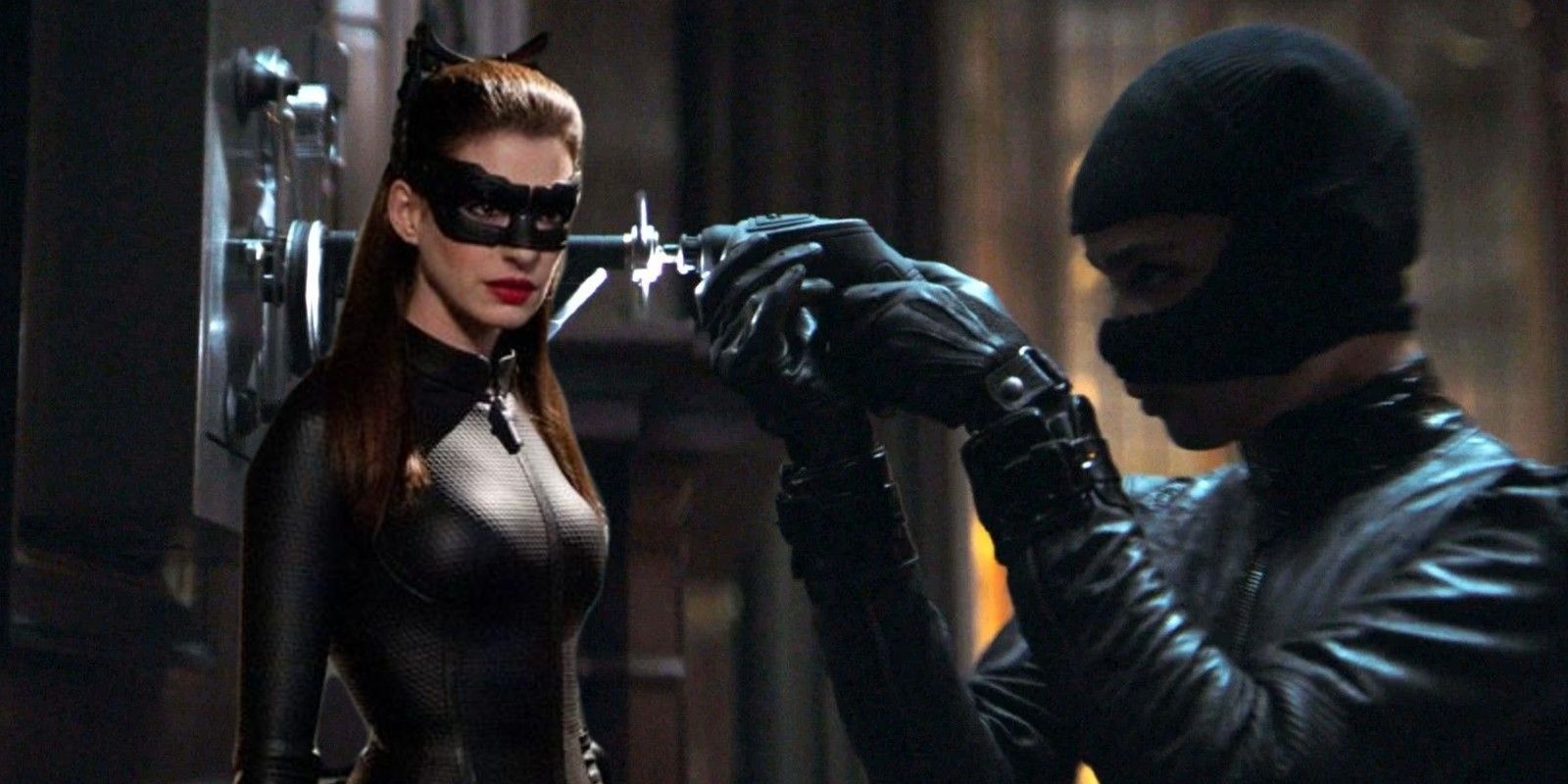
When the news first broke that Anne Hathaway was cast as Selina Kyle in Christopher Nolan’s The Dark Knight Rises, the internet basically imploded. It was 2011. People were still riding the high of Heath Ledger’s Joker, and the skepticism was through the roof. Could the girl from The Princess Diaries actually pull off a gritty, Nolan-style Catwoman?
Honestly, the doubt was loud.
But looking back from 2026, Hathaway’s performance hasn't just aged well—it’s become a masterclass in how to play a comic book character without the camp. She didn't just play a thief; she played a survivor who happened to be the smartest person in any room she walked into.
The Casting Choice That Nobody Saw Coming
Nolan has a thing for subverting expectations. He did it with Ledger, and he did it again here. Hathaway actually walked into her audition thinking she was reading for Harley Quinn. She wore a crazy Vivienne Westwood top with pins sticking out and did this whole "unhinged" vibe for about an hour before Nolan told her, "It’s actually Selina Kyle."
Talk about a pivot.
She had to drop the mania and find the grace. To prepare, she went back to the roots of the character, specifically looking at Hedy Lamarr, the 1940s screen siren who originally inspired the Catwoman creator, Bob Kane.
The competition was fierce, too. We’re talking about Jessica Biel, Keira Knightley, and Natalie Portman all being in the mix. But Anne had this specific quality—a mix of vulnerability and "I will kick your teeth in"—that won Nolan over. She wasn't just a femme fatale; she was a woman with a worldview shaped by the class divide in Gotham.
"Living on Kale and Dust": The Physical Transformation
You’ve probably heard the stories about the catsuit. Hathaway called it a "psychological terrorist."
She spent ten months in the gym. Ten. Months.
She worked out five days a week, doing a mix of martial arts, Bikram yoga, and heavy lifting. At one point, she was working out next to a pregnant Jessica Alba and joked that Alba could do more push-ups than she could. But the goal wasn't just to look good in the Lycra; it was about the stunts.
Nolan’s Gotham is tactile. It’s real.
Hathaway did a massive amount of her own stunt work. Those high-heeled boots? They weren't just for show. They were designed with serrated edges on the heels to be used as actual weapons. If you watch the fight scenes closely—like the rooftop brawl where she teams up with Batman against Bane’s mercenaries—her movement is fluid and feline but grounded in actual combat logic.
There was no "magic" here. Just a lot of bruises.
Her stunt double, Jolene Van Vugt, a legendary motocross rider, had to master the Batpod in just three days because Nolan was adamant about not using a male rider for the character. The attention to detail was so intense that Van Vugt even wore a helmet specially designed to look like the top of Hathaway's head so they could film high-speed chases without a CGI face-swap.
Why This Selina Kyle Still Matters
What most people get wrong about Anne Hathaway in Batman is the idea that she’s just a sidekick or a love interest.
She’s the moral compass of the movie, in a weird way.
While Bruce Wayne is brooding in his mansion, Selina is on the ground. She’s the one who tells him, "There's a storm coming, Mr. Wayne." She represents the people Gotham left behind. She’s not "evil" like Bane or "chaotic" like the Joker. She’s practical.
Her motivation is the "Clean Slate"—a mythical computer program that can wipe a person's criminal history. That’s such a human goal. She doesn't want to rule the world; she just wants a chance to start over.
Key Elements of Hathaway's Performance:
- The Voice: She shifts her tone depending on who she’s talking to. To the cops, she’s a helpless victim. To Bruce, she’s a peer.
- The Tech: The "ears" on her costume are actually night-vision goggles that flip up. It’s a functional design that fits the "Nolanverse."
- The Humor: In a movie that is incredibly heavy and dark, she provides the only real levity. Her "disappearing act" on Batman is a classic nod to the comics.
The Legacy of the 2012 Catwoman
Critics at the time were divided on the movie itself, but they were almost unanimous on Hathaway. Slate called her the "best Catwoman ever to grace the big screen," noting that she avoided the "female trauma" tropes that usually plague the character.
She wasn't a victim seeking revenge. She was a pro.
Even with Zoë Kravitz’s excellent turn in The Batman (2022), Hathaway’s version remains the most "operatic." She fit perfectly into the grand, Shakespearean finale of the trilogy. She gave Batman a reason to finally stop being Batman.
The ending of the film—where Alfred sees Bruce and Selina at a café in Florence—is still debated. But whether you think it was a dream or reality, it worked because Hathaway earned that happy ending. She took a character known for being a "bad girl" and made her the hero of her own story.
If you’re revisiting the trilogy, pay attention to the scene at the masquerade ball. The way she dances with Bruce while basically telling him his world is about to burn down is pure cinema. It’s not just a "Batman movie" moment; it’s a great character moment, period.
To really appreciate the depth here, go back and watch her scenes without the suit. The "maid" sequence at the beginning of the film is a perfect example of her range—switching from a mousy servant to a cold-blooded thief in the blink of an eye. That’s the real Anne Hathaway magic.
Actionable Insights for Movie Buffs:
- Watch the 1940s films of Hedy Lamarr to see the exact "cool detachment" Hathaway was aiming for.
- Analyze the "Clean Slate" dialogue during the dance scene; it’s the most important thematic setup in the entire film.
- Look for the serrated heels in the rooftop fight scene to see the practical stunt design in action.