People usually think of state capitals as the beating heart of their respective states. You picture massive skyscrapers, endless traffic, and the kind of cultural gravity that pulls everyone toward the center. But honestly? That’s rarely the case. If you look at all 50 state capitals, you’ll realize that America has a strange obsession with putting its seats of power in the middle of nowhere.
Take Montpelier, Vermont. It has fewer than 8,000 people. You can walk across the "downtown" in about ten minutes, and it's the only state capital without a McDonald's. Compare that to Phoenix, Arizona, which is a sprawling desert metropolis of nearly 1.7 million people. The disconnect is wild. We have this patchwork of tiny mountain towns and massive concrete jungles all holding the same title.
Most of these cities weren't chosen because they were the "best" places to live. They were chosen because of 19th-century logistics. Back then, if you couldn't get there by horse or riverboat in a day, the location was useless. That's why so many capitals feel like they’re stuck in a time capsule, while the "cool" cities like NYC, Chicago, or Seattle took all the glory.
Why Some of the Smallest Cities Hold the Most Power
It’s a common trivia trap. Most people guess that the biggest city in a state is the capital. Wrong. In fact, in 33 out of 50 states, the capital is not the most populous city.
Look at New York. Most of the world thinks the state begins and ends at Times Square, but the laws are actually signed in Albany. Albany is fine, sure, but it’s a far cry from the "City That Never Sleeps." Then you've got California. Everyone knows Los Angeles and San Francisco, but Sacramento is where the budget—which is basically the size of a small country's GDP—gets hammered out.
There is a historical reason for this. In the 1800s, there was a massive push to keep capitals "centrally located." Lawmakers didn't want the coast or a single port city to have all the influence. They wanted the farmer in the middle of the state to have the same access to the governor as the merchant on the harbor. This led to the creation of "purpose-built" cities. Jefferson City, Missouri, is a perfect example. It was basically carved out of the wilderness because it sat on the Missouri River and was roughly in the center of the state.
The Absolute Giants vs. The Tiny Outposts
The scale of all 50 state capitals is truly bizarre when you see them side-by-side.
- Phoenix, Arizona: The undisputed heavyweight. It's the only state capital with over a million people. It’s hot, it’s huge, and it’s growing faster than the infrastructure can sometimes handle.
- Austin, Texas: The "cool" capital. Unlike many others, Austin managed to become the cultural and tech hub of its state while still keeping the government buildings.
- Pierre, South Dakota: On the flip side, Pierre is tiny. Like, "everybody knows your name" tiny. It has about 14,000 residents. If you're driving through, you might miss it if you blink.
- Juneau, Alaska: This one is just plain difficult. You can't drive to Juneau. There are no roads connecting it to the rest of Alaska or North America. You have to take a plane or a boat. Imagine trying to run a state where you're effectively on an island.
A Coastal Run of Power and History
In the East, the capitals feel like museums. Boston, Massachusetts, is probably the most "capital-y" of them all. It’s got the history, the gold-domed State House, and the actual population to back it up. It feels prestigious.
Then you go south to Annapolis, Maryland. It’s beautiful, bricks everywhere, right on the water. It actually served as the temporary capital of the United States for a brief window in the 1780s. But it’s small. If you aren’t there for the Naval Academy or the legislature, you’re there for the crab cakes.
Richmond, Virginia, carries a heavy weight. You can't walk through those streets without feeling the layers of Civil War history. It’s a city that has spent the last few decades trying to balance its status as a "New South" tech and arts hub with its deeply complicated past.
The Mid-Country Hubs
In the Midwest, capitals often double as massive college towns. Columbus, Ohio, is a beast. Between the state government and Ohio State University, the city is an economic juggernaut. It’s one of the few Midwestern cities that isn’t shrinking; it’s actually exploding.
Madison, Wisconsin, sits on an isthmus between two lakes. It’s gorgeous. It’s also arguably the most politically charged capital in the region. Because the university and the capitol building are on the same street, the energy there is always high.
Then you have the "Insurance Capital of the World," Hartford, Connecticut. Or Des Moines, Iowa, which basically decides who the next President will be every four years because of the caucuses. These cities might not have the "glamour" of Vegas or Miami, but they are where the gears of the American machine actually turn.
The Western Frontier Capitals
Out West, things get spread out. Salt Lake City, Utah, is framed by mountains that look like a movie backdrop. It’s clean, it’s organized, and it’s the religious and political center of the state in a way few other capitals are.
Cheyenne, Wyoming, still feels like the Old West. They have the "Frontier Days" rodeo, and the wind blows hard enough to knock you over. It’s a high-plains city that doesn't care about being trendy. It just works.
Boise, Idaho, is the surprise hit of the last decade. It’s become a massive destination for people fleeing the high costs of California. It’s got a river running through the middle, mountains nearby, and a downtown that is actually thriving. It’s one of the few "small" capitals that feels like it’s becoming a big city in real-time.
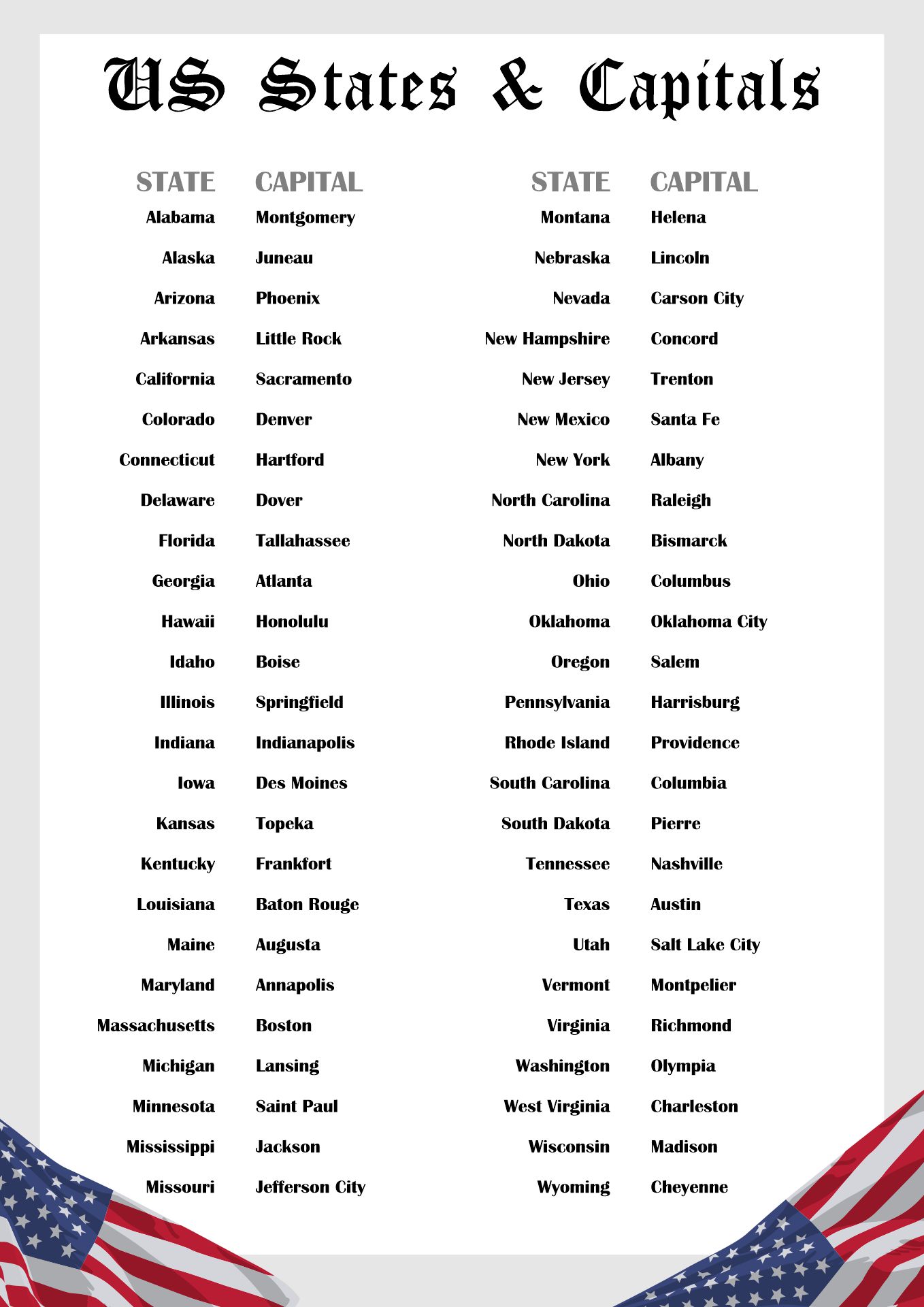
The Full List: All 50 State Capitals at a Glance
If you're trying to memorize these or just need a quick reference, here they are. No fluff.
- Alabama: Montgomery
- Alaska: Juneau
- Arizona: Phoenix
- Arkansas: Little Rock
- California: Sacramento
- Colorado: Denver
- Connecticut: Hartford
- Delaware: Dover
- Florida: Tallahassee
- Georgia: Atlanta
- Hawaii: Honolulu
- Idaho: Boise
- Illinois: Springfield
- Indiana: Indianapolis
- Iowa: Des Moines
- Kansas: Topeka
- Kentucky: Frankfort
- Louisiana: Baton Rouge
- Maine: Augusta
- Maryland: Annapolis
- Massachusetts: Boston
- Michigan: Lansing
- Minnesota: Saint Paul
- Mississippi: Jackson
- Missouri: Jefferson City
- Montana: Helena
- Nebraska: Lincoln
- Nevada: Carson City
- New Hampshire: Concord
- New Jersey: Trenton
- New Mexico: Santa Fe
- New York: Albany
- North Carolina: Raleigh
- North Dakota: Bismarck
- Ohio: Columbus
- Oklahoma: Oklahoma City
- Oregon: Salem
- Pennsylvania: Harrisburg
- Rhode Island: Providence
- South Carolina: Columbia
- South Dakota: Pierre
- Tennessee: Nashville
- Texas: Austin
- Utah: Salt Lake City
- Vermont: Montpelier
- Virginia: Richmond
- Washington: Olympia
- West Virginia: Charleston
- Wisconsin: Madison
- Wyoming: Cheyenne
The Architecture of Power
If you visit all 50 state capitals, you’ll notice a theme: domes. Specifically, Neoclassical domes that look like the U.S. Capitol in D.C.
But there are rebels.
Louisiana’s state capital in Baton Rouge is a 450-foot Art Deco skyscraper. It’s the tallest state capitol in the country. Huey P. Long, the legendary (and controversial) governor, wanted something that looked like the future, not the past.
Florida’s capitol in Tallahassee is also a skyscraper, though it’s... let’s just say it’s a bit of an acquired taste. It looks more like a 1970s office building than a seat of government.
New Mexico has the "Roundhouse." It’s the only circular state capitol in the U.S., designed to look like a Zia sun symbol from above. It’s a beautiful nod to the indigenous culture that was there long before the state was ever formed.
Hawaii’s capitol is also unique. It’s built to resemble a volcano, with a central courtyard that is open to the sky, allowing the rain and the wind to come right into the building. It’s a stunning piece of architecture that perfectly fits the islands.
What People Get Wrong About These Cities
The biggest misconception? That they are boring.
Sure, if you go to Springfield, Illinois, on a Tuesday night in February, it might feel a bit quiet. But these cities are often the culinary and artistic hubs of their regions because they have a stable base of state employees and students.
Take Providence, Rhode Island. It’s a small capital, but it has one of the best food scenes in the country thanks to the nearby culinary schools. Or Santa Fe, New Mexico, which is basically one giant art gallery.
Even the "boring" ones have secrets. Did you know that underneath the streets of Oklahoma City, there’s a tunnel system called the "Underground" that connects all the major government buildings? It’s a climate-controlled maze filled with art and history.
Actionable Tips for Your State Capital Road Trip
If you're actually planning to visit some of these, don't just go to the capitol building and leave.
Check the legislative calendar. If the "ledge" is in session, the energy in the city changes completely. The bars are packed with lobbyists, the coffee shops are buzzing with gossip, and you can actually walk into the galleries and watch laws being made. It's democracy in its rawest, most chaotic form.
Look for the "Old" Capital. Many states moved their capitals several times. In California, Benicia and Vallejo were capitals before Sacramento. Visiting the "lost" capitals is a great way to see how the state's power shifted over time.
Eat where the politicians eat. Every capital has a "power lunch" spot. In Austin, it might be a taco joint; in Boston, it's probably a high-end steakhouse. Ask a local where the staffers go. That’s where you’ll find the best food and the real stories.
Focus on the geography. Notice how many of these cities are on rivers. In a pre-highway world, the river was the lifeblood. Walking the waterfronts in cities like Sacramento, Harrisburg, or St. Paul gives you a much better sense of why these cities exist in the first place.
Download a self-guided tour app. Most state capitols have free tours, but they are often limited to business hours. Many cities now have apps that let you walk the grounds and learn about the statues and monuments on your own time.
America’s state capitals aren't just dots on a map or answers on a geography quiz. They are the physical manifestations of how we’ve tried to organize ourselves for 250 years. Some are thriving, some are struggling, but all of them have a story that is way more interesting than a textbook would lead you to believe.