It has been ten years. Ten years since the Toronto skyline provided the backdrop for what most people consider the greatest slugfest in NBA All-Star history. If you mention the Aaron Gordon 2016 dunk contest performance to any basketball fan today, you’ll likely get one of two reactions. They’ll either stare off into the distance like they’re remembering a lost love, or they’ll immediately start yelling about how the judges "robbed" him.
Honestly, it’s one of those "where were you" moments. I remember sitting on my couch, watching a 6’8” forward for the Orlando Magic do things with a basketball that felt like they violated the laws of physics. People weren't just cheering; they were confused. How does a human body do that?
The Night the Dunk Contest Finally Woke Up
Before we get into the nitty-gritty of why the Aaron Gordon 2016 dunk contest run was so special, you have to remember the context. The event was kinda dying. For years, we’d seen guys miss five times in a row or use props that felt like bad corporate sponsorships. Then came 2016.
Zach LaVine was the defending champ, a pogo stick in a Timberwolves jersey. But Aaron Gordon was the wild card. He didn't just bring power; he brought a level of creativity that made the rim look like a stage for Cirque du Soleil.
The battle didn't just go to the final round. It went to a "dunk-off." Then another one. It was basically the basketball equivalent of a heavyweight boxing match where neither guy would go down. Every time Gordon dropped a 50, LaVine answered with a 50. It felt endless. In a good way.
Breaking Down the Masterpieces
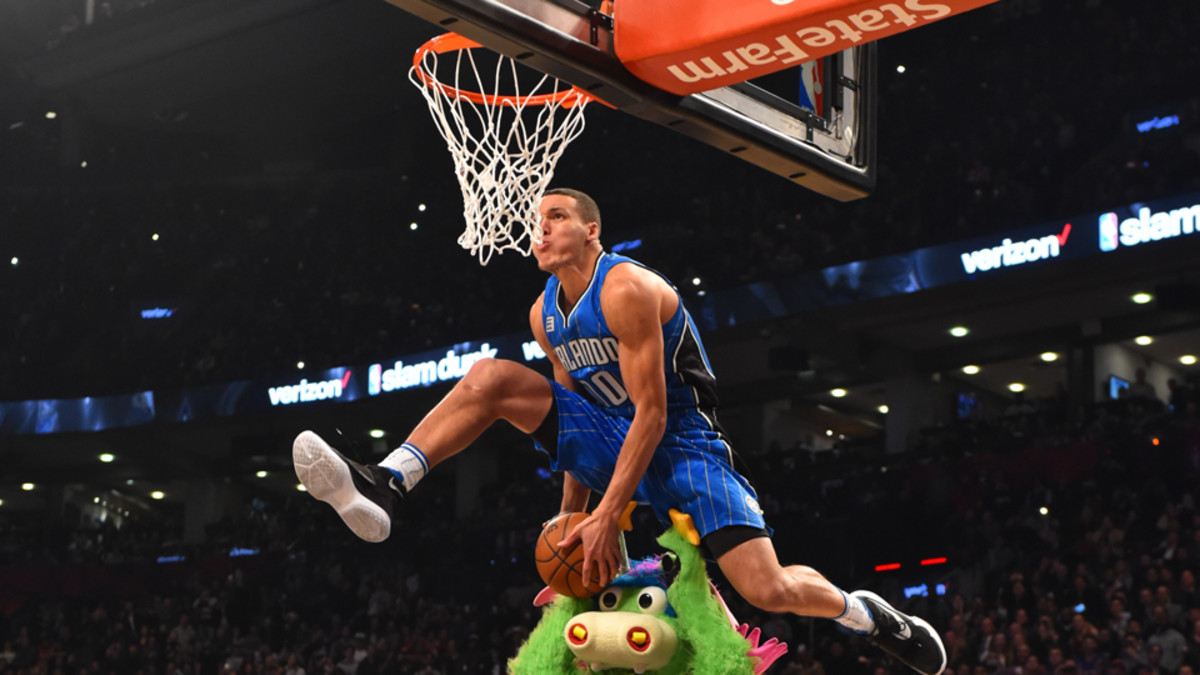
If you haven't watched the highlights recently, your memory probably does a disservice to how difficult these dunks actually were. Gordon’s collaboration with "Stuff the Magic Dragon" (the Magic’s mascot) is the stuff of legend.
First, there was the "Hoverboard Dunk." Stuff was spinning in circles on a hoverboard—remember when those were everywhere?—while holding the ball. Gordon timed his run perfectly, snatched the ball from the mascot's hands, and pulled off a 360-degree windmill that looked effortless.
But that wasn't even the peak.
The peak was the "Sitting in Mid-Air" dunk. You know the one. He jumped over Stuff, who was standing on the hoverboard. But instead of just jumping over him, Gordon tucked both legs under his body, effectively sitting in an invisible chair 7 feet in the air, passed the ball under both hamstrings, and slammed it home.
Shaquille O'Neal, who was judging, looked like he'd seen a ghost.
The vertical leap required for that is insane. Analysts later calculated that Gordon’s hips were nearly level with the rim. If that happened in an Olympic high jump competition, he would've been a serious medal contender.
The Controversy: Was Aaron Gordon Actually Robbed?
This is where the internet gets spicy. The scoring system in the NBA Dunk Contest is, frankly, a bit of a mess. When everything is a 50, nothing is a 50.
After several rounds of perfect scores, Gordon eventually lost when he received a 47 on his final dunk—a double-pump reverse where he brought the ball down to his knees before finishing. LaVine responded by going between his legs from the free-throw line. LaVine got a 50. Gordon went home with a trophy-less memory.
Why the 47 Felt Like a Crime
A lot of fans argue that by the time Gordon did his final dunk, the judges were just tired. They wanted a winner. But if you look at the technical difficulty, Gordon was doing things we hadn't seen. LaVine was incredible, but he was doing variations of the same thing: taking off from the charity stripe.
Gordon was changing the geometry of the dunk.
- Creativity: Gordon used the mascot and the hoverboard as active participants, not just stationary props.
- Physics: The "under the legs" dunk required a hang time that seemed to defy gravity.
- Variety: He showed power, grace, and 360-degree rotation.
There’s also the "big man" bias. Usually, smaller guards like LaVine look more "graceful" because they move through the air differently. Gordon is a big dude. For a guy that size to have that much body control in the air is rare.
The Legacy of Toronto 2016
The Aaron Gordon 2016 dunk contest didn't just make him a household name; it changed how players approached the contest. Suddenly, just jumping high wasn't enough. You needed a "concept." You needed to tell a story with the mascot.
Unfortunately, it also started a bit of a curse for Gordon. He went back in 2020 and got "robbed" again in a duel with Derrick Jones Jr. (the infamous Dwyane Wade 9-point score). It’s sorta poetic and tragic at the same time. He’s arguably the greatest dunker to never win the actual trophy.
But does the trophy even matter?
In 2026, nobody talks about who has the physical trophy in their house. They talk about the video clips. Gordon's "under the legs" dunk has millions more views than many of the winning dunks from the last decade. He won the "culture," even if he lost the hardware.
How to Watch and Analyze Like a Pro
If you want to really appreciate what happened that night, don't just watch the slow-motion replays. Watch the live speed. The speed at which Gordon transitions from the jump to the ball-transfer under his legs is blink-and-you-miss-it fast.
Pay attention to:
- The Takeoff Point: Most of his dunks started further back than people realize.
- The Mascot's Timing: If Stuff the Magic Dragon moves an inch, the dunk fails.
- The Reaction of the Bench: Look at the other NBA All-Stars in the background. Their faces tell you everything you need to know about the "robbery."
To truly get the most out of revisiting this moment, go find a high-definition upload of the full broadcast. Don't just watch the 10-second clips. You need to feel the tension building in the arena as they kept trading 50s. It was a heavyweight fight that happened to involve a basketball.
Next time you’re in a debate about the GOAT dunker, remember that Vince Carter had the best single performance in 2000, but Aaron Gordon gave us the best competition we’ve ever seen. Go back and watch that "sitting" dunk one more time. Focus on his head level. He’s looking down at the rim. That’s not normal. That’s Aaron Gordon.
Study the frame-by-frame breakdown of the "under both legs" dunk to see the exact moment he clears the mascot without using his hands for leverage. Comparing his 2016 tape to his 2020 performance provides a fascinating look at how his dunking style evolved from raw verticality to complex, power-based rotations.