You’ve heard it before. Maybe in a third-grade classroom or while scrolling through a trivia site during a boring meeting. A man, a plan, a canal, Panama. It’s the king of palindromes. It reads the same backward and forward, provided you ignore the punctuation and the spaces. Most people just think it’s a clever trick of the English language. But if you actually look at the nouns in a famous palindrome like this one, you realize it isn't just a linguistic fluke. It’s a condensed history of one of the most audacious engineering projects in human history.
Wordplay is weird.
Leigh Mercer is the guy we usually thank for this specific 1948 masterpiece. He was a British wordplay expert, and honestly, he nailed it. But why these words? Why not "A dog, a plan, a canal, pagoda"? Because the nouns here—man, plan, canal, Panama—actually mean something. They aren't just placeholders. They represent a specific intersection of ego, geography, and geopolitics that changed how the world trades.
The "Man" Behind the Palindrome
When people talk about the nouns in a famous palindrome, they often start with the "man." In Mercer’s line, the man is generally accepted to be Ferdinand de Lesseps. Or maybe it’s Theodore Roosevelt. It depends on who you ask and how much you like late 19th-century history.
De Lesseps was the superstar who built the Suez Canal. He thought he could do the same in Central Panama. He was wrong. He tried to build a sea-level canal, ignoring the fact that the Atlantic and Pacific oceans have different tidal levels and, you know, there’s a giant mountain range in the middle. He was the "man," but his "plan" was a disaster. Thousands of workers died from yellow fever and malaria. The project went bankrupt. It was a mess.
Then comes Teddy Roosevelt. If de Lesseps was the man who failed, Roosevelt was the man who forced it to happen. He didn't just want a canal; he wanted an American legacy. He basically orchestrated a revolution to make Panama an independent country just so he could get the land rights. That’s a pretty intense way to fulfill a palindrome.
Breaking Down the "Plan"
The "plan" is the second of the crucial nouns in a famous palindrome. In the context of Panama, the plan shifted from a sea-level ditch to a complex lock system. This wasn't just a minor tweak. It was the difference between a graveyard and a miracle of engineering.
Engineering isn't always sexy. It’s a lot of math.
The plan involved creating Gatun Lake, which, at the time, was the largest man-made lake in the world. They had to dam the Chagres River. They had to carve through the Culebra Cut, a literal mountain of rock that kept sliding back down every time they dug. Imagine spending all day digging a hole only for the dirt to melt back in like chocolate syrup. That’s what happened. The plan had to account for the rainy season, the mud, and the sheer scale of moving millions of cubic yards of earth.
Why the Plan Almost Failed
- Disease: They didn't know mosquitoes carried yellow fever. Once they figured that out, the plan changed to include massive sanitation efforts.
- Geology: The soil in Panama is unstable. It's not just dirt; it’s a nightmare of clay and shale.
- Politics: The U.S. Congress wasn't always on board with the spending.
That "Canal" and Why It Matters
Now we get to the "canal." This is the core of the nouns in a famous palindrome. A canal isn't just a big puddle. It’s a machine. The Panama Canal operates using gravity—no pumps. When a ship enters a lock, water flows from a higher level to a lower level just by opening valves.
It's basically a giant water elevator.
If you’ve ever seen a massive Post-Panamax ship squeeze through the Neopanamax locks, it’s terrifying. There are mere inches on either side. These ships carry thousands of containers filled with everything from iPhones to cheap plastic toys. Without this canal, a ship going from New York to San Francisco would have to sail all the way around Cape Horn at the tip of South America. That’s an extra 8,000 miles.
Think about the fuel. Think about the time. The canal is the reason your online orders don't take six months to arrive.
The Final Destination: Panama
Panama is the final noun. It’s the anchor. Geographically, it’s the "Isthmus," a narrow strip of land connecting two larger landmasses. But as one of the nouns in a famous palindrome, it represents more than just a place. It represents the sovereignty and the struggle of a nation caught between two oceans.
For a long time, the Canal Zone was American territory. It was a little slice of the U.S. in the middle of the jungle. Panamanians weren't always happy about this. In 1977, the Torrijos-Carter Treaties were signed, which eventually handed the canal back to Panama on December 31, 1999.
Now, Panama runs the show. They’ve expanded it. They’ve turned it into a massive revenue generator for their country. It’s no longer just a "plan" by a foreign "man." It’s theirs.
Exploring Other Famous Palindromic Nouns
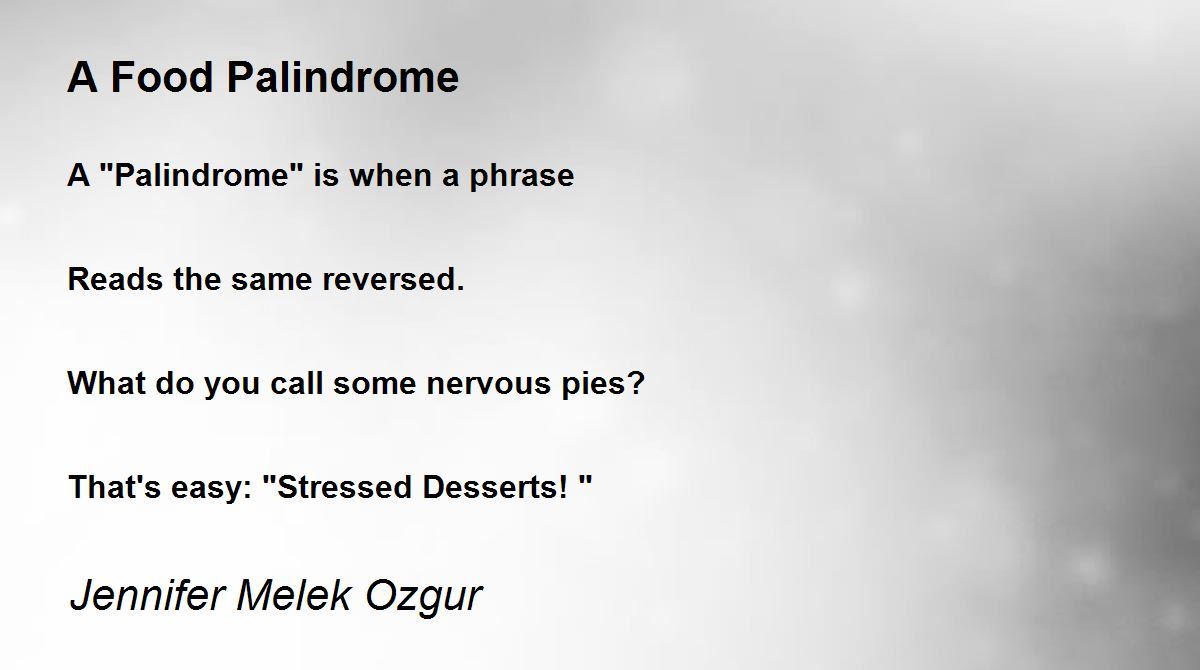
While Mercer’s Panama line is the most famous, other palindromes use nouns to create equally vivid (if weirder) images. Look at "Satan oscillates tonight." The noun here is "Satan." It’s dark, rhythmic, and honestly, a bit creepy. Or "Go hang a salami, I'm a lasagna hog." Here, the nouns "salami," "lasagna," and "hog" create a bizarre culinary visual that feels like a fever dream.
Palindromes work because nouns provide the "weight." Verbs provide the action, but nouns give you the picture.
A Quick Look at Palindromic Structure
Nouns are often the pivot points. In "A man, a plan, a canal, Panama," the word "a" acts as a separator, but the nouns are the rhythmic beats.
- Man (Subject)
- Plan (Concept)
- Canal (Object)
- Panama (Location)
It moves from the individual to the idea, to the physical thing, to the geographic location. It’s a perfect telescopic view of history.
Why We Are Obsessed With These Words
Humans love patterns. Our brains are hardwired to find symmetry. When we find a string of words that works the same way in both directions, it feels like we’ve discovered a secret code in the universe. Linguists call these "reversible sentences," but that sounds too clinical.
They’re puzzles.
When you deconstruct the nouns in a famous palindrome, you’re engaging in a form of literary archaeology. You’re looking at how letters like 'n', 'a', and 'p' can be rearranged to tell a story about a specific place in time. Panama is the perfect word for this because of its vowel structure. The 'a-a-a' pattern makes it incredibly flexible for palindromists.
Misconceptions About the Panama Palindrome
One big misconception is that the palindrome was written during the construction of the canal. Nope. Mercer wrote it decades after the canal was finished. Another myth is that it’s the "perfect" palindrome. Technically, some people argue that "Panama" is a proper noun, which "cheats" a little bit, but that’s just being pedantic.
The reality is that the nouns in a famous palindrome need to be recognizable. If Mercer had used "A man, a plan, a canal, Urbana," it wouldn't have the same punch. Everyone knows Panama. Not everyone knows Urbana (no offense to Illinois).
Actionable Insights for Wordplay Lovers
If you want to dive deeper into the world of palindromes or even try writing your own, you have to start with the nouns. They are your anchors.
Start with "A" words. Words like "area," "ala," or "alpha" are great for beginning or ending strings.
Look for pivot letters. The letter 'v' is hard. The letter 's' is easy because it can make things plural, which helps with symmetry.
Study the greats. Don't just look at Mercer. Look at Demetri Martin’s 224-word palindrome. It’s insane. He uses nouns like "poet," "poem," and "star" to weave a narrative that actually makes sense (mostly).
Visit the source. If you ever get the chance, go to the Miraflores Locks in Panama. Stand there and watch a ship rise. It makes the nouns in a famous palindrome feel very, very real. You realize that "a plan" wasn't just a word—it was a blueprint that thousands of people died to execute.
To truly appreciate this linguistic feat, try this:
- Write down the four main nouns: Man, Plan, Canal, Panama.
- Research one specific person (the Man) involved, like Chief Engineer John Stevens.
- Look at a map of the Culebra Cut (the Canal) to see the physical scale.
- Say the phrase out loud, slowly. Notice how your mouth moves the same way at the start and the end.
There is a weird beauty in the fact that a massive, world-changing engineering project can be boiled down to four nouns and a few "a's." It’s a reminder that language, much like a canal, is a tool we use to bridge the gaps between us. Whether those gaps are between oceans or just between the front and back of a sentence, the goal is the same: to find a way through.